

The Man who Saw Dajjal/Anti-christ
The Grave of Tamim al-Dari: The Companion Who Encountered the Dajjal
By Saad
This is the grave of the man who physically saw the Dajjal/Antichrist.
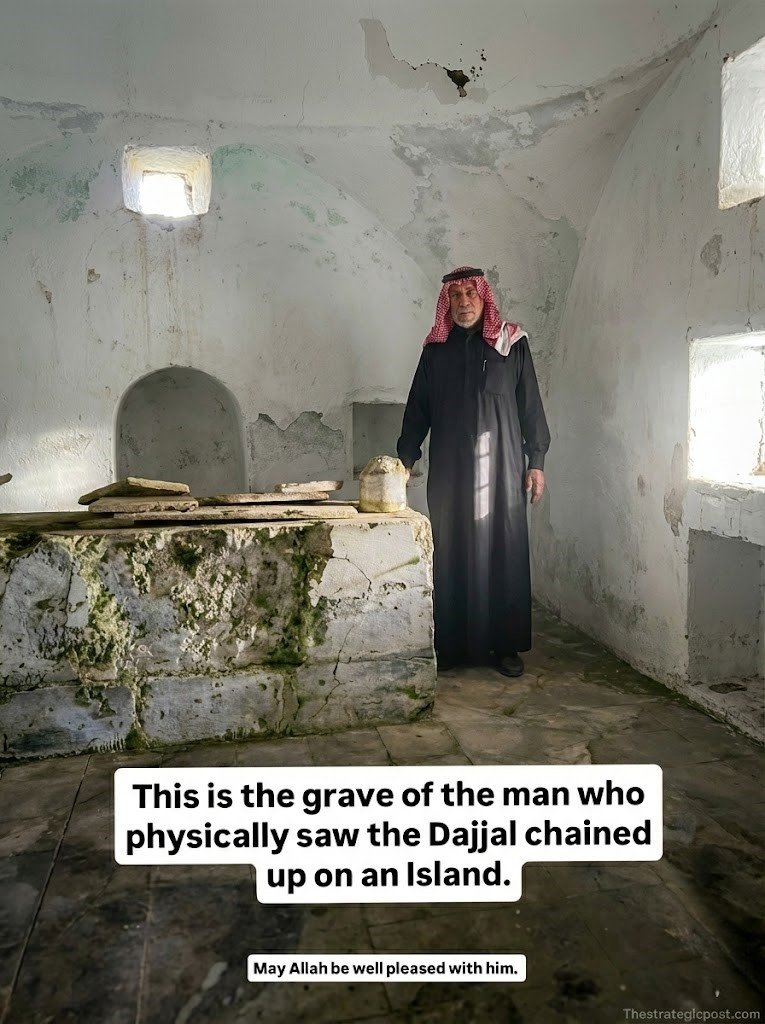
Tamim al-Dari, originally a Christian sailor from Byzantine-ruled Palestine, lived during the time of the Prophet Muhammad ﷺ. He later converted to Islam, became one of the Prophet’s companions (Sahaba), and narrated a remarkable encounter that became part of Islamic eschatological tradition. According to preserved hadith, Tamim sailed with a group of men, endured a month of stormy seas, and reached a remote island where they met a strange creature called al-Jasasah before confronting a chained giant who identified himself as the Dajjal.

By Bukvoed – Own work, CC BY 4.0, Link
Tamim passed away in the mid-7th century CE, and tradition held that he was buried in Bayt Jibrin (also known as Beit Guvrin), a town in the vicinity of Hebron in Palestine. His resting place, referred to in sources as a maqam or shrine, stood as a modest marker tied to his legacy as a companion who witnessed signs of the end times.
The Island Encounter
Historical narrations, primarily from Sahih Muslim (Hadith 2942), described how Tamim al-Dari set out on a sea journey with thirty men from the tribes of Lakhm and Judham. A violent storm tossed their ship for a full month until it carried them to an unfamiliar island at sunset. The group rowed ashore in small boats and soon encountered a hairy beast that covered its body so completely that its front could not be distinguished from its back.
The men asked the creature what it was, and it identified itself as al-Jasasah. It then directed them to a man in a nearby monastery who wished to learn about them. Fearing it might be a devil, the group hurried to the monastery, where they found an enormous man bound in heavy chains—his hands secured to his neck and his legs shackled from knees to ankles with iron.
The chained figure questioned the visitors about distant regions: the date-palm trees of Baysaan (whether they still bore fruit), the lake of Tabariyyah (Tiberias, and if it held water), and the spring of Zughar (whether its waters irrigated crops). The men answered affirmatively, but the figure predicted that these would soon fail—palms would cease fruiting, the lake would dry, and the spring would diminish.
He then inquired about the “unlettered Prophet” from Arabia. The travelers reported that the Prophet Muhammad ﷺ had left Makkah, settled in Yathrib (Madinah), prevailed over nearby Arabs, and gained their obedience. The chained man responded that obedience to this prophet benefited them, then revealed his own identity: he was the Dajjal, soon to be permitted to emerge and travel the earth, entering every town for forty nights except Makkah and Madinah, which angels would guard against him.
Conversion and Companionship with the Prophet ﷺ
After escaping the island and returning, Tamim al-Dari sought out the Prophet Muhammad ﷺ in Madinah. He accepted Islam and shared his account, which the Prophet ﷺ presented to the community. The narration, transmitted through Fatimah bint Qays and recorded in Sahih Muslim, aligned with earlier warnings the Prophet ﷺ had given about the Dajjal. The Prophet ﷺ affirmed the story’s consistency, noting the Dajjal’s location in the east (or seas), and emphasized the protection of Makkah and Madinah.
Tamim became a respected companion. Sources indicated that the Prophet ﷺ granted him a large land endowment (qita’a or waqf) in the Hebron area, including parts of Hebron, Beit Einun, and surrounding regions, though Palestine remained under Byzantine control at the time. This land symbolized trust and provision. Tamim later requested and received confirmation of holdings in Bethlehem or nearby, formalized after Muslim conquests.
He contributed to early Islamic life, known in some traditions as an early narrator of religious stories and one who helped illuminate mosques. He resided in Madinah for a period before returning to his native Palestine around 655 CE.
Later Life and Burial in Bayt Jibrin
Tamim al-Dari died in 661 CE (40 AH) in Palestine. Traditional accounts placed his grave in Bayt Jibrin, northwest of Hebron, a site associated with ancient Biblical cities like Beit Guvrin and Maresha. The location featured a stone tomb or maqam traditionally attributed to him, sometimes called the Maqam of Sheikh Tamim.
The grave of Tamim al-Dari, a companion of the Prophet Muhammad known for his encounter with the Dajjal, is traditionally located in Bayt Jibrin (Beit Guvrin), near Hebron in Palestine, though it’s described as neglected and within an illegal settlement area today. His maqam (shrine) stands north of the modern-day Kibbutz Beit Guvrin, marking his burial place after he moved from Medina back to his native Palestine and died there around 661 CE (40 AH).
Key Details about his Grave:
Historical Context: He returned to Palestine during the unrest of Caliph Uthman’s time and died there.
Location: Beit Guvrin (Jibreen), near Hebron, Palestine.
Current State: Described as abandoned and sometimes within contested or illegal settlement lands.
Over centuries, the grave drew occasional mention in travelogues and histories. Descendants reportedly maintained family ties to the endowed lands for generations, as noted by early historians like Ibn Lahi’a (d. 790 CE). The site remained modest, reflecting the simplicity of many Sahabi graves. In modern times, sources described the maqam as abandoned or neglected, situated near contemporary settlements, with limited pilgrimage activity due to regional circumstances.
The endowment linked to Tamim persisted in various forms, tied to charitable uses in Hebron and surroundings, though disputes over land custodianship arose in later periods.
Significance in Islamic Tradition
Tamim al-Dari’s narration stood as one of the key authentic accounts of the Dajjal in Sunni sources, preserved in major hadith collections like Sahih Muslim. It served as a warning about end-times trials, emphasizing discernment, obedience to the Prophet ﷺ, and the divine barriers protecting holy cities.
The story highlighted themes of transformation—from a Christian background to Islamic companionship—and the intersection of personal encounter with prophetic foreknowledge. Scholars valued it for corroborating other descriptions of the Dajjal as a one-eyed deceiver whose emergence would test faith.
The grave in Bayt Jibrin, though understated, symbolized continuity: a sailor’s extraordinary experience preserved through oral and written tradition, reminding generations of signs foretold and the enduring guidance of revelation.
FAQs
- What authentic source narrates Tamim al-Dari’s encounter with the Dajjal? The primary narration appears in Sahih Muslim (Hadith 2942), transmitted through Fatimah bint Qays, where Tamim shared his story with the Prophet ﷺ after converting to Islam.
- Where was Tamim al-Dari traditionally buried? Tradition placed his grave in Bayt Jibrin (Beit Guvrin), a town near Hebron in Palestine, marked by a modest maqam that later became abandoned according to historical descriptions.
- What questions did the chained figure ask Tamim’s group? He inquired about the fruitfulness of Baysaan’s date palms, the water in Lake Tabariyyah, the irrigation from Zughar’s spring, and the status of the Prophet Muhammad ﷺ, predicting future changes before revealing himself as the Dajjal.
- Why did the Prophet ﷺ value Tamim’s account? The Prophet ﷺ stated that Tamim’s narration corroborated his prior warnings about the Dajjal, including the prohibition on entering Makkah and Madinah, affirming its alignment with divine revelation.
External Authority Sources
- Sahih Muslim Hadith 2942 (full narration): https://sunnah.com/muslim:2942a
- IslamQA on the Hadith of Tamim al-Dari: https://islamqa.info/en/answers/82643
- Wikipedia entry on Tamim al-Dari (summarizing traditional sources): https://en.wikipedia.org/wiki/Tamim_al-Dari
- Aljumuah Magazine biography: https://www.aljumuah.com/tamim-al-dari-ra-the-sahabi-who-had-a-close-encounter-with-the-dajjal
Disclaimer: This article compiles information from established Islamic sources and historical traditions for educational purposes. It does not constitute religious fatwa or scholarly ijtihad; refer to qualified experts for deeper guidance.
📖 Tamim al-Dari & Dajjal Narration Quiz
Test Your Understanding of This Traditional Account