




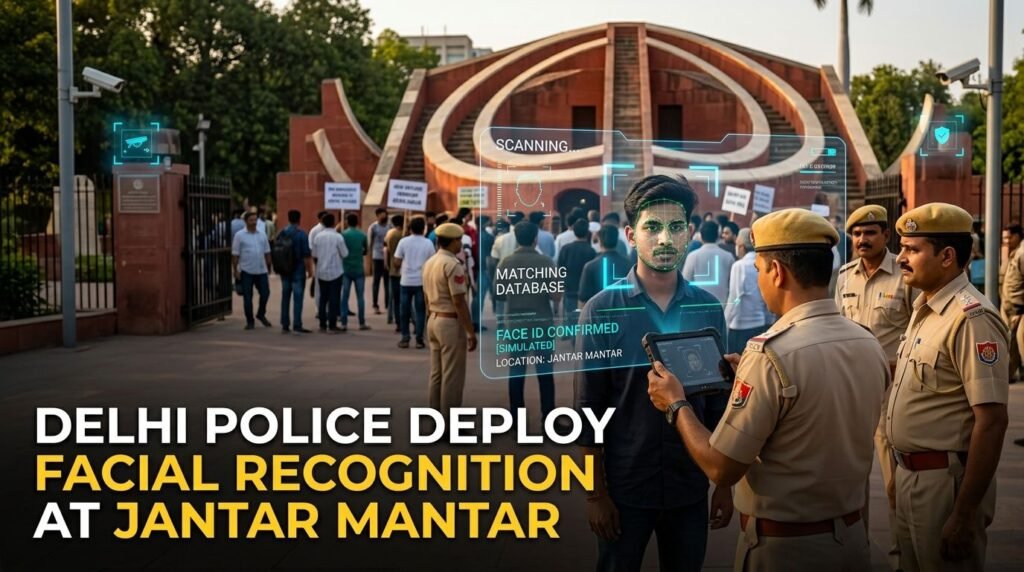
Delhi Police Deploy Facial Recognition at Jantar Mantar: What It Means for Security, Privacy, and Public Protests
The deployment of facial recognition technology at New Delhi’s Jantar Mantar has sparked a nationwide discussion about the balance between public safety and individual privacy. As one of India’s most well-known protest sites, Jantar Mantar frequently hosts demonstrations, making security a key concern for law enforcement.
Recently, the Delhi Police deployed facial recognition at Jantar Mantar as part of enhanced security arrangements. Officials say the technology is intended to identify wanted criminals, absconders, and habitual offenders who might attempt to exploit large public gatherings. However, the move has also raised important questions about surveillance, civil liberties, and data privacy.
In this article, we’ll explore why facial recognition systems have been introduced, how they work, the arguments for and against their use, and what this development could mean for the future of policing in India.
Why Did Delhi Police Deploy Facial Recognition at Jantar Mantar?
According to Delhi Police officials, four Facial Recognition System (FRS) units have been installed around key entry and exit points of Jantar Mantar. The system is connected to existing police databases and is designed to identify individuals who are already listed as wanted criminals, absconders, or history-sheeters. Police have stated that the technology is not intended to monitor ordinary protesters but rather to prevent criminal elements from using demonstrations to create law-and-order problems. (India Today)
The deployment comes after recent protests that required heightened security measures and increased police presence in the area. Authorities argue that large public gatherings often attract individuals with criminal backgrounds, making technology-assisted monitoring an important preventive tool. (The Times of India)
How Does the Facial Recognition System Work?
Modern facial recognition systems use artificial intelligence and computer vision to identify people in real time.
Step 1: Face Detection
High-resolution cameras capture video feeds of people entering or moving around the protest site.
Step 2: Facial Analysis
The software identifies facial landmarks such as the eyes, nose, jawline, and mouth to create a unique biometric representation.
Step 3: Database Matching
The captured facial data is compared against police databases containing records of wanted individuals and known offenders.
Step 4: Real-Time Alerts
If the system identifies a potential match, officers receive an alert and can verify the identity before taking legal action if necessary. Police officials say this process is designed to help identify suspects quickly while maintaining public safety. (India Today)
Why Jantar Mantar Is a Sensitive Location
Jantar Mantar is more than a historic monument. It has become one of India’s most prominent public protest venues, hosting demonstrations by students, workers, activists, and civil society organizations.
Because thousands of people may gather at a single event, maintaining security is often challenging. Police argue that advanced surveillance tools help them:
- Prevent violence before it occurs.
- Detect individuals with outstanding criminal cases.
- Respond faster to security threats.
- Improve crowd management.
From a law enforcement perspective, facial recognition offers an additional layer of security without requiring manual identity checks for every individual.
Delhi Police’s Official Position
Delhi Police have repeatedly emphasized that the facial recognition system is not intended for mass surveillance of peaceful protesters.
Officials say the technology focuses only on identifying people already present in police databases, including:
- Wanted criminals
- Absconders
- History-sheeters
- Individuals classified as habitual offenders
Authorities have described the system as a preventive and investigative tool aimed at reducing the possibility of criminal activities during protests and maintaining law and order. (The Times of India)
Privacy Concerns Raised by Experts
While police view facial recognition as an important security measure, privacy advocates and civil rights organizations have raised several concerns.
Potential Chilling Effect
Some experts argue that people may hesitate to attend peaceful demonstrations if they believe their identities are being continuously monitored.
Transparency Questions
Critics have asked important questions, including:
- How long is facial data stored?
- Who has access to collected information?
- What safeguards exist against misuse?
- What oversight governs the system’s operation?
These concerns highlight the need for transparency whenever biometric technologies are used in public spaces. (The Indian Express)
The Broader Debate Around Facial Recognition
The discussion extends beyond Delhi.
Governments worldwide are increasingly adopting AI-powered surveillance systems for airports, railway stations, public events, and major gatherings.
Supporters argue that facial recognition helps:
- Catch fugitives faster.
- Improve emergency response.
- Prevent terrorist activities.
- Reduce manual policing efforts.
Opponents counter that the technology may:
- Produce false matches.
- Affect individual privacy.
- Be used beyond its original purpose.
- Require stronger legal safeguards.
Finding the right balance between security and civil liberties remains one of the biggest challenges facing governments globally.
AI in Modern Policing
Artificial intelligence is transforming policing in many countries.
Beyond facial recognition, police departments increasingly use AI for:
Predictive Crime Analysis
Algorithms analyze historical crime data to identify high-risk locations.
Traffic Monitoring
AI cameras automatically detect traffic violations.
Crowd Analytics
Video analytics help authorities estimate crowd sizes and identify unusual activity.
Missing Person Investigations
Facial recognition can assist in locating missing individuals by comparing images across multiple databases.
The deployment at Jantar Mantar reflects this broader trend toward technology-driven policing.
Challenges of Facial Recognition Technology
Although AI has improved dramatically, facial recognition is not perfect.
Some common challenges include:
Accuracy Limitations
Poor lighting, face coverings, camera angles, or crowded environments can affect recognition accuracy.
False Positives
An incorrect match could result in unnecessary questioning or investigation, making human verification essential.
Ethical Considerations
Governments must ensure that biometric technologies are used responsibly, proportionately, and within clear legal frameworks.
These limitations explain why many experts recommend combining AI with human oversight rather than relying solely on automated systems.
What Citizens Should Know
For ordinary citizens attending peaceful demonstrations, the Delhi Police maintain that the technology is intended to identify individuals already wanted in criminal investigations rather than monitor everyone indiscriminately. At the same time, public discussion continues around transparency, accountability, and safeguards for biometric data. (India Today)
Understanding both the security objectives and the privacy implications helps citizens participate in informed discussions about the future use of AI-powered surveillance technologies.
Could This Become a Nationwide Trend?
The deployment at Jantar Mantar may signal broader adoption of AI-assisted surveillance across India.
If authorities view the technology as effective in improving public safety, similar systems could eventually appear at:
- Major public events
- Political rallies
- Religious gatherings
- Transportation hubs
- Sports venues
However, wider adoption would likely intensify discussions about privacy laws, data protection policies, judicial oversight, and accountability.
Conclusion
The decision by the Delhi Police to deploy facial recognition at Jantar Mantar marks another significant step in the growing use of artificial intelligence for public security. Officials maintain that the system is focused on identifying wanted criminals and preventing law-and-order issues rather than monitoring ordinary protesters. At the same time, privacy advocates continue to call for greater transparency, clear legal safeguards, and independent oversight.
As AI becomes increasingly integrated into modern policing, governments will need to balance technological innovation with the protection of civil liberties. Whether facial recognition ultimately strengthens public trust will depend not only on its effectiveness but also on how responsibly and transparently it is implemented.
For readers interested in technology, cybersecurity, artificial intelligence, and public policy, this development offers an important glimpse into how AI is reshaping law enforcement and the broader conversation about security and privacy in the digital age.