



Dharmendra Pradhan Resigns as India’s Education Minister: Full Story, Timeline and What Comes Next
On July 25, 2026, news broke that sent shockwaves through India’s political and education circles: Union Education Minister Dharmendra Pradhan has resigned from his post, submitting his resignation letter to Prime Minister Narendra Modi. The announcement came after nearly seven weeks of relentless student protests at Delhi’s Jantar Mantar, organised under the banner of the youth-led “Cockroach Janta Party” (CJP), demanding accountability for a string of examination paper leaks — most notably the NEET-UG controversy.
For millions of students, parents, teachers, and education stakeholders across the country, Dharmendra Pradhan’s resignation as Education Minister is a landmark moment. It raises immediate questions: Who takes over the Ministry of Education next? What reforms might follow? And how does this fit into the bigger picture of India’s troubled examination system? Here’s a complete, easy-to-follow breakdown of what happened, why it happened, and what to expect in the days ahead.
Why Did Dharmendra Pradhan Resign as Education Minister?
Dharmendra Pradhan’s resignation didn’t happen overnight. It was the culmination of weeks of mounting public pressure, student unrest, and political controversy centred on the credibility of India’s national entrance examinations — particularly the NEET-UG medical entrance test.
The NEET Paper Leak Controversy
The National Eligibility-cum-Entrance Test (NEET-UG), which decides admission into India’s medical colleges, ran into serious trouble after allegations surfaced that its question paper had been leaked. With more than two million candidates competing for a limited number of medical seats, the exam was cancelled and later re-conducted, throwing students and families into weeks of uncertainty. The controversy was compounded by irregularities in other national-level tests, including UGC-NET, which further eroded public trust in the National Testing Agency (NTA) and the examination system it administers.
This wasn’t a one-off crisis, either. Complaints about paper leaks and exam irregularities have followed NEET for several years, but the scale and intensity of the 2026 fallout — including reports of student distress during the turmoil — turned it into a national flashpoint.
The Cockroach Janta Party Protests at Jantar Mantar
The movement that ultimately forced Dharmendra Pradhan’s exit has an unusual origin story. It began after a remark by the Chief Justice of India referring dismissively to certain complainants sparked a wave of youth satire online. A digital strategist turned the jibe into a rallying cry, founding the “Cockroach Janta Party” in May 2026 as a satirical youth movement. What started as social media mockery of the ruling establishment quickly grew into one of India’s largest youth-led protest movements in years.
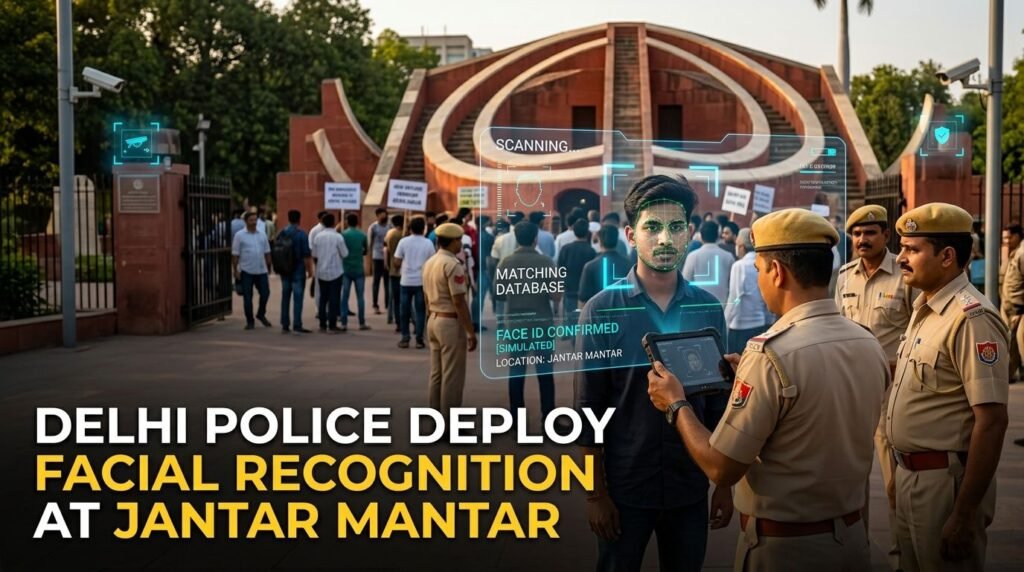
Protesters set up camp at Jantar Mantar starting June 6, 2026, demanding Dharmendra Pradhan’s resignation, compensation for affected families, and structural reforms to how national exams are conducted. The movement gained further momentum when Ladakhi engineer and education activist Sonam Wangchuk began an indefinite hunger strike at the protest site on June 28. By July 20, the agitation had swelled to thousands of demonstrators marching toward Parliament, a march that ended in police using tear gas to disperse the crowd — a moment widely seen as a turning point in the standoff.
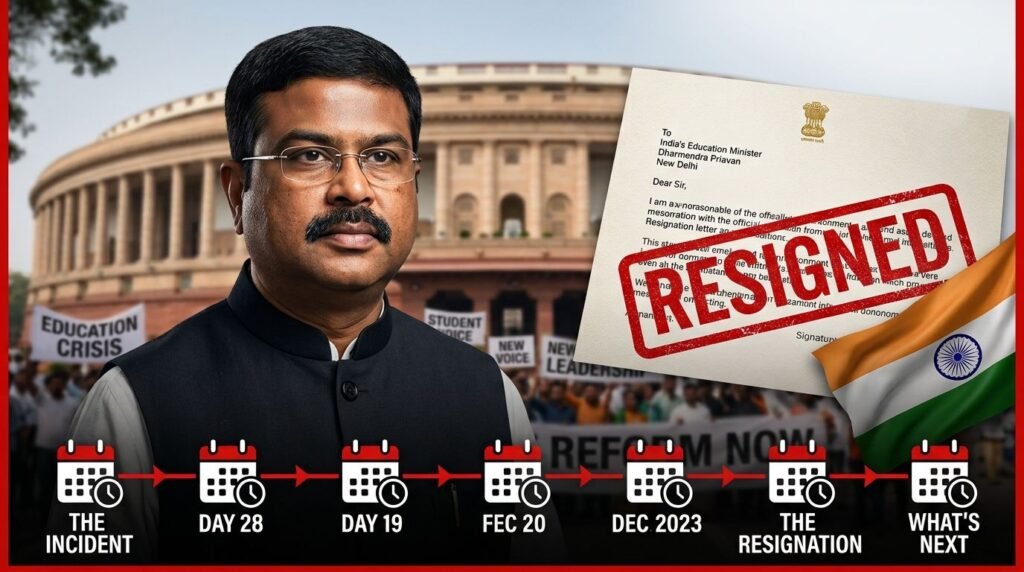
Timeline: Key Events Leading Up to the Resignation
Here’s a quick recap of how the crisis unfolded:
- May 2026 — Allegations of a NEET-UG paper leak surface; the exam is cancelled and later re-conducted.
- May 16, 2026 — The Cockroach Janta Party (CJP) is founded as a satirical youth movement.
- June 6, 2026 — Sustained protests begin at Jantar Mantar, demanding Dharmendra Pradhan’s resignation.
- June 28, 2026 — Activist Sonam Wangchuk starts an indefinite hunger strike in support of the protesters.
- July 20, 2026 — Thousands march toward Parliament; police use tear gas to control the crowd.
- July 25, 2026 — Dharmendra Pradhan announces his resignation as Education Minister on social media, and protest leaders agree to call off their agitation.
What Dharmendra Pradhan Said in His Resignation Letter
In his resignation letter to Prime Minister Modi, Dharmendra Pradhan framed his decision as an effort to protect students’ futures and preserve national unity rather than as an admission of personal failure. He wrote that he did not want the situation at Jantar Mantar to be exploited by “anti-national forces,” and that no student’s future should be entangled in legal complications because of the ongoing standoff. He also expressed gratitude to his cabinet colleagues and ministry staff, noting simply, “Serving the nation is my highest priority in life.”
The tone of the letter suggests Pradhan positioned his exit as a sacrifice made in the interest of restoring calm — a common approach in Indian political resignations, where officials often frame departures around duty and national interest rather than direct responsibility for the controversy that triggered them.
Who Is Dharmendra Pradhan? A Quick Profile
For readers less familiar with Indian politics, here’s some quick context on the man at the centre of this story.
Political Career Highlights
Dharmendra Pradhan is a senior leader of the Bharatiya Janata Party (BJP) from Odisha. He first entered the Lok Sabha in 2004 from Deogarh and later served in the Rajya Sabha, representing Bihar from 2012. He is widely credited as India’s longest-serving Union Petroleum Minister, a role in which he became known as the architect of the Ujjwala Yojana, a scheme providing free cooking gas connections to low-income households.
Pradhan took charge of the Education Ministry in July 2021, succeeding Ramesh Pokhriyal “Nishank,” and retained the portfolio when the Modi government returned for a third term in June 2024. During his tenure, he was closely associated with the rollout of the National Education Policy (NEP) 2020 — making his resignation as Education Minister especially significant given how central he had become to India’s education reform agenda.
What Happens Next for India’s Education Ministry?
The Constitutional Process Behind a Resignation
Under India’s constitutional framework, Union Ministers are appointed by the President on the advice of the Prime Minister, and resignations follow the same channel in reverse — a minister submits their resignation to the Prime Minister, who then advises the President to formally accept it. This means Dharmendra Pradhan’s resignation, while announced publicly, still needs to move through this formal process before it is complete.
Possible Successors and Interim Arrangements
As of now, the government has not officially named a successor. In similar past situations, the Prime Minister has sometimes assigned another minister additional charge of the vacant ministry temporarily before a permanent appointment is made. Given the scale of public attention on the Education Ministry right now, expect any announcement of a new minister to come with close scrutiny of their stance on examination reform.
How This Compares to Past Education Ministry Exits
Dharmendra Pradhan’s resignation as Education Minister is not the first high-profile exit from this portfolio. His predecessor, Ramesh Pokhriyal “Nishank,” also resigned in 2021, though he cited personal health reasons rather than public pressure. The contrast is notable: Pradhan’s departure is unusual because it comes directly in response to sustained, large-scale youth protests rather than a private or health-related decision — making it one of the more politically consequential ministerial resignations in recent Indian history.
What This Means for Students, Parents and Educators
If you’re a student, parent, or educator wondering what to do next, here are a few practical takeaways:
- Watch for NTA reform announcements. Given that examination irregularities were the root cause of this crisis, expect renewed discussion around restructuring or replacing the National Testing Agency’s processes.
- Keep an eye on the exam calendar. Any leadership transition at the Education Ministry can affect timelines for upcoming national exams, so check official NTA and Ministry of Education notifications regularly rather than relying on rumours.
- Stay updated through official channels. With political developments moving quickly, rely on the Ministry of Education’s official website and verified government social media handles for confirmed updates, rather than unverified social media posts.
- Understand this is part of a larger reform conversation. Whoever succeeds Dharmendra Pradhan will inherit pressure not just to manage the ministry, but to visibly rebuild trust in India’s examination system.
Conclusion: A Turning Point for Indian Education Policy
Dharmendra Pradhan’s resignation as India’s Education Minister marks one of the most significant political outcomes of a student-led protest movement in recent Indian history. Triggered by the NEET-UG paper leak controversy and sustained by weeks of demonstrations at Jantar Mantar, this resignation is being widely read as a victory for student advocacy and a signal that examination transparency has become a non-negotiable public demand.
As the government works through the formal process of accepting the resignation and identifying a successor, the bigger story to watch is whether this moment leads to lasting reform in how India conducts its national examinations. For students preparing for future exams, and for anyone following Indian education policy, this is a story worth continuing to track closely in the weeks ahead.