

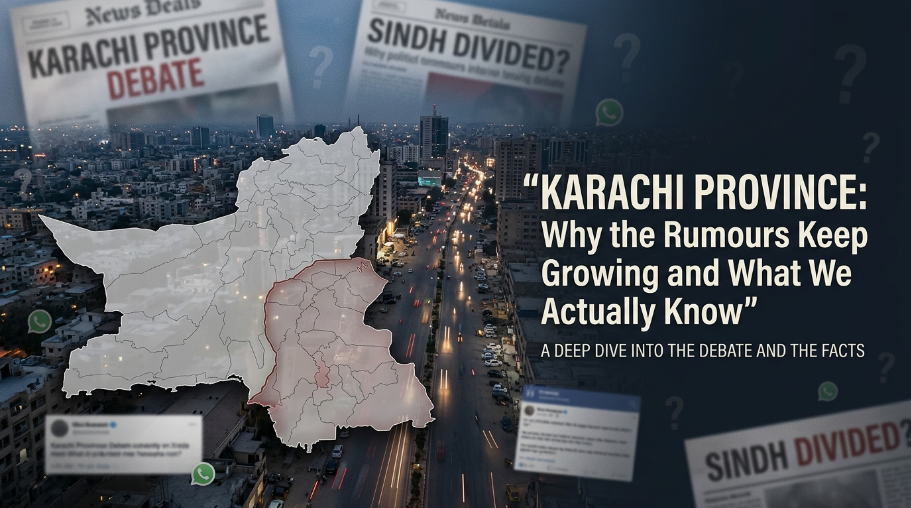
On Tuesday night, August 18, I was sitting with my phone in one hand and a cup of tea getting cold beside me when someone dropped a message into our family WhatsApp group: “Karachi province banne wala hai.”
No source. No government notice. Just that sentence.
Within a few minutes, three more messages followed. Someone said the announcement was coming soon. Someone else said the province would have its own government. Then an old screenshot appeared, the kind with tiny text and a dramatic headline that makes you want to believe it before you’ve even read it.
I nearly forwarded it.
That was the part that bothered me.
I live with these rumours the same way I live with traffic noise in Karachi. They are always somewhere in the background. Sometimes they get loud enough that I stop what I’m doing and listen.
But hearing a rumour often enough doesn’t turn it into a fact.
Where the rumour comes from
I’ve heard some version of the Karachi province idea for years.
The basic argument is easy to understand. Karachi is enormous. It has its own economic weight, its own problems, its own political history, and a population that often feels that decisions about the city are made too far away from the streets where those decisions actually land.
I’ve seen this argument become especially loud whenever Karachi is struggling with something visible.
A road stays broken for months.
Garbage piles up beside a market.
Rain turns a familiar street into a shallow river.
A water tanker becomes part of someone’s weekly routine.
Then somebody says, “If Karachi were a separate province, this wouldn’t happen.”
I understand why that sentence has staying power. It gives a complicated problem a simple shape.
But that’s also where I think we need to slow down.
A province is not created because a city has problems. It is created through a political and constitutional process. Those are very different things.
The rumour feels simple because the frustration behind it is real.
Karachi is not the same thing as a province
This is where I used to make the mistake of treating “Karachi province” as if it were just another administrative upgrade.
It isn’t.
Karachi is currently part of Sindh province. If Karachi were to become a separate province, that would mean changing Pakistan’s existing provincial structure, not simply drawing a new line on a municipal map.
That distinction sounds dry until you think about what would actually have to move around.
Government departments.
Revenue.
Public services.
Political representation.
Administrative boundaries.
Assets.
Responsibilities.
And, perhaps most importantly, constitutional arrangements.
When I see a social media post saying “Karachi province approved,” I now look for the boring details. Which government approved it? Under what law? What constitutional amendment is involved? Where is the official notification?
Usually, the answer disappears at exactly that point.
The boring part is often the most important part.
What people actually mean when they say it
One thing that confused me for a long time was that people use “Karachi province” to mean several different things.
Sometimes they mean a completely separate province.
Sometimes they mean greater administrative powers for Karachi.
Sometimes they are talking about restoring a stronger local government system.
Sometimes they simply mean that Karachi should have more control over its own money and services.
Those are not the same proposal.
I once heard someone explain it over chai in almost one sentence: “Bhai, province ho ya jo bhi naam hai, bas Karachi ka kaam Karachi ke logon ke haath mein hona chahiye.”
That was actually more useful than most of the dramatic posts I’d seen online.
Because underneath the argument about the word “province” is another argument about control.
Who collects money?
Who decides where it goes?
Who runs transport?
Who handles waste?
Who plans roads?
Who has the authority to make decisions quickly when something goes wrong?
Those questions matter whether the answer is a new province, stronger local government, or something else entirely.
The name gets attention, but the powers are what change people’s lives.
Why the rumours spread so quickly
I’ve noticed something about political rumours in Karachi.
They usually arrive when people are already frustrated.
Nobody sends me ten messages about a new administrative proposal when everything is working perfectly. The rumours appear after a power outage, during heavy rain, after another argument about local government, or when somebody posts a photograph of a flooded road.
The emotion comes first.
The explanation comes afterward.
Social media makes that process even faster. A post can start with “sources say” and end up being treated as an official announcement by the time it reaches the fifth WhatsApp group.
I’ve made that mistake myself.
I once read a post that looked convincing because it used an official-looking logo and formal language. I shared it before checking where it came from. Ten minutes later I found the original post and realised the “announcement” was somebody’s political commentary.
I deleted my message.
That tiny mistake taught me something I now keep in mind whenever Karachi province rumours start circulating.
A screenshot is not a notification.
What would actually have to happen
If Karachi were genuinely going to become a separate province, I would expect to see something much more substantial than a viral graphic.
Pakistan’s Constitution sets out the process for altering provincial boundaries. Article 239 deals with constitutional amendments, and changes affecting the limits of a province require a particularly serious parliamentary process.
That matters because a province cannot simply appear because a political leader announces it at a press conference.
There would need to be formal political action and constitutional steps.
And that is where the rumour becomes much less dramatic and much more complicated.
I would want to see the actual bill.
I would want to know which boundaries were being proposed.
I would want to know how representation would work.
I would want to know what happens to existing provincial institutions.
I would want to know how revenue and assets are divided.
I would want to know what happens to areas that are economically and administratively connected to Karachi.
Those questions aren’t obstacles to the idea. They are the idea.
If the details don’t exist, the province doesn’t exist yet.
The argument for a separate province
I don’t think the demand itself should simply be laughed off.
There is a serious argument behind it.
Karachi contributes an enormous amount to Pakistan’s economy and is home to millions of people. It is also a city where responsibilities are spread across different layers of government, which can make accountability feel like a game of passing a football around a crowded room.
I’ve experienced that frustration in ordinary ways.
One department points to another.
Another says the issue belongs to the local authority.
The local authority says it needs funds.
Someone else says the province controls the funds.
Meanwhile the broken road is still sitting outside someone’s house.
From that point of view, the province argument has an obvious attraction: put more authority closer to the people who actually live there.
A separate province could, in theory, create a clearer administrative structure.
But “in theory” matters here.
A new province would not automatically create competent administration. Changing the boundary on a map does not repair a road.
The strongest argument for a Karachi province is really an argument for better control and accountability.
Whether a new province is the best way to achieve that is a separate question.
The argument against it
The other side deserves the same honesty.
Creating another province would be politically and administratively difficult.
It could create disputes over territory, resources, institutions and political representation. It could also deepen tensions between communities if the debate is handled as an ethnic contest instead of an administrative one.
That worries me.
Karachi has always been complicated. People from different parts of Pakistan have made lives here. Different languages are spoken in the same neighbourhoods. Families have arrived over generations and built businesses, homes and careers.
I don’t want a discussion about government efficiency to turn into a discussion about who supposedly “owns” the city.
There is another uncomfortable comparison too.
If someone tells me that creating a province will fix Karachi’s problems, I compare that promise with what happens when an existing institution receives more authority but still fails to use it properly.
More power can mean better decisions.
It can also mean bigger mistakes.
A new province would change the structure. It would not magically change the people running that structure.
That is the tradeoff I think gets lost in the excitement.
What I would actually look for
These days, when I see a claim about Karachi province, I don’t start by asking whether I like the idea.
I start by asking whether something has actually happened.
Is there an official government statement?
Has a bill been introduced?
Has Parliament taken a formal step?
Has there been a constitutional amendment?
Has the proposed territory been clearly defined?
Are credible news organisations reporting an actual development rather than repeating a politician’s demand?
Those questions take maybe five minutes.
I’ve spent longer than that scrolling through the comments underneath a rumour.
The difference is that one helps me understand what happened, while the other mostly tells me how angry everyone is.
Anger can be real without the rumour being true.
What I think Karachi really needs
I’ve gone back and forth on the province question because I can see why people support it.
But if somebody asked me what I want first, I wouldn’t start with a new provincial name.
I’d start with clear responsibility.
If a road is damaged, I want to know who is responsible for fixing it.
If garbage isn’t collected, I want to know which institution is accountable.
If public transport needs improvement, I want the authority responsible for it to have enough power and money to actually do the job.
And if it fails, I want voters to know exactly who to blame.
That’s the difference I see between a slogan and a functioning system.
A slogan says, “Give Karachi a province.”
A functioning system says, “This person is responsible for this service, this is the money available, and this is what happens if the job isn’t done.”
I would take the second one seriously.
The province question can still be discussed. It should be discussed. But I don’t think Karachi’s problems should have to wait for a constitutional miracle.
The part people forget
There is one thing I keep thinking about from that WhatsApp message on August 18.
The message said, “Karachi province banne wala hai.”
Not “there is a proposal.”
Not “a political party is demanding it.”
Not “a bill has been introduced.”
“Banne wala hai.”
That’s how rumours work. They skip the middle.
Something is discussed, then suddenly it becomes approved. Someone makes a demand, then suddenly it becomes a decision. Somebody posts an old photograph, and suddenly everyone is talking about tomorrow’s announcement.
I don’t blame ordinary people for getting caught in it.
When you care about your city, you want good news to be true.
I know that feeling.
But wanting something to happen and knowing that it has happened are two different things.
The rumour may keep returning because the underlying questions haven’t disappeared. Karachi still has serious problems with governance, infrastructure, transport, water, waste and accountability. Those problems are real even when the viral announcement isn’t.
So I’m not interested in telling people to stop talking about Karachi province.
I’m interested in getting the conversation to the point where we stop confusing a conversation with a decision.
That is where the truth usually starts.
A rumour is only a message until someone can put a document on the table.