
On August 18, I kept coming back to one detail in the news: Imran Khan was supposed to leave Adiala Jail and be taken to Shifa International Hospital in Islamabad within 48 hours.
It was not a release order. It was not a political deal. It was a court order about medical treatment.
Still, in Pakistan, I have learned that even a hospital door can become political.
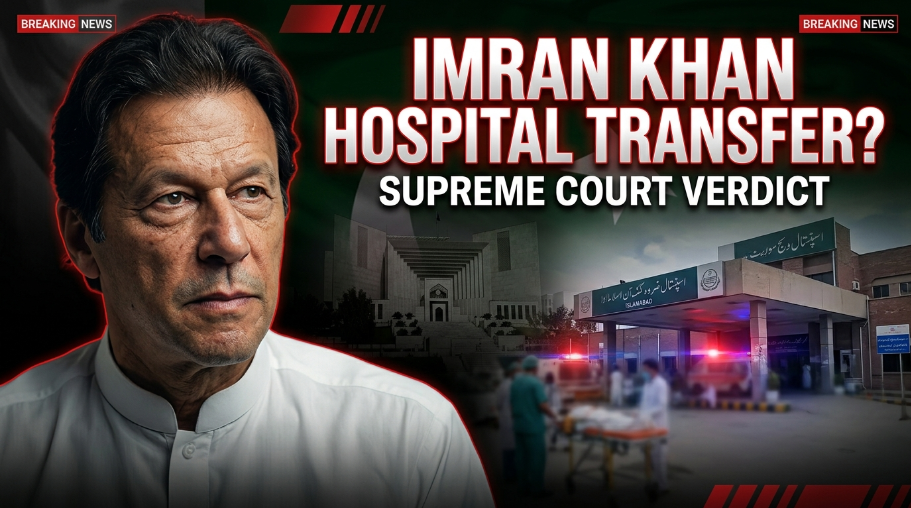
The Supreme Court ordered that Khan be transferred to Shifa for medical assessment and treatment and directed that a medical board be formed, with access for his private doctors. The order also dealt with family meetings. (Geo News)
Then the government challenged the order.
That is where this stopped being just a story about one prisoner’s health.
The small legal decision suddenly became part of the much larger fight over Imran Khan’s future, PTI’s future and the relationship between the courts and the government.
What the Supreme Court actually decided
I think the first thing I have to separate is the court order from everything people are reading into it.
The Supreme Court did not order Imran Khan’s release.
The three-member bench headed by Justice Shahid Waheed ordered his transfer from Adiala Jail to Shifa International Hospital for medical examination and treatment. The order was set to cover treatment until September 16 and included the formation of a medical board. (Geo News)
That distinction matters.
I have seen Pakistani political arguments turn one legal development into five different conclusions within a few hours. A court orders medical treatment and suddenly one side sees the beginning of freedom while the other sees a political concession.
The actual order was narrower.
Khan has been imprisoned since 2023 and faces a large number of legal cases. Reuters reported that he has been involved in more than 100 cases since his removal from office in 2022, although several major convictions have been overturned or suspended and he continues to deny wrongdoing. (Reuters)
So I would not describe the hospital transfer as a legal escape route.
It is something smaller.
But smaller does not mean unimportant.
The court has drawn a line around Khan’s medical treatment, and that line now has political consequences.
Why the hospital matters politically
For months, Khan’s family and lawyers had been pushing for access to specialist treatment and for greater access to his family and personal doctors.
That fight did not begin on August 18.
In July, the Supreme Court had already accepted a chamber appeal concerning Khan’s request to be moved to Shifa and to receive access to his family, personal physicians and counsel. (Dawn)
That tells me something important.
The hospital was never simply about a hospital.
For Khan’s supporters, medical access has become connected to a much bigger issue: whether the state is treating him fairly while he remains imprisoned.
For the government, there is another concern. Officials argued that prisoners should generally be treated through public hospitals and challenged the decision to send Khan to a private facility. The government said it was not against medical care itself but objected to the private-hospital arrangement. (AP News)
I can understand why both sides are framing the issue differently.
A private hospital for a former prime minister can look like special treatment.
But refusing a requested hospital can also look like the state is being unnecessarily restrictive.
That is the uncomfortable part.
The same hospital room can look like privilege from one side and basic medical access from the other.
The government’s challenge changed the story again
On August 19, the government filed a review petition challenging the Supreme Court’s hospital-transfer order.
Its argument was not that Imran Khan should receive no medical treatment. The government questioned the decision to send him to a private hospital and argued that the court had gone beyond its jurisdiction. (Al Jazeera)
Then, on August 20, the Supreme Court Registrar’s Office returned the government’s review petition after raising objections. Government officials indicated that another filing could follow after those objections were addressed. (Geo News)
I find this part more politically interesting than the original hospital order.
Because now the argument is not simply between PTI and the government.
It is also about how far the Supreme Court can go when dealing with the treatment of a high-profile prisoner.
That is a much bigger question.
If the government complies quickly, PTI can point to the decision as evidence that the courts can still constrain the executive.
If the government keeps fighting the order, PTI can use the delay as another example of what it describes as political pressure against Khan.
Either way, the court has become part of the political conversation again.
The hospital order did not settle the fight. It moved the fight into another room.
What it means for PTI
I do not think the biggest immediate effect will be on Khan himself.
It will be on his party.
PTI has spent years trying to operate without its founder being physically present in normal political life. That is a difficult thing for any party, especially one built so heavily around a single personality.
Khan remains enormously important to PTI’s supporters. His imprisonment has not erased that connection. In fact, his continued absence has often made him more central to the party’s message.
The scale of that support was visible again earlier this month when PTI supporters rallied across Pakistan to demand his release after three years in jail. (Al Jazeera)
The hospital decision gives PTI something it badly needs: a court order it can point to without having to argue about an election result.
That is different from saying the party has won politically.
It has not.
PTI still faces serious organisational problems. Many of its leaders have been imprisoned, gone into hiding or become less visible. Reuters reported this week that the party remains fragmented despite continuing support for Khan. (Reuters)
That is the weakness I would not ignore.
A party can have a hugely popular leader and still struggle to turn that popularity into a stable political structure.
For PTI, the hospital transfer is a moment of relief, not a solution to the party’s larger problem.
What it means for the government
I think the government has a difficult calculation in front of it.
If it complies with the Supreme Court order, it risks giving PTI an important political talking point. Khan receives treatment at a private hospital with access to his doctors and family, and PTI can say the state was forced to accept the court’s position.
But if the government continues resisting, the cost could be higher.
It could make Khan’s supporters believe that even a medical matter is being turned into another confrontation.
That is already happening to some degree.
PTI leaders have welcomed the Supreme Court ruling and demanded implementation of the order. (The Express Tribune)
At the same time, government officials have stressed that they are not opposed to Khan receiving necessary treatment.
I think the safest political route for the government is actually the least dramatic one: follow the court order, provide security, let the doctors do their work and keep the politics outside the hospital.
That sounds boring.
Boring would probably be good here.
When the argument is about a patient’s treatment, the smartest political move may be to stop making the patient the battlefield.
The military question is sitting underneath all of this
There is another issue I cannot ignore.
Imran Khan’s relationship with Pakistan’s military establishment has been one of the central political conflicts of the last several years.
That relationship may now be entering a different phase.
On August 20, Reuters reported that a close Khan aide said Khan would not confront Army Chief Asim Munir if released and suggested that Khan would prioritise national unity. PTI spokesperson Zulfikar Bukhari also spoke about reconciliation rather than continued confrontation. (Reuters)
I would be careful about reading too much into that.
A statement from an aide is not necessarily the same thing as a statement from Khan himself.
But even the change in language matters.
For years, political discussion around Khan and the military has been filled with confrontation, accusations and mistrust. If PTI begins talking seriously about reconciliation, that could change the political temperature.
The hospital order alone cannot produce that change.
But it may create a little room for it.
And sometimes that is how political shifts begin. Not with a grand announcement. With people changing the words they use.
A softer political tone does not mean the old conflict has disappeared, but it can make a different future possible.
Will this change Pakistan’s political landscape?
I think it can, but not in the way some people expect.
I do not think one Supreme Court order suddenly changes who controls Pakistan’s politics.
It does not remove Khan’s convictions.
It does not automatically restore PTI to power.
It does not erase the government’s authority.
And it certainly does not settle the conflict between Khan and the institutions that have shaped Pakistan’s politics over the past few years.
What it does is create a new point of pressure.
If Khan receives proper treatment and family access, his supporters may feel that the legal system has given them at least one meaningful result.
If the government continues to challenge the order, the confrontation may become sharper.
If Khan eventually leaves prison, even temporarily or under some other legal arrangement, the political reaction could be much larger than the hospital transfer itself.
That is where I think the real uncertainty sits.
Pakistan’s political landscape has been unusually dependent on personalities. Nawaz Sharif, Benazir Bhutto and Imran Khan all built political identities that went far beyond ordinary party structures.
Khan’s imprisonment has not removed him from politics.
In some ways, it has kept him at the centre of politics without allowing him to participate normally.
That is a strange kind of political power.
The question is not whether the hospital transfer alone changes Pakistan; it is whether it becomes the first step in a larger political opening.
There is a downside nobody should ignore
I would be lying if I said I saw this as automatically positive.
There is a real danger in turning every court decision involving Imran Khan into a political victory or defeat.
That creates a system where medical treatment becomes symbolic, judges become political actors in public perception and every administrative decision is treated as part of a larger conspiracy.
I think that is unhealthy.
A prisoner should receive appropriate medical treatment because he needs medical treatment.
A court should make decisions according to law.
A government should obey court orders.
A political party should be able to criticise the government without turning every legal development into proof that the entire system has collapsed.
Those things sound obvious when I write them down. They become much harder when the person involved is Imran Khan and when millions of people already have strong feelings about him.
I also think PTI has to be honest about its own limitations.
The hospital order cannot replace political organisation.
It cannot bring back leaders who are unwilling or unable to participate.
It cannot solve the party’s internal divisions.
And it cannot guarantee that Khan himself will return to office.
I remember the small detail that started this whole piece: August 18 and the planned journey from jail to a hospital.
That sounds almost ordinary.
But in Pakistan right now, it is anything but ordinary.
The danger is turning every legal door into a political battlefield.
What I think happens next
I expect the hospital issue to remain tied to the wider question of Khan’s political future.
The immediate issue is whether and when the authorities implement the Supreme Court’s order. As of August 20, the government was still dealing with the review process and officials said there was no fixed deadline for the transfer while they awaited the court’s position. (Geo News)
After that comes the harder question.
What happens if Khan’s health improves?
What happens if he gets regular family access?
What happens if PTI follows through with its planned protest on September 27?
And what happens if the softer language coming from Khan’s camp about reconciliation with the military becomes a genuine political strategy rather than a temporary message?
I do not think anybody can answer those questions honestly yet.
But I do think the old political arrangement is under pressure.
The Supreme Court has shown that it is willing to intervene in an issue directly connected to Khan’s imprisonment. The government has shown that it is willing to challenge that intervention. PTI has shown that it intends to use the ruling to push harder for Khan’s rights and eventually his release.
None of that guarantees a political settlement.
But it creates movement.
And after years in which Pakistani politics has often felt frozen around the same arguments, movement itself matters.
The hospital transfer is not the end of Imran Khan’s political story. It may be the moment when the next chapter starts.
On August 18, the important image was supposed to be a prisoner leaving a jail for a hospital.
Instead, I think the more lasting image may be the door between the two institutions: the court on one side, the government on the other, and Imran Khan’s political future still somewhere in the middle.
Sometimes a political turning point does not look like a revolution. It looks like a hospital door opening.