

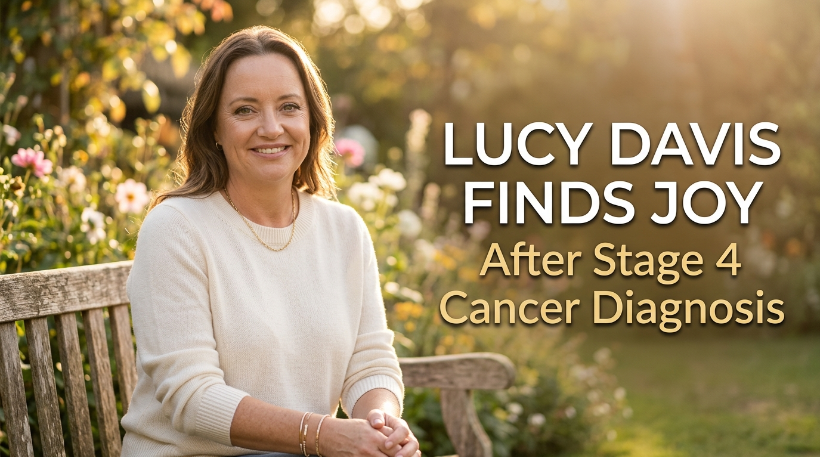
Lucy Davis, best known for playing Dawn Tinsley in the original British version of The Office, has shared deeply personal news about living with stage 4 breast cancer. The 53-year-old actress revealed that she was diagnosed around 18 months ago and that the cancer has since spread to her bones, including her spine, right hip and ribs.
Although Davis is facing an incurable diagnosis and significant physical challenges, her message has not been defined solely by fear or sadness. Instead, she has spoken about finding joy, humor, peace and meaning in the time she has.
Her story is a reminder that living with an advanced cancer diagnosis can involve much more than medical treatment. It can also involve relationships, personal passions, laughter, spirituality, advocacy and choosing how to spend meaningful time.
Lucy Davis Reveals Her Stage 4 Breast Cancer Diagnosis
Davis recently decided to publicly share that she has been living with stage 4 breast cancer for approximately a year and a half.
According to her account, the cancer has metastasized to her bones, including her spine, right hip and ribs. She has also explained that the disease is now considered incurable and that chemotherapy is no longer an option for her.
The announcement was emotional, but Davis did not present herself simply as a cancer patient. Instead, she emphasized that she still wants to experience life on her own terms.
That distinction is important.
A serious diagnosis can quickly become the most visible part of someone’s identity. Davis has made it clear that she does not want people around her to forget the person behind the diagnosis.
She continues to value acting, animals, humor and the people closest to her. Rather than allowing cancer to completely define her remaining time, she is trying to make room for moments that still feel meaningful.
Her Initial Breast Cancer Symptom Was Easy to Overlook
One of the most important parts of Lucy Davis’s story is how subtle her initial symptom reportedly was.
Davis described noticing a small, hard area in her breast. It did not initially seem like what she would have considered a typical lump, and she admitted that she nearly ignored it.
That experience has led her to encourage others not to dismiss unusual changes in their bodies.
Why paying attention to changes matters
Breast cancer does not always begin with an obvious or dramatic symptom. A change in the breast, nipple or surrounding area can have many possible causes, and most changes are not automatically cancer.
However, an unfamiliar change deserves medical attention rather than guesswork.
Depending on the individual, warning signs can include:
- A new lump or unusually hard area
- A change in breast size or shape
- Changes in the skin
- Nipple changes or unusual discharge
- Persistent discomfort or swelling
- A change that does not go away
The lesson from Davis’s experience is not that every small change means cancer. It is that people should avoid deciding for themselves that a persistent or unusual change is insignificant.
If something feels different from normal, speaking with a qualified healthcare professional is the safest approach.
What Stage 4 Breast Cancer Means
Stage 4 breast cancer generally means that the cancer has spread beyond the breast and nearby lymph nodes to distant parts of the body. This is also known as metastatic breast cancer.
In Davis’s case, she has said that the cancer has spread to her bones.
Stage 4 cancer is different from earlier-stage breast cancer because treatment is generally focused on controlling the disease, managing symptoms, maintaining quality of life and, where possible, extending life.
Importantly, stage 4 breast cancer does not look exactly the same for every person. Different cancers can have different biological characteristics, and treatment decisions depend on factors such as the type of breast cancer, where it has spread, previous treatments and the individual’s overall health.
This is why one person’s cancer journey cannot be used as a prediction for another person’s future.
Finding Joy Doesn’t Mean Ignoring the Reality
Perhaps the most striking part of Lucy Davis’s story is her decision to focus on joy while acknowledging the seriousness of her prognosis.
Finding happiness after a stage 4 cancer diagnosis does not necessarily mean pretending everything is fine.
For many people, joy can exist alongside grief, pain, uncertainty and fear.
Someone can have a difficult day and still laugh with a friend. They can feel frightened about the future while appreciating a beautiful afternoon. They can be physically exhausted while still finding meaning in a favorite hobby.
Davis’s approach illustrates this complicated reality.
Humor remains important to Davis
Davis has spoken about wanting to retain her sense of humor and has pushed back against being treated solely as a “sick person.”
That perspective can be powerful because illness can unintentionally change the way friends and family interact with someone.
When every conversation becomes about medical appointments, symptoms or prognosis, the individual can feel as though their previous identity has disappeared.
Sometimes, continuing ordinary conversations, sharing jokes or talking about completely unrelated interests can be a form of emotional support.
She Wants to Continue Acting and Animal Advocacy
Despite her health challenges, Davis has expressed a desire to continue doing things that matter to her.
Acting has been an important part of her life for decades. Audiences may recognize her from The Office, Shaun of the Dead, Wonder Woman, The Chilling Adventures of Sabrina and other television and film projects.
Her connection to animals is also significant. Davis has been involved in animal-rights advocacy, another area she continues to care about.
These interests show why quality of life can be so personal.
For one person, meaningful living may mean spending time with children or grandchildren. For another, it could mean traveling, painting, working, caring for animals, watching movies or simply enjoying coffee with friends.
There is no universal definition of what makes life meaningful.
Why Small Moments Can Become More Valuable
One of the broader lessons from Davis’s experience is the importance of appreciating ordinary moments.
When people hear the phrase “making the most of life,” they may imagine dramatic bucket-list experiences: expensive holidays, major adventures or lifelong dreams.
But meaning does not always come from extraordinary events.
A conversation with someone you love can matter. So can sitting with a pet, watching a favorite show, eating a familiar meal or laughing about an old memory.
For someone living with advanced cancer, energy and physical ability can fluctuate. That can make smaller experiences more realistic and sometimes more meaningful than trying to complete an exhausting list of major goals.
Quality time can look different for everyone
A useful approach is to ask:
What makes today feel worthwhile?
The answer might be different every morning.
On one day, it could mean seeing friends. On another, resting without guilt. On another, working on a creative project or spending time with family.
This mindset can remove the pressure to make every day extraordinary.
Davis’s Story Also Highlights the Importance of Emotional Support
Cancer affects more than the person receiving the diagnosis. Family members, partners and close friends can experience their own fear, sadness and uncertainty.
Davis has acknowledged the emotional impact her illness has had on those close to her while also expressing her own feelings about what lies ahead.
For families dealing with advanced cancer, communication can become especially important.
Rather than assuming what someone wants, loved ones can ask simple questions:
- Do you want company today?
- Would you rather talk about something normal?
- Is there anything I can do to make today easier?
- Do you want advice, or would you rather I simply listen?
Sometimes the best support is not a solution. It is presence.
Her Message About Peace and Acceptance
Davis has also spoken about feeling at peace with her situation and about spirituality playing a role in how she thinks about death.
Acceptance is often misunderstood.
It does not necessarily mean someone is happy about what is happening or has stopped caring about life. It can simply mean acknowledging reality without allowing fear to consume every moment.
For some people, acceptance comes through spirituality. For others, it comes through family, therapy, friendships, creativity or simply taking life one day at a time.
There is no single correct emotional response to a terminal diagnosis.
People can feel hopeful one day and devastated the next. They can make plans while also recognizing uncertainty. They can laugh and cry within the same conversation.
All of those reactions can be part of living with a serious illness.
What People Can Learn From Lucy Davis’s Cancer Journey
Lucy Davis’s stage 4 breast cancer diagnosis is heartbreaking, but the way she has chosen to talk about it offers several meaningful lessons.
First, unusual health changes should not automatically be dismissed. Davis’s experience with a small, hard area in her breast reinforces the importance of seeking medical advice when something feels different.
Second, a diagnosis does not erase someone’s identity. Davis remains an actress, animal advocate, friend, family member and individual with her own sense of humor and interests.
Third, joy does not have to disappear when life becomes difficult. It may simply take a different form.
And finally, there is value in allowing people facing serious illness to define what a meaningful life looks like for themselves.
Conclusion: How Lucy Davis Is Finding Joy After Stage 4 Breast Cancer
Lucy Davis is facing an extraordinarily difficult chapter after being diagnosed with incurable stage 4 breast cancer that has spread to her bones. Yet her public message has focused not only on the reality of her illness but also on how she wants to live.
She is choosing humor where she can, continuing to value acting and animal advocacy, appreciating the people and experiences that matter to her, and speaking openly about finding peace.
Her story also carries a practical reminder: unusual changes in the body should not be ignored, even when they seem small.
Most importantly, Lucy Davis’s journey shows that joy and sadness can coexist. Finding joy after a stage 4 breast cancer diagnosis does not require denying pain or uncertainty. Sometimes, it simply means continuing to recognize the moments, relationships and passions that make life meaningful.
For anyone affected by cancer, her experience is a reminder that there is no single way to navigate such a diagnosis. Every person’s journey is different, and the most meaningful path is often the one that allows them to remain connected to who they are beyond the illness.