

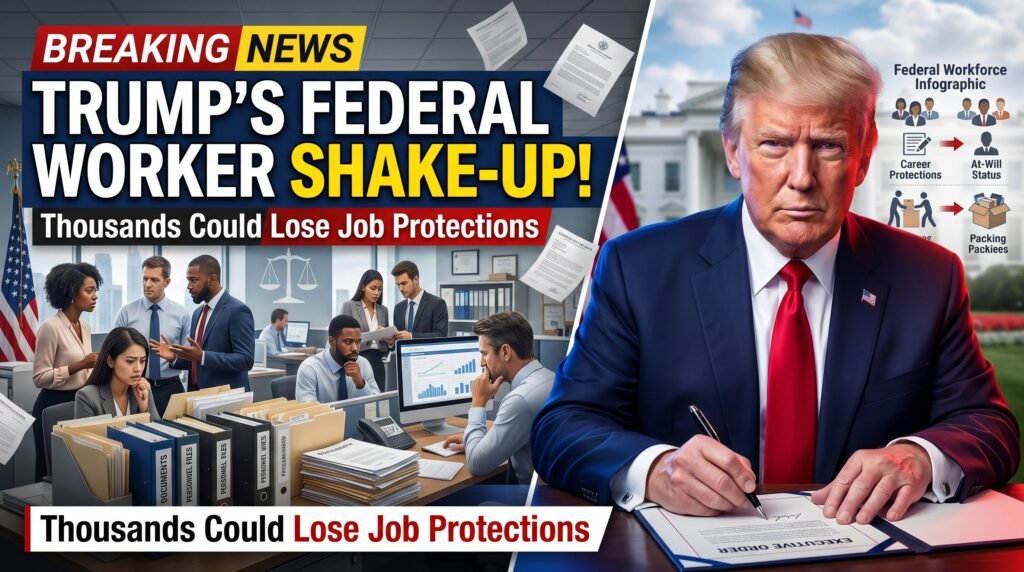
Trump’s At-Will Federal Workers Plan: What It Means for the Future of the U.S. Government

Introduction
One of the most controversial policies associated with President Donald Trump is his effort to make thousands of federal employees “at-will” workers. Supporters argue the move will improve accountability and make government agencies more responsive to elected leadership. Critics, however, warn that it could fundamentally reshape the American civil service system and increase political influence over government operations.
The issue has gained renewed attention after the Trump administration moved forward with plans to reclassify thousands of senior federal employees into a new category known as Schedule Policy/Career, formerly referred to as Schedule F. The change could make it significantly easier to dismiss certain government workers. (Reuters)
This debate is about far more than jobs. It touches on questions of government efficiency, presidential authority, civil service protections, and the balance between politics and public administration.
What Are At-Will Employees?
In the private sector, many workers are employed “at will.” This means employers can terminate employment for almost any legal reason without extensive procedural requirements.
Federal employees traditionally operate under a different system. Since the late 19th century, the U.S. civil service has been built around merit-based hiring and protections designed to shield government workers from political pressure.
Under current civil service rules, federal employees generally have:
- Protection against politically motivated firing
- Appeal rights for disciplinary actions
- Due-process procedures before termination
- Whistleblower protections
The proposed reforms would remove many of these protections for selected policy-related positions. (NPR)
The Origins of Schedule F
The idea first emerged during Trump’s first presidential term in 2020.
The administration argued that some federal employees wield significant influence over policy while remaining difficult to remove, even when they obstruct presidential priorities. To address this, Trump introduced Schedule F, a classification that would move certain policy-related positions out of traditional civil service protections.
The policy was later rescinded by President Joe Biden after taking office. However, Trump revived the concept upon returning to office, renaming it Schedule Policy/Career. (Federal News Network)
What Changed in 2026?
In June 2026, Trump signed an executive order affecting approximately 8,000 senior federal employees.
These positions largely include:
- Senior policy advisors
- Chiefs of staff
- Division directors
- Regulatory officials
- Senior attorneys involved in policy creation
- High-ranking managers and administrators
Most affected workers occupy senior GS-15 or leadership-level positions within federal agencies. The executive order makes these employees effectively at-will workers, reducing many of their traditional civil service protections. (Reuters)
Why Supporters Back the Plan
Supporters argue that the federal government has become too bureaucratic and resistant to change.
According to administration officials, elected presidents should have greater authority to ensure that federal agencies carry out policies approved by voters.
Supporters believe the reform could:
1. Improve Accountability
Advocates argue that under current rules, poorly performing employees can remain in government positions for years despite ineffective performance.
2. Speed Up Government Reform
Presidents often struggle to implement policy changes because career officials remain in place across multiple administrations.
3. Strengthen Democratic Control
Supporters contend that voters elect presidents to implement specific agendas. They believe federal workers should faithfully execute those policies rather than resist them.
Administration officials have described the reform as a way to remove employees who engage in misconduct, poor performance, or deliberate obstruction of presidential directives. (Federal News Network)
Why Critics Are Concerned
Opponents see the proposal very differently.
Labor unions, government watchdog groups, and civil service advocates argue that the policy threatens the independence of the federal workforce.
Their concerns include:
1. Politicization of Government
Critics fear employees may feel pressure to align with political priorities to keep their jobs.
2. Loss of Expertise
Many affected positions require years of specialized experience. Large-scale dismissals could lead to a loss of institutional knowledge.
3. Reduced Whistleblower Protections
Some analysts worry that employees may become less willing to report misconduct if job protections are weakened.
4. Return to the “Spoils System”
Historically, government jobs were often awarded based on political loyalty rather than qualifications. Critics argue the reforms could move the federal workforce closer to that model. (The Guardian)
Could More Workers Be Affected?
The current executive order impacts roughly 8,000 positions.
However, earlier government estimates suggested that as many as 50,000 federal jobs could potentially qualify for reclassification under broader versions of the policy. That would represent approximately 2% of the entire federal workforce. (NPR)
While administration officials currently say there are no immediate plans to expand the list beyond the initial group, observers expect ongoing debate about the scope of the policy. (Reuters)
Legal Challenges Ahead
The policy is already facing legal scrutiny.
Federal employee unions and advocacy groups have filed lawsuits challenging the administration’s authority to make such sweeping changes to civil service protections.
Key legal questions include:
- Does the president have authority to reclassify these positions?
- Are existing civil service protections being unlawfully bypassed?
- Could the policy violate federal employment laws?
Courts are expected to play a major role in determining how far the administration can go with workforce restructuring. (Reuters)

What This Means for the Future
The debate over at-will federal workers reflects a broader struggle over the role of government in America.
Supporters view the reform as a necessary modernization effort that will make government more efficient and accountable. Critics see it as a threat to the nonpartisan civil service system that has existed for generations.
Regardless of political perspective, the policy represents one of the most significant federal workforce reforms in decades. Its ultimate impact will depend on future court rulings, administrative implementation, and the political landscape in Washington.
Final Thoughts
Trump’s at-will federal worker initiative has become one of the defining governance debates of the decade. By reclassifying thousands of senior federal employees and reducing traditional job protections, the administration aims to create a workforce that is more responsive to presidential leadership.
Whether the policy leads to greater accountability or increased politicization remains a matter of intense debate. What is certain is that the outcome will influence not only federal employees but also the future structure and operation of the U.S. government for years to come. (Reuters)