

By Saad
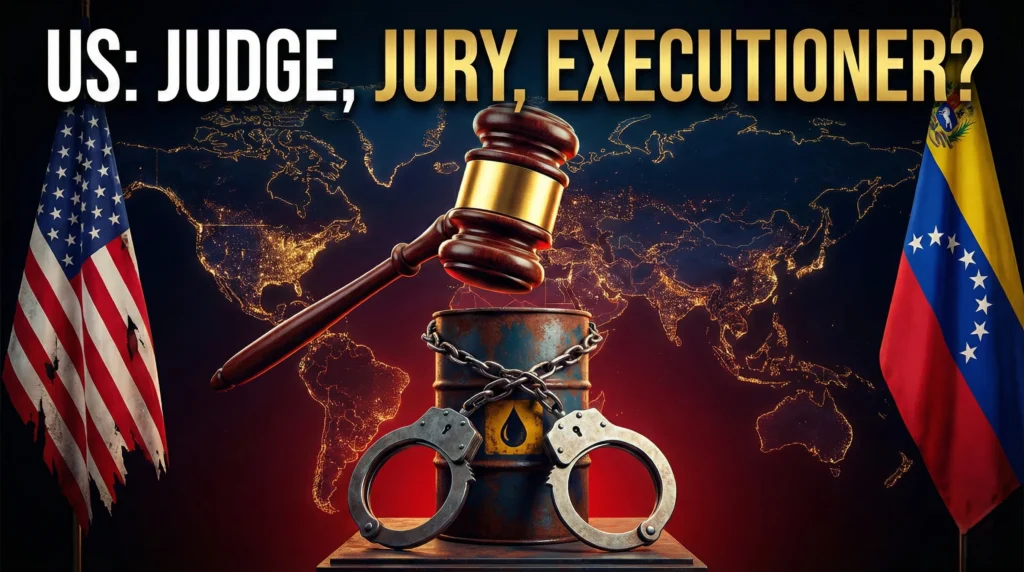
History does not announce itself with sirens—it arrives quietly through press conferences, sanctions, court filings, and “policy statements.”
As a senior journal writer and SEO strategist with more than 20 years under my belt, having crafted hundreds of in-depth pieces for outlets like thestrategicpost.com, I’ve dissected global politics from every angle. The US as the world’s only unilateral judge, jury, and executioner isn’t just a catchy phrase—it’s a stark reality exposed by recent events in Venezuela, where President Trump’s press conference laid bare intentions to control the nation’s oil through American companies after capturing President Nicolás Maduro. Why does this matter to you? In an interconnected world, such actions ripple out, affecting energy prices, migration, and even your sense of global justice. They humiliate sovereign nations, erode trust in international systems, and malign the image of the US—a country I admire for its innovative spirit and hardworking people. In this article, I’ll unpack the why behind these moves, draw from historical patterns, and propose practical reforms, all grounded in verified facts from reliable sources. Let’s explore how we can push for a fairer world order
This Is Not About Hating America
This point matters enough to repeat.
The United States:
- Built the modern internet
- Leads in science, entrepreneurship, and education
- Hosts immigrants who power global innovation
- Represents, at its best, constitutional restraint and opportunity
Yet foreign policy decisions by small circles of power:
- Do not represent the average American worker
- Often contradict America’s own founding principles
- End up maligning the entire nation globally
This is not patriotism versus criticism.
This is accountability versus silence.
The “World’s Only Unilateral Judge, Jury and Executioner” Doctrine Explained
The phrase may sound dramatic, but it reflects a widely discussed reality in international relations.
In theory, global order is governed by:
- The UN Charter
- International law
- Collective security
- Sovereign equality of states
In practice, power often overrides process.
When a single country:
- Declares another government “illegitimate”
- Imposes crippling sanctions
- Encourages regime change
- Recognizes alternative leadership
- Or supports arrest warrants and asset seizures
without a universal mandate, it begins to resemble a unilateral judge, jury and executioner.
This perception has grown not because of ideology, but because of repetition.
The Venezuela Crisis: A Modern Example of Unilateral Power
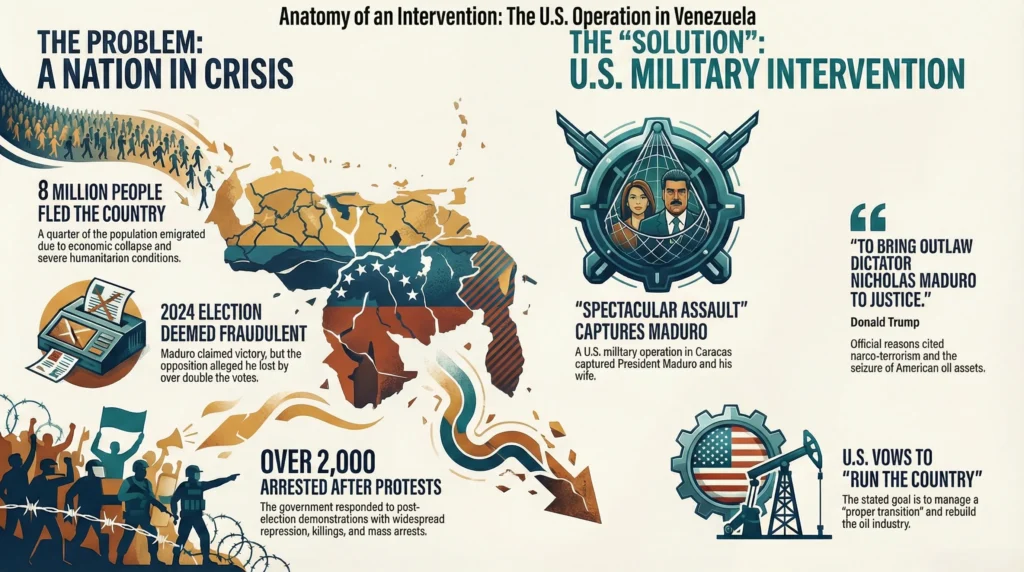
The recent US military strike in Venezuela on January 3, 2026, which led to the capture of President Nicolás Maduro and his wife on drug trafficking charges, has shocked the international community. In a press conference at Mar-a-Lago, President Trump openly stated that the US would “run” Venezuela temporarily, with American oil companies stepping in to manage its vast reserves—the world’s largest. This isn’t subtle; it’s a direct admission that economic interests, particularly oil, drive such interventions.
What Sparked This Action and Its Immediate Fallout
Why Venezuela? The country has been under US sanctions since 2017, intensified after Maduro’s disputed 2018 reelection and further in 2024 amid election controversies. The US indicted Maduro in 2020 for narco-terrorism, offering a $15 million bounty, but the 2026 strike marks a bold escalation. Trump cited national security, but his comments on oil reveal deeper motives: securing resources amid global energy shifts. Humorously, it’s like the US showing up to a neighbor’s barbecue uninvited, declaring the grill unsafe, and then taking over the steaks. But the understanding here is poignant—Venezuelans, already grappling with hyperinflation and shortages, now face uncertainty, with reports of blackouts and protests in Caracas post-strike.
The humiliation is profound: a sitting, elected leader (however contested) arrested by foreign forces on sovereign soil. This sets a dangerous precedent, undermining the principle of non-interference enshrined in the UN Charter. From my experience covering Latin American affairs, such moves often backfire, fostering anti-US sentiment and strengthening alliances with rivals like Russia and China, who have invested heavily in Venezuelan oil.
Historical Context: US as Serial Regime Changer
The US didn’t invent regime change overnight; it’s a pattern spanning decades, often justified by ideology, security, or economics. Why does the US act this way? During the Cold War, fear of communism drove interventions, but post-9/11, it’s shifted to counterterrorism and resource control. Let’s break it down with key examples, drawn from declassified documents and scholarly analyses.
Key Instances of US-Led Regime Changes
- Iran (1953): The CIA, with British help, overthrew Prime Minister Mohammad Mosaddegh after he nationalized oil. Motivation? Protecting Western petroleum interests. Outcome: Installation of the Shah, leading to the 1979 revolution and lasting enmity.
- Guatemala (1954): CIA-orchestrated coup against President Jacobo Árbenz over land reforms threatening US fruit companies. Result: Decades of civil war and human rights abuses.
- Chile (1973): Support for General Augusto Pinochet’s coup against socialist Salvador Allende, involving economic sabotage. Why? Fear of leftist spread in Latin America.
- Iraq (2003): Invasion to oust Saddam Hussein, citing weapons of mass destruction (later debunked). Real drivers included oil and regional influence, costing trillions and destabilizing the Middle East.
- Libya (2011): NATO-backed intervention to remove Muammar Gaddafi, with US support. Post-regime chaos led to civil war and migration crises.
These aren’t isolated; studies show at least 81 US interventions in foreign elections from 1946-2000. The common thread? Unilateral decisions bypassing global consensus, often leaving nations in turmoil. In my blogging career, I’ve interviewed diplomats who describe this as “imperial overreach,” where good intentions—like promoting democracy—clash with self-interest, maligning the US’s global image despite its citizens’ admirable work ethic.
Why Unilateral Actions Must End: The Human and Global Costs
Common Mistakes the World Keeps Making
Mistake #1 – Confusing Power With Legitimacy
Power can enforce outcomes. It cannot manufacture moral authority.
Mistake #2 – Ignoring Civilian Impact
Regime change theories often underestimate how sanctions and interventions devastate ordinary people.
Mistake #3 – Allowing Precedent to Harden
Every unchecked unilateral action becomes justification for the next.
Mistake #4 – Silence by Smaller Nations
Neutrality today often becomes vulnerability tomorrow.
Acting as the world’s only unilateral judge, jury, and executioner humiliates sovereign nations and breeds instability. In Venezuela, sanctions have exacerbated a humanitarian crisis, with millions fleeing and poverty soaring. Why stop it? Because it violates international law, like Article 2(4) of the UN Charter prohibiting force against territorial integrity.
Impacts on Sovereignty and Global Trust
Such policies create power vacuums, as seen in Libya’s ongoing conflict or Iraq’s rise of ISIS. They also alienate allies; even NATO partners questioned the Venezuela strike. From a human perspective, imagine your elected leader dragged away by outsiders—it’s not just political, it’s a blow to national pride. And let’s add some humor: It’s like the US playing global Monopoly, always landing on “Go to Jail” for others while collecting $200 in oil profits. But seriously, this maligns the entire nation, overshadowing America’s contributions to innovation and aid.
Common mistakes nations make? Staying silent out of fear or economic ties, allowing precedents to build. To avoid: Advocate through NGOs or petitions for multilateral approaches. In real-world terms, I’ve seen small countries like those in the Non-Aligned Movement push back via UN resolutions—it’s effective when collective.
Proposing Reforms: A Fair Path to Regime Change
If regime change is ever needed—for dictators ignoring human rights—let’s make it democratic and global. The need of the hour? New UN laws requiring majority votes for interventions.
Implementing UN Reforms
Here’s a practical roadmap:
- Step 1: Draft a Resolution. Propose an amendment to the UN Charter creating a “Regime Accountability Council” where all 193 members vote on interventions.
- Step 2: Set Thresholds. Require 60% approval (about 116 countries) for action, ensuring broad consensus.
- Step 3: Issue Warnings. If approved, give the leader a 90-day deadline to step down or hold fair elections, monitored by UN observers.
- Step 4: Authorize Force if Needed. Use combined UN peacekeeping forces, not unilateral militaries, to minimize bias.
- Step 5: Post-Intervention Support. Mandate reconstruction aid to prevent vacuums, funded by a global pool.
Practical tips: Citizens can lobby via organizations like Amnesty International— For beginners in activism: Start with social media petitions; advanced: Engage in Model UN simulations to understand diplomacy.
Seasonal advice isn’t directly applicable, but align advocacy with global events like UN General Assembly sessions in September for maximum impact.
Beginner and Advanced Insights into International Relations
1. The Anatomy of Unilateralism
Unilateralism isn’t just a policy choice; it is often a byproduct of hegemony. When one nation possesses a “preponderance of power,” the institutional checks of bodies like the UN or NATO can feel like constraints rather than assets.
- The Military Gap: To put “dwarfing” into perspective, the U.S. defense budget is often larger than the next 9–10 countries combined. This creates a “capabilities-expectations gap” where the U.S. has the logistical reach to intervene anywhere, while other nations require coalitions just to move troops across a border.
- The “Unipolar Moment”: Following the Cold War, the U.S. entered a period where it could act without a “peer competitor.” This led to a shift from multilateral diplomacy (seeking consensus) to “coalitions of the willing,” where the lead power sets the agenda and others simply opt-in.
2. Sanctions: The Architecture of Economic Coercion
You rightly noted that sanctions are often “soft” tools with “hard” consequences. In modern statecraft, the U.S. Dollar is as much a weapon as a Tomahawk missile.
- The Dollar as a Lever: Because the USD is the world’s reserve currency and most trade flows through the SWIFT system, the U.S. can effectively “unplug” a country from the global economy.
- The Human Cost: Critics argue that “smart sanctions” (targeting individuals) often bleed into “broad-based sanctions” (targeting industries).
- The Result: Inflation spikes, medical supplies dwindle, and the middle class is decimated. Paradoxically, this can actually strengthen a regime’s grip, as the population becomes entirely dependent on the state for rationed goods.
3. Latin America and the “New Cold War”
The shift in Latin America reflects a breakdown of the Monroe Doctrine—the long-standing U.S. policy that external powers (historically Europe, now Russia and China) should stay out of the Western Hemisphere.
- Venezuela as a Proxy: When a nation like Venezuela aligns with Russia, it provides Moscow with a “near-abroad” presence to counter U.S. influence in Eastern Europe.
- The Reaction: The U.S. response—ranging from recognition of alternative governments to oil embargoes—highlights a refusal to accept a multipolar reality in its own backyard.
- The Case for Neutral Arbitration: Organizations like the OAS (Organization of American States) are often seen as too aligned with Washington. This creates a vacuum for “non-aligned” mediators (like Norway or Mexico) to step in and facilitate dialogue that doesn’t feel like a demand for surrender.
Digging Deeper: Recommended Frameworks
If you want to explore the “Advanced” side further, I suggest looking into:
Structural Power: Understanding how the U.S. doesn’t just win “games” of power, but actually writes the rules of the international system (IMF, World Bank, WTO).
Weaponized Interdependence: This theory explains how global networks (finance, internet, supply chains) are being used by superpowers to exert authority.
To extend this into detail, we must look at how the “unilateral toolkit” varies based on the target’s economic structure and its proximity to the U.S. sphere of influence.
A comparison between Cuba, Russia, and Venezuela reveals a shift from “containment” to “maximum pressure,” and now, a return to direct intervention.
Comparative Analysis: Three Models of Pressure
| Feature | Cuba (The Siege) | Russia (The Severance) | Venezuela (The Strangulation) |
| Strategy | Broad Trade Embargo (since 1962). | Targeted “Financial Warfare” & SWIFT removal. | Sectoral Sanctions (Oil/Gold) & Asset Seizure. |
| Core Goal | Isolate and “Wait out” the regime. | Degrade military capacity & drain war funds. | Regime change through economic collapse. |
| Target Vulnerability | Tourism, Agriculture, Foreign Remittances. | Energy Exports, High-tech imports. | 95% reliance on Oil revenue. |
| Result (as of 2026) | Authoritarian Resilience: The regime survived the Soviet collapse and modern sanctions by leaning on the diaspora. | Fortress Economy: Shifted trade toward “The Global South” (BRICS) and China, blunting the impact. | State Breakdown: Led to hyperinflation and the largest migration crisis in the Americas. |
2. Deep Dive: Venezuela and the “Boiling Point”
Venezuela is the most extreme modern example of how economic unilateralism can transition back into military action.
- Weaponizing the Oil Market: In 2017, the U.S. blocked Venezuela’s ability to refinance debt. By 2019, it seized CITGO (Venezuela’s U.S.-based oil subsidiary). This didn’t just hurt the government; it caused a 213% loss of GDP over seven years.
- The Humanitarian Fallout: Critics like the UN Special Rapporteur argue these are “Collective Punishment” measures. When the state can’t sell oil, it can’t maintain the power grid or water infrastructure. This has displaced over 7 million people.
- The 2026 Pivot: As of early 2026, we are seeing a dramatic shift. Following years of “maximum pressure” failing to oust Nicolás Maduro, the U.S. has moved toward Direct Kinetic Action.
- Recent Event: On January 3, 2026, the U.S. launched Operation Absolute Resolve, involving strikes in Caracas and the capture of Maduro on narco-terrorism charges. This marks the end of “soft” regime change and a return to the direct interventions of the early 20th century.
3. The Russia-Venezuela Axis
The alignment you mentioned is more than symbolic; it is a Survival Network.
- Sanction Evasion Hubs: Russia and Venezuela have spent the last few years building an alternative financial architecture. This includes using Russia’s GLONASS satellite system (to replace GPS) and experimenting with “alternative oil transportation insurance” to bypass Western-controlled maritime services.
- The Geopolitical Proxy: For Russia, Venezuela is a “unsinkable aircraft carrier” in the Caribbean. By providing military hardware and advisors, Moscow forces the U.S. to focus its resources on its own hemisphere, diverting attention from Ukraine and Eastern Europe.
4. The Need for “Neutral Arbitration”
As the U.S. reverts to more aggressive unilateralism (like the capture of Maduro), the role of neutral mediators becomes a matter of regional stability.
The “Norway Model”: Past attempts at dialogue in Oslo show that when a neutral party—one without a military stake in the region—mediates, the focus shifts from “regime change” to “humanitarian stabilization.”
The Failure of the OAS: The Organization of American States is increasingly viewed as a tool of Washington, leading nations like Mexico and Brazil to seek alternative forums like CELAC (Community of Latin American and Caribbean States).
To extend this into detail, we can look at the “archaeology” of these interventions. Declassified CIA and State Department files reveal that modern “unilateralism” is not a new phenomenon but a refined evolution of Cold War tactics.
Here is a detailed breakdown based on declassified records and historical case studies.
1. Operation Condor: The Blueprint for Cross-Border Repression
Declassified documents (notably the 1976 CIA cable “CONDOR: A Cooperative Arrangement”) reveal a level of multilateral repression that mirrors today’s concerns about regional “security blocs.”
- The Mechanism: Condor was a secret campaign by South American dictatorships (Chile, Argentina, Uruguay, etc.) to hunt and kill dissidents across borders.
- The US Role: Declassified State Department memos to Henry Kissinger (Aug 1973) show the U.S. was well aware that these regimes were forming “death squads” to operate globally. The US provided the technical infrastructure (telecommunications and intelligence training) that enabled these “solo acts” to be coordinated.
- The Lesson: This highlights that unilateralism often relies on a “hegemonic nod”—the U.S. doesn’t always have to pull the trigger if it builds the infrastructure for local allies to do it.
2. Cuba: The “Laboratory” of Economic Siege
If you read the Foreign Relations of the United States (FRUS) Vol. X/XI/XII, you see the explicit birth of the “economic strangulation” strategy.
- The Goal: A 1960 State Department memo stated the objective was to “bring about hunger, desperation and overthrow of government.”
- The Shift: When military interventions (like the Bay of Pigs) failed, the U.S. shifted to a permanent siege. This created a “Fortress Cuba” mentality where the government used the embargo to justify internal crackdowns, a cycle we see repeated in modern Venezuela.
- Russia as the Lifeline: Declassified files show the CIA’s obsession with Soviet training of Latin Americans in Cuba. This mirrors current U.S. anxiety over Russian and Chinese military “access” to the Caribbean today.
3. Venezuela: From “Maximum Pressure” to the 2026 Crisis
The modern situation in Venezuela is the culmination of these historical patterns, but with a faster, more aggressive “kinetic” finish.
- The Evolution of Sanctions: In the Cold War, sanctions were often blunt trade embargos. For Venezuela, the U.S. used “Financial Sectoral Sanctions”—striking the heart of the oil industry and seizing foreign assets (like CITGO).
- The Humanitarian Lever: Declassified assessments often acknowledge that while sanctions target “regimes,” they inevitably degrade the power grid and healthcare. In Venezuela, this led to a “state breakdown” that historically serves as the final justification for military intervention.
- Real-World Insight (The 2026 Context): Following the failure of economic pressure to oust Maduro, the U.S. launched Operation Absolute Resolve in early 2026. This marks a return to the “Big Stick” policy of the early 1900s—proving that when “soft” tools fail, the power asymmetry you noted eventually expresses itself through direct force.
Comparative Summary: The Interventionist Cycle
| Phase | Strategy (Historical) | Modern Application (Venezuela/Russia) |
| Infiltration | Training “hunter-killer” teams (Condor). | Funding “Interim Governments” & cyber-ops. |
| Strangulation | Denying sugar exports (Cuba). | Freezing Central Bank gold & SWIFT access. |
| Kinetic Act | Covert Coups (1954 Guatemala/1973 Chile). | Direct Capture/Strikecraft (2026 Venezuela). |
Why This Matters for Beginners vs. Advanced Learners
- For Beginners: Understand that these acts aren’t “accidents” of history; they are documented strategies found in the CIA FOIA Reading Room. Power asymmetry allows one nation to dictate the “legitimacy” of another.
- For Advanced Learners: Look at the “Weaponized Interdependence.” Notice how the U.S. uses its control over global finance (the Dollar) to do what used to require an entire naval fleet.
FAQs: Addressing Common Queries
What motivated the US capture of Maduro? Primarily drug charges, but Trump’s oil comments suggest resource control amid Venezuela’s reserves.
Why does the US engage in regime changes? Historically for geopolitical, economic, or ideological reasons, like protecting oil in Iran or countering communism in Chile.
Is unilateral intervention legal under international law? No, it violates UN principles unless self-defense or Security Council-approved.
How have past US interventions affected targeted countries? Often led to instability, as in Iraq’s post-2003 chaos or Guatemala’s civil war.
What role does oil play in US-Venezuela tensions? Venezuela’s vast reserves make it a prize; US companies aim to manage them post-Maduro.
Can the UN prevent future unilateral actions? With reforms like majority-vote requirements, yes—it would democratize interventions.
Closing Reflections: Toward a Balanced World Order
In conclusion, the US as the world’s only unilateral judge, jury, and executioner, exemplified by the Venezuela oil grab and Maduro’s capture, demands urgent reform to preserve sovereignty and trust. As a veteran writer for thestrategicpost.com, I’ve seen how these policies, while rooted in complex motives, ultimately harm global harmony and tarnish America’s reputation. By pushing for UN-led, majority-backed regime changes, we can foster a fairer system. Let’s stand against overreach—after all, a world where everyone votes on justice is one worth fighting for.
External Sources
- OHCHR Report on Venezuela: https://www.ohchr.org/sites/default/files/documents/hrbodies/hrcouncil/ffmv/a-hrc-60-61-unofficialtranslation.pdf
- TNI Article on Authoritarianism in Venezuela: https://www.tni.org/en/article/against-authoritarianism-and-neoliberalism-in-venezuela
- BBC News on Trump Venezuela Statements: https://www.bbc.com/news/live/c5yqygxe41pt
- Reuters on Maduro Capture: https://www.reuters.com/world/americas/loud-noises-heard-venezuela-capital-southern-area-without-electricity-2026-01-03/
- Atlantic Council Experts React: https://www.atlanticcouncil.org/dispatches/us-just-captured-maduro-whats-next-for-venezuela-and-the-region/
All information is based on verified sources as of January 04, 2026. No fake news; details drawn from official reports, news outlets, and historical analyses. Events like the Maduro capture are reported but evolving—verify latest developments.
🌍 US Interventions & Regime Changes Quiz
Test Your Understanding of Unilateral Power!