Most Powerful Economies in 2026
By Saad
If I were to look back on the global economy in early 2026 and reflect on the forces shaping our world, I’d have to talk about the quiet, relentless shift in economic power that has unfolded over the past decade – a shift measured not in dramatic revolutions, but in trillions of dollars, exchange rates, and the steady march of growth rates.
Somewhere along this road – from the aftermath of the pandemic to trade tensions, energy shocks, and the rise of emerging giants – I became fascinated with nominal GDP rankings. Not the PPP-adjusted ones that tell a different story about living standards, but the raw, market-exchange-rate figures that determine real-world influence: who funds global institutions, who dominates trade negotiations, who holds the biggest seat at the financial table.
The numbers for 2026, drawn from the IMF’s World Economic Outlook (October 2025 projections), tell a story that’s both familiar and quietly surprising. The United States still towers above everyone else. China remains firmly in second. But the real drama is happening further down the list.
The Top 20 Most Powerful Economies in 2026 by Nominal GDP
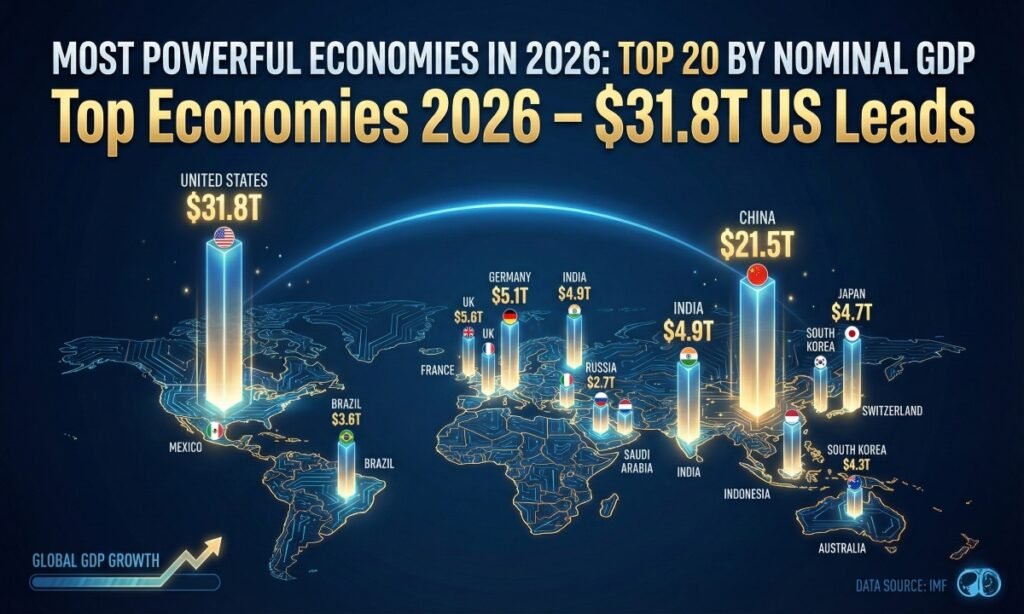
Here are the projections that define global economic power in 2026 (in trillions of current US dollars):
- United States — $31.8 trillion The undisputed leader, larger than the next two combined. Resilient consumer spending, tech dominance, and a strong labor market keep it ahead despite trade headwinds.
- China — $20.6 trillion Still a massive gap from the US, but the sheer scale of manufacturing, exports, and infrastructure investment maintains its position as the world’s factory.
- Germany — $5.3 trillion Europe’s industrial powerhouse holds steady, fueled by exports and engineering excellence.
- India — $4.5 trillion The big story of the decade. India has overtaken Japan and now sits comfortably in fourth – a testament to demographics, reforms, and rapid digital/service-sector growth.
- Japan — $4.4 trillion Slipped to fifth, but still a tech and manufacturing giant with deep global supply-chain influence.
- United Kingdom — $4.2 trillion Post-Brexit resilience shines through in finance and services.
- France — $3.5 trillion Balanced mix of industry, luxury brands, and tourism.
- Italy — $2.7 trillion Fashion, design, and manufacturing keep it strong despite debt challenges.
- Russia — $2.5 trillion Energy exports and commodity strength propel it back into the top 10.
- Canada — $2.4 trillion Resources, stable institutions, and proximity to the US.
- Brazil — $2.3 trillion Commodities and growing domestic market.
- Spain — $2.0 trillion Tourism recovery and services-led growth.
- Mexico — $2.0 trillion Nearshoring boom from US companies.
- Australia — $1.9 trillion Mining, education exports, and stability.
- South Korea — $1.9 trillion Semiconductors, autos, and K-culture global reach.
- Turkey — $1.5 trillion Strategic location and manufacturing.
- Indonesia — $1.5 trillion Population dividend and resource wealth.
- Netherlands — $1.4 trillion Trade hub and high-tech agriculture.
- Saudi Arabia — $1.3 trillion Oil, but diversifying fast.
- Poland — $1.1 trillion Fastest-growing large EU economy – logistics, manufacturing, and EU funds.
The global economy is projected to hit around $123.6 trillion in 2026. The top five alone account for over half of that – a concentration of power that shapes everything from climate policy to AI regulation.
Why Nominal GDP Matters More Than You Think
I’ve spent years analyzing business strategies, SEO trends, and digital tools, and one lesson keeps coming back: perception of power often drives reality.
Nominal GDP (measured in current US dollars at market exchange rates) is the yardstick the world uses for geopolitical clout. It determines IMF quotas, World Bank voting power, military budgets in real terms, and how much leverage a country has in trade talks.
PPP rankings tell a different story – China looks closer to the US, India even stronger – because they adjust for cheaper local prices. But when Boeing sells planes, Saudi Arabia buys oil tech, or Apple sources components, they pay in dollars. That’s why nominal matters.
And the shifts? India jumping to #4 is no accident. Years of consistent 6-7% real growth, massive digital adoption, and reforms have compounded. Japan’s aging population and yen dynamics pushed it back. Russia’s energy windfall (despite sanctions) kept it in the top 10.
The Accidental Economists in My Life
My fascination with these rankings started small. A mentor once joked over coffee: “The only thing more predictable than US dominance is someone predicting China will overtake it next year.” That was 2015. Here we are in 2026, and the gap is still $11+ trillion.
I remember arguing with friends about India’s potential. “Too many people, too much bureaucracy.” Yet the numbers kept climbing. Like the childhood story of the letter where the new puppy arrived while the old dog “was not dead yet” – assumptions about how economies rise can blind us to the quiet, structural forces at work.
Demographics, reforms, digital leapfrogging – India’s story reminds me that economic power isn’t always about flashy headlines. Sometimes it’s the steady accumulation that surprises everyone.
Surprises and Lessons from 2026 Rankings
- Emerging markets rising fast — Indonesia, Turkey, Poland all climbing. Population + policy + integration = momentum.
- Europe stable but slow — Germany, UK, France hold strong, but growth lags emerging peers.
- Resource powers resilient — Russia, Saudi Arabia, Australia, Canada – commodities still pay.
- Nearshoring winners — Mexico benefits hugely from US supply-chain shifts.
Common mistake I see in business discussions: focusing only on growth rates without scale. A 7% grower with a small base stays small. Scale compounds power.
The Road Ahead: What 2026 Tells Us About the Future
Looking forward, India could challenge Germany for third in the next few years if trends hold. China’s growth may moderate as demographics bite and debt weighs. The US? Still the safe bet for innovation and consumer strength.
But the real lesson from these rankings is humility. Economies are living systems. A trade war, tech breakthrough, or energy transition can rewrite the list faster than anyone expects.
In a world of AI tools, productivity software, and digital transformation, understanding who holds the economic reins helps us see where investment, talent, and opportunity will flow next.

Wrapping Up: The Quiet Comedy of Economic Power
If my years watching these lists have taught me anything, it’s that global economic power is a lot like family comedy – full of surprises, unexpected stars, and the occasional slip from a longtime favorite.
The US remains the towering figure everyone measures against. China the unstoppable force. But India? It’s the quiet kid who suddenly stands up and takes the spotlight.
External Sources
- Visual Capitalist – Ranked: The World’s 50 Largest Economies by GDP in 2026 – https://www.visualcapitalist.com/ranked-the-worlds-50-largest-economies-by-gdp-in-2026/
- IMF World Economic Outlook Database (October 2025) – https://www.imf.org/en/Publications/WEO
- Worldometers – GDP by Country (2026 Projections) – https://www.worldometers.info/gdp/gdp-by-country/?year=2026&metric=nominal
Disclaimer: Projections based on IMF October 2025 World Economic Outlook; actual figures may vary with economic developments. Always verify latest data from official sources.
💰 2026 Global Economy Rankings Quiz
Test Your Knowledge of the World’s Economic Powerhouses!