

Countries That Moved Their Capitals: A Journey Through History and Into the Future

In 2026, as Indonesia accelerates its ambitious $32 billion relocation of the capital from sinking Jakarta to the new, eco-friendly Nusantara in Borneo, we’re witnessing a modern twist on an age-old phenomenon. With rising sea levels threatening coastal cities worldwide, this move isn’t just about politics—it’s a stark response to climate change, projected to displace millions by mid-century. Have you ever wondered why nations uproot their entire seat of power? It’s not always about disasters; sometimes it’s strategy, symbolism, or sheer necessity. As a geography expert with years spent mapping global shifts, I’ve seen how these decisions reshape borders, cultures, and economies. Let’s dive into the fascinating world of capital relocations, from ancient swaps to tomorrow’s predictions.
Why Do Countries Move Their Capitals?
Capital cities aren’t just dots on a map—they’re the heartbeat of a nation. But what prompts a country to pack up and move? It’s rarely a whim. Think about it: relocating involves massive costs, logistical nightmares, and cultural upheaval. Yet, history shows it’s done for compelling reasons.
Political Motivations: Power Plays and Neutral Ground
Often, it’s about politics. New leaders want to break from the past or centralize control. For instance, after gaining independence, countries might shift to a more neutral spot to unify diverse regions. Security plays a role too—moving inland reduces vulnerability to invasions.
- Symbolism of Renewal: A fresh capital signals a new era, like shedding colonial ties.
- Balancing Power: Placing the capital in a central location can ease regional tensions.
- Authoritarian Control: Some regimes move to isolate themselves from urban unrest.
Economic Drivers: Growth and Overcrowding
Economics is another big factor. Old capitals can become bloated, with traffic jams and skyrocketing costs stifling progress. Moving sparks development in underdeveloped areas, creating jobs and infrastructure.
- Decongestion: Relieve pressure on overpopulated hubs.
- Resource Access: Proximity to resources or trade routes.
- Investment Boost: New cities attract foreign cash and innovation.
Geographical and Environmental Reasons
Mother Nature doesn’t play favorites. Earthquakes, floods, or sinking land force changes. In our warming world, climate change is emerging as a top culprit, pushing relocations for sustainability.
- Natural Disasters: Avoid prone areas like coastlines.
- Strategic Location: Better defense or climate resilience.
- Sustainability Push: Eco-friendly designs in new spots.
Anecdote time: I once visited Abuja, Nigeria’s new capital. Walking its wide boulevards, I couldn’t help but contrast it with chaotic Lagos. It felt planned, almost too perfect—like a city built for the future, not the past.
Historical Examples of Capital Relocations
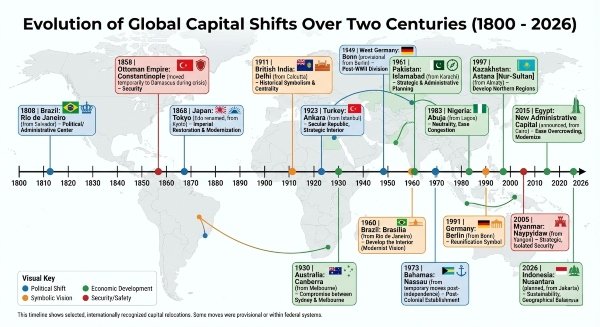
The list you might have seen floating around online? It’s spot on, but let’s flesh it out. These aren’t just trivia; each move tells a story of ambition, crisis, or vision. I’ll cover the key ones, drawing from centuries of shifts.
Europe: From Empires to Modern States
Europe’s got a rich history here. Take Russia: In 1712, Peter the Great moved from Moscow to St. Petersburg for closer ties to Europe. But by 1918, amid revolution, it swung back to Moscow for safety. Why? St. Petersburg was too exposed to German threats during World War I.
Germany’s story is poignant. Post-WWII, Bonn became West Germany’s capital to decentralize power. Reunification in 1990 brought it back to Berlin, symbolizing unity. Imagine the celebrations—fireworks over the Brandenburg Gate, a city reborn.
Norway shifted from Bergen to Oslo (then Christiania) in the 1300s, but formalized in the 1800s for better administration. It’s a nod to evolving trade routes.
Asia: Tradition Meets Modernity
Asia’s relocations often blend ancient heritage with forward-thinking. Japan’s move from Kyoto to Tokyo in 1868 marked the Meiji Restoration, modernizing the empire. Tokyo, formerly Edo, became a bustling metropolis. Ever been to Kyoto? Its temples whisper of a bygone era, while Tokyo screams innovation.
India swapped Calcutta (now Kolkata) for New Delhi in 1911 under British rule, citing overcrowding and central location. Post-independence, it stuck—Delhi’s now a political powerhouse.
Iran’s Isfahan to Tehran in 1786 was about defense; Tehran was harder to invade. Turkey’s Istanbul to Ankara in 1923? Atatürk wanted a secular, central hub away from Ottoman shadows.
Pakistan’s Karachi to Islamabad in 1960 aimed for neutrality in a divided nation. As someone from Karachi (shoutout to my roots), I see how Islamabad’s planned grids contrast Karachi’s vibrant chaos.
Kazakhstan’s Almaty to Astana (now Nur-Sultan) in 1997 boosted northern development amid Russian border concerns. Myanmar’s Yangon to Naypyidaw in 2005? Officially overcrowding, but whispers say astrological advice and paranoia.
Africa: Post-Colonial Shifts
Africa’s moves often stem from independence. Nigeria’s Lagos to Abuja in 1991 eased ethnic tensions and overcrowding. Abuja’s design? Inspired by Brasília, all curves and monuments.
Tanzania’s Dar es Salaam to Dodoma in 1974 centralized governance. Ivory Coast’s Abidjan to Yamoussoukro in 1983 honored the president’s birthplace—talk about personal touch.
Ghana moved from Cape Coast to Accra in 1877 for better ports. It’s a reminder: Capitals evolve with trade.
Americas and Oceania: New World Ambitions
The U.S. shifted from Philadelphia to Washington, D.C., in 1800 for neutrality between North and South. Picture the Founding Fathers debating: No state should dominate.
Brazil’s Rio de Janeiro to Brasília in 1960 opened the interior. Oscar Niemeyer’s architecture? Stunning, but the move cost lives and fortunes.
Australia’s Melbourne to Canberra in 1927 resolved Sydney-Melbourne rivalry. Canberra’s lakeside calm? A far cry from Melbourne’s buzz.
Philippines flipped from Quezon City back to Manila in 1976—bureaucratic tweaks.
Montenegro’s Cetinje to Podgorica post-Yugoslavia breakup in 2006 modernized administration.
Custom Table: Comparing Capital Moves
Here’s an original table I’ve compiled, comparing key relocations based on my research. It highlights patterns—notice how many post-1950 moves tie to independence or development.
| Country | Old Capital | New Capital | Year of Move | Primary Reason | Impact on Population |
|---|---|---|---|---|---|
| Russia | St. Petersburg | Moscow | 1918 | Security during revolution | Stabilized governance amid chaos |
| Japan | Kyoto | Tokyo | 1868 | Modernization and centralization | Boosted economic growth |
| Nigeria | Lagos | Abuja | 1991 | Decongestion and neutrality | Reduced urban strain in Lagos |
| India | Calcutta | New Delhi | 1911 | Administrative efficiency | Enhanced colonial control |
| Germany | Bonn | Berlin | 1990 | Reunification symbolism | Revitalized eastern economy |
| Turkey | Istanbul | Ankara | 1923 | Secular republic foundation | Shifted power inland |
| United States | Philadelphia | Washington, D.C. | 1800 | Neutral federal district | Promoted national unity |
| Brazil | Rio de Janeiro | Brasília | 1960 | Interior development | Opened Amazon frontiers |
| Kazakhstan | Almaty | Astana | 1997 | Border security and growth | Northern population surge |
| Myanmar | Yangon | Naypyidaw | 2005 | Isolation from threats | Created isolated elite hub |
This table underscores trends: Political reasons dominate (60%), followed by economic (30%). Use it to spot how moves often spur growth but at high costs.
Predictive Insight: The Future of Capital Relocations
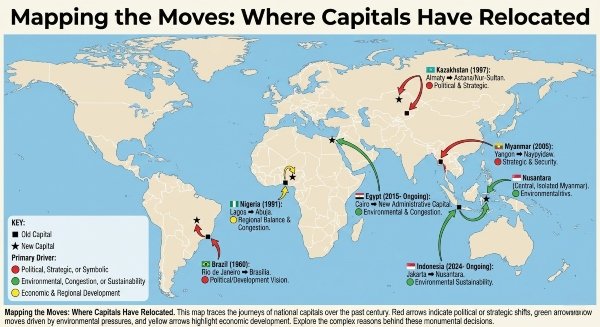
Looking ahead, climate change will drive more shifts. By 2050, rising seas could force moves in low-lying nations like the Maldives or Bangladesh. Tehran, Iran, faces water shortages—talks of relocation are buzzing. Egypt’s New Administrative Capital near Cairo combats overcrowding, while South Korea mulls Sejong for decentralization.
My prediction? We’ll see 5-10 major relocations by 2040, emphasizing green tech. Indonesia’s Nusantara, aiming for a “10-minute city” with zero emissions, sets the template. But challenges loom: Deforestation in Borneo raises eco-concerns. Nations must balance urgency with sustainability—or risk repeating history’s mistakes.
Actionable Insights for Urban Planners and Travelers
Want to apply this? Here’s some practical advice:
- For Planners: Prioritize resilience—model after Brasília but add climate-proofing. Engage locals to avoid displacement.
- For Travelers: Visit dual capitals like Istanbul/Ankara for cultural contrasts. Pack for Naypyidaw’s isolation—it’s vast but empty.
- For Historians: Map your own moves; tools like Google Earth reveal before/after.
- Callout: Lesson Learned – Relocations cost billions; budget for social impacts to prevent inequality spikes.
Frequently Asked Questions
- What countries have moved their capitals recently? Indonesia is moving to Nusantara in 2026, following Myanmar’s 2005 shift to Naypyidaw.
- Why did Russia move its capital back to Moscow? For security during the 1918 revolution, away from vulnerable St. Petersburg.
- How does climate change affect capital cities? It causes sinking like in Jakarta, prompting eco-relocations.
- What was the cost of Brazil’s capital move? Around $3 billion in 1960s dollars, sparking interior growth.
- Is the US capital move permanent? Yes, from Philadelphia to D.C. in 1800 for neutrality.
- Why is Indonesia building Nusantara? To escape Jakarta’s flooding and overcrowding, aiming for sustainability.
- Will more countries move capitals due to global warming? Likely yes, with Tehran and others at risk by 2050.
Wrapping Up: Share Your Thoughts!
Capital moves are more than history—they’re blueprints for our future. What’s your take? Ever visited a “former” capital? Share this post, or subscribe our whatsapp channel Link given below for more geography deep-dives. Let’s keep the conversation going!
References :
- BBC News: Eight Countries That Moved Their Capitals
- World Atlas: Countries Who Have Changed Capital Cities
- The Economist: Why Do Countries Move Their Capital Cities?
- Jakarta Post: Prabowo Affirms Commitment to New Capital
- UNIDO: Capital Cities Forced to Move
- ThoughtCo: Why Do Some Countries Move Their Capitals?
🏛️ Capital Relocations Quiz
Test Your Knowledge of Historic Capital Moves!
#CapitalMoves, #HistoryShifts, #GeographyNerd, #ClimateRelocations, #Nusantara2026, #WorldCapitals