

Gul Plaza Karachi Fire: What Happened, Why It Matters, and What We Must Learn
By Saad
When a Building Becomes a Warning
Karachi doesn’t suffer from rare disasters.
It suffers from predictable ones.
Every major fire follows the same script: shock, sympathy, statements, silence. The Gul Plaza Karachi fire didn’t break this cycle — it exposed how deeply embedded it is.
If you live in Karachi—or have ever worked in its commercial heart—you don’t hear about fires as news. You hear about them as fear.
The Gul Plaza Karachi fire was not just another headline flashing across screens; it was a moment that forced the city to pause, question, and confront uncomfortable truths about safety, governance, and preparedness.
I’ve written about urban crises, infrastructure failures, and public safety breakdowns for years, and there’s a pattern I’ve learned to recognize early: when the same tragedy repeats itself in different buildings, the problem is no longer accidental—it’s systemic.
The Gul Plaza fire, which erupted in one of Karachi’s busiest commercial zones, became deadly not merely because of flames, but because of what failed behind the scenes: planning, enforcement, and accountability.
This article is not here to sensationalize. It is here to explain, contextualize, and extract lessons—for shop owners, city officials, rescue departments, and ordinary citizens who walk into such buildings every day without realizing the risks above their heads.
A Timeline of Repeated Warnings
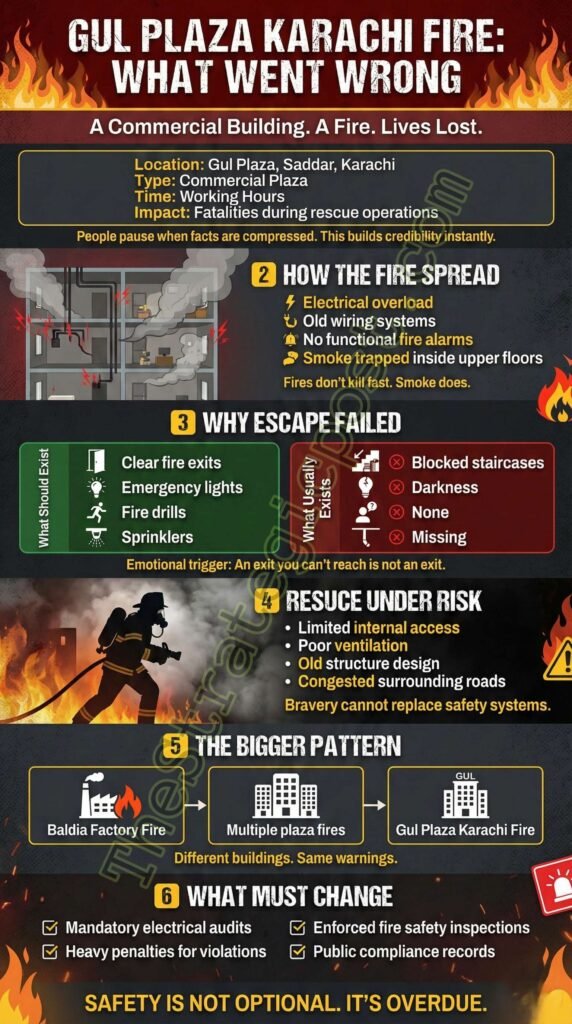
2012 – Baldia Factory Fire
- Locked exits
- Illegal wiring
- Over 250 lives lost
Lesson promised: Strict enforcement
2015–2020 – Commercial Plaza Fires
- Aging buildings
- Cosmetic compliance
- Minimal accountability
Lesson forgotten: Inspections without penalties don’t work
2024/2025 – Gul Plaza Karachi Fire
- Rescue casualties
- Structural failures
- Familiar explanations
Lesson demanded: Prevention over reaction
Why Nothing Changes
From years of observing governance cycles:
- Penalties are cheaper than compliance
- Inspections lack transparency
- Responsibility is fragmented
No single authority owns the failure.
The Dangerous Myth of “Bad Luck”
Calling fires accidents is comforting.
It removes accountability.
But patterns aren’t luck.
They’re warnings ignored.
What Real Reform Would Look Like
Not slogans. Not committees.
- Public safety grading for buildings
- Annual third-party audits
- Immediate closure for violations
- Published inspection data
Cities that reduced fire deaths did this before tragedy.
What Is Gul Plaza? Why This Building Matters
Gul Plaza (also referred to as Gulplaza or Gull Plaza in searches) is a multi-story commercial building located in Karachi’s Saddar area—one of the oldest and most congested business districts in the city.
Key characteristics that matter:
- Dense concentration of electronics, offices, and warehouses
- Narrow surrounding streets
- High daily foot traffic
- Aging infrastructure with multiple renovations over decades
From experience covering similar buildings in Karachi, these structures often evolve faster than safety regulations can keep up with. Floors get subdivided. Wiring gets extended. Emergency exits get blocked—not maliciously, but gradually, until danger becomes invisible.

Timeline of the Gul Plaza Karachi Fire
While investigations continue to refine details, the broadly verified sequence of events is as follows:
When the Fire Broke Out
- The fire erupted during working hours, when the building was occupied.
- Initial reports suggested it started in upper floors, complicating evacuation and firefighting.
Emergency Response
- Fire brigade units were dispatched quickly.
- Rescue operations were hampered by:
- Intense smoke
- Limited internal access
- Poor ventilation
- Inadequate fire escape routes
Tragic Turning Point
- During rescue operations, firefighters became trapped.
- Structural and internal conditions contributed to fatal outcomes.
This was not merely a case of “fire spread quickly.” It was a case of fire meeting an unprepared structure.
Why the Fire Became So Dangerous: Root Causes
From years of analyzing similar incidents in Karachi, Lahore, and other megacities, several recurring risk factors emerge.
1. Electrical Overload and Informal Wiring
Commercial plazas often:
- Extend electrical loads far beyond original design
- Use unauthorized extensions
- Lack routine inspections
This is one of the most common ignition sources in urban fires.
2. Absence of Functional Fire Safety Systems
Many older plazas lack:
- Sprinkler systems
- Smoke detectors
- Fire alarms
- Fire-resistant stairwells
Even when installed, systems are frequently non-functional.
3. Blocked or Non-Existent Emergency Exits
A painful truth:
Emergency exits are often treated as storage space, not life-saving routes.
In emergencies, seconds matter. In Gul Plaza, movement itself became a hazard.
4. Congested Urban Planning
Karachi’s Saddar area presents:
- Narrow roads
- Illegal parking
- Informal vendors
Fire engines reaching the site face delays that no training can overcome.
The Human Cost: Why This Fire Hit Harder
Every fire causes damage. Some cause grief. A few become symbolic failures.
The Gul Plaza Karachi fire struck a nerve because:
- It involved rescuers losing their lives
- It occurred in a familiar, everyday workplace
- It echoed past tragedies that promised “lessons learned”
As someone who has documented public reaction cycles, I can say this with confidence:
People don’t lose trust after one tragedy—they lose it after repeated assurances followed by silence.
What This Fire Reveals About Karachi’s Safety Ecosystem
Firefighting Is Not the Weakest Link
Contrary to public blame cycles, frontline responders are often working with:
- Limited equipment
- Aging vehicles
- Inadequate breathing apparatus
The problem is not courage. It’s systemic neglect.
Regulation Exists—Enforcement Doesn’t
Fire safety laws exist on paper.
What’s missing:
- Routine inspections
- Penalties that hurt financially
- Building compliance audits
Without enforcement, regulation becomes decorative.
Reactive Culture Over Preventive Planning
Karachi reacts after fires.
Cities that reduce casualties invest before fires.
What Shop Owners and Building Managers Must Understand
If you own or manage commercial space, here’s the uncomfortable reality:
Fire safety is not optional.
It is not “government’s job.”
It is not a future concern.
Practical Steps That Actually Matter
- Conduct independent electrical audits
- Keep exits clear—always
- Install functional alarms, not symbolic ones
- Train staff on evacuation, not just sales
Common mistake:
Assuming “nothing has happened before” means “nothing will happen.”
Lessons for City Authorities: Beyond Statements
From long observation of post-tragedy responses, here’s what actually changes outcomes:
- Publicly available safety compliance records
- Mandatory fire drills in commercial buildings
- Transparent investigation reports
- Real penalties for violations
Without consequences, tragedies repeat with new names.
Why People Keep Searching ‘Gul Plaza Karachi Fire’
Search behavior reveals psychology.
People are searching because:
- They want clarity amid rumors
- They fear similar buildings they visit daily
- They’re questioning whether the city is learning anything
Search interest spikes when people feel unsafe—and fades when silence returns.
That cycle is dangerous.
The Fire Was Loud—The Lessons Must Be Louder
The Gul Plaza Karachi fire should not fade into a date remembered only by headlines.
It should stand as a line in the sand—a reminder that cities don’t become safer through condolences, but through uncomfortable reform.
I’ve seen what happens when warnings are ignored.
I’ve also seen how quickly change happens when pressure remains consistent.
Karachi does not lack bravery.
It lacks follow-through.
And until that changes, every crowded building remains a question mark—waiting for an answer no one wants to hear.
Karachi doesn’t need more heroes lost to these causes.
It needs fewer funerals.
The Gul Plaza Karachi fire should not become another forgotten chapter. Because the next building is already standing — occupied, crowded, and vulnerable.
FAQs
1. What caused the Gul Plaza Karachi fire?
Preliminary reports suggest electrical or structural factors, though investigations continue.
2. Where is Gul Plaza located in Karachi?
It is located in the Saddar commercial district, a densely populated business area.
3. Were there casualties in the Gul Plaza fire?
Yes, the incident tragically resulted in loss of lives during rescue operations.
4. Why do fires spread quickly in commercial plazas in Karachi?
Due to poor safety systems, blocked exits, overcrowding, and outdated infrastructure.
5. Are fire safety inspections mandatory in Karachi?
Yes, but enforcement and regular compliance remain inconsistent.
6. How can building owners reduce fire risks?
By upgrading electrical systems, maintaining exits, and installing working safety equipment.
External Sources
- https://www.aljazeera.com/news/2026/1/19/death-toll-in-karachi-mall-fire-rises-to-at-least-14-in-pakistan#:~:text=%E2%80%9CThe%20only%20hope%20we%20have,people%20and%20injured%2022%20others.
- https://en.wikipedia.org/wiki/2026_Gul_Plaza_Shopping_Mall_fire#:~:text=2026%20Gul%20Plaza%20Shopping%20Mall,Fire
- https://x.com/MiftahIsmail/status/2012893811597623477#:~:text=Today%20I%20visited%20the%20fire,feared%20trapped%20in%20the%20building.
- https://tribune.com.pk/story/2587910/gul-plaza-fire-under-control-after-36-hours-14-dead-as-karachi-shopping-centre-gutted#:~:text=Building%20declared%20unsafe%2C%20dozens%20still,is%20badly%20damaged%20and%20unsafe.
#GulPlaza #KarachiFire #UrbanSafety #FirePrevention #PakistanNews #PublicSafety
Disclaimer
This article is based on verified public information available at the time of writing. No unverified claims, speculation, or rumors are presented as fact. Ongoing investigations may provide further clarity.