

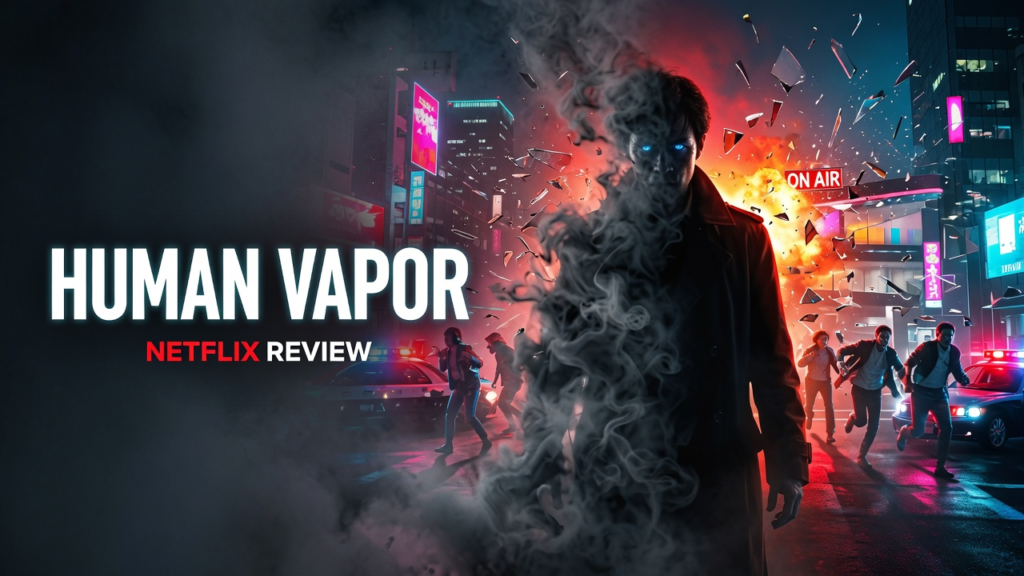
Human Vapor on Netflix: Inside Toho’s Gas-Man Reboot
A man walks into a live television interview, swells up like a balloon, and explodes in front of a stunned studio audience. That’s how Netflix’s new Japanese series announces itself, and if you’re wondering whether you missed something, you didn’t — this is genuinely how episode one opens. The show is called Human Vapor, and depending on which corner of the internet you frequent, you’ve either never heard of it or you’ve been waiting years for it to finally arrive.
I want to walk through what this series actually is, why it took nearly a decade of quiet groundwork to get made, and whether it lives up to the pedigree behind it, because the names attached to this project are not small ones.
What Exactly Is Human Vapor?
Human Vapor is a 2026 Japanese science fiction crime thriller series inspired by the classic 1960 tokusatsu film The Human Vapor. The original movie was directed by Ishirō Honda, the legendary filmmaker behind the first Godzilla, and written by Takeshi Kimura.
The 1960 film followed a librarian who becomes the victim of a scientific experiment that gives him the ability to transform into gas. He uses his new powers to rob banks and support his girlfriend’s dancing career while becoming one of Tokyo’s most wanted criminals.
Netflix’s new adaptation keeps the fascinating concept of a man who can turn into vapor and pass through walls, but it tells an entirely new story. The series is a Japanese–South Korean co-production written by Yeon Sang-ho and Ryu Yong-jae, directed by Shinzo Katayama, and produced by Toho Studios in collaboration with Wow Point. It also marks the first-ever partnership between Netflix and Toho.
Why the Toho Partnership Matters
For decades, Toho rarely allowed its classic franchises to be adapted for streaming platforms. That’s why its partnership with Netflix is such a significant milestone. It opens the door for modern adaptations of some of Japan’s most iconic science fiction properties.
The screenplay comes from Yeon Sang-ho, best known for Train to Busan, alongside his longtime collaborator Ryu Yong-jae. Their work is known for blending thrilling entertainment with deeper themes about society, corruption, and human nature, and Human Vapor follows that same approach.
The visual effects were created by Shirogumi, the award-winning studio behind Godzilla Minus One. Their experience with high-quality visual effects helps bring the vapor transformation to life while maintaining a realistic and cinematic feel throughout the series.
The Story: What Is Human Vapor About?
The story begins with a shocking incident during a live television broadcast when a man suddenly swells up and explodes in front of viewers. Authorities soon discover that the killings are linked to a mysterious figure who can transform his body into gas, allowing him to move through walls and escape without leaving evidence.
One of the victims is Professor Sano, an environmental energy expert. Before every attack, the mysterious killer announces his intentions, creating panic and leaving investigators unable to predict his next move.
Leading the investigation is suspended detective Kenji Okamoto, played by Shun Oguri, who is brought back to track down the seemingly unstoppable killer. At the same time, journalist Kyoko Kono investigates a decades-old government conspiracy connected to a secret research facility known as the White Center. As both investigations unfold, the series reveals dark secrets that completely reshape the story compared to the original 1960 film.
Meet the Cast
The series features an impressive lineup of Japanese actors, including:
- Shun Oguri as Detective Kenji Okamoto
- Yu Aoi as journalist Kyoko Kono
- Suzu Hirose as Kaho Fujikawa
- Kento Hayashi as Fujita Fujikawa
- UTA as the Human Vapor
- Yutaka Takenouchi in a major supporting role
One interesting detail is that Yu Aoi and Shun Oguri are appearing together in a live-action project for the first time since the 2005 television movie 24 Eyes. Another major talking point is the casting of UTA, who makes his acting debut as the mysterious Human Vapor. Despite being a newcomer, his performance has received praise from many early viewers.
Production: Behind the Scenes
Production on Human Vapor began in September 2024 at Toho Studios in Tokyo, with additional filming taking place across Shizuoka Prefecture before wrapping in April 2025.
Director Shinzo Katayama revealed that the production team received permission to film in locations that are usually unavailable to television productions, giving the series a unique visual style.
Instead of relying entirely on CGI, the filmmakers combined practical effects with modern visual effects to recreate the Human Vapor’s transformations. This approach pays tribute to the practical filmmaking techniques that made classic tokusatsu movies so memorable while delivering visuals that meet today’s streaming standards.
How It Compares to the 1960 Original
| Element | 1960 Film | 2026 Series |
|---|---|---|
| Format | Single feature film | Eight-episode series |
| Protagonist | A librarian turned bank robber | A detective and a reporter investigating a killer |
| Motive | Funding his girlfriend’s dancing career | Revenge tied to a covered-up government experiment |
| Villain’s goal | Financial gain through theft | Exposing and punishing those behind a secret program |
| Tone | Crime drama with tokusatsu elements | Conspiracy thriller with horror and sci-fi elements |
| Effects | Practical suits and in-camera tricks (Tsuburaya) | CGI plus practical effects (Shirogumi) |
The core transformation — a person turning into gas and back — is really the only throughline connecting the two versions. Everything around it, from the villain’s motivation to the surrounding cast of characters, has been rebuilt from scratch, which is exactly what the creative team set out to do.
Release Date and Where to Watch
Human Vapor premiered exclusively on Netflix on July 2, 2026. Instead of releasing weekly episodes, Netflix dropped all eight episodes worldwide on the same day, allowing viewers to binge-watch the entire series. Each episode has a runtime of approximately 54 minutes, making it a relatively easy series to finish over a weekend.
Before the series premiered, a companion novel written by Rokuro Inui was released by Kodansha on June 30, 2026. The novel helped build anticipation among fans and highlighted the importance of Netflix and Toho’s collaboration ahead of the show’s global debut.
Early Reactions: Is Human Vapor Worth Watching?
Early reviews for Human Vapor have been mostly positive. Viewers have praised its impressive visual effects, suspenseful atmosphere, and the performance of UTA, who makes his acting debut in the lead role. Many fans also appreciated the emotional moments throughout the story, particularly the relationship between the Human Vapor and one of the younger characters.
That said, the series hasn’t received universal praise. Some viewers felt the pacing is slower than expected, especially during the investigative scenes between the major action sequences. Others believed the White Center conspiracy storyline feels somewhat familiar, drawing comparisons to other sci-fi thrillers featuring secret government experiments.
Overall, Human Vapor has earned solid early ratings and is generally recommended for fans of slow-burn mysteries, science fiction, crime thrillers, and Japanese drama. If you enjoy suspenseful storytelling with strong visual effects and a darker tone, it’s definitely worth adding to your watchlist.
What Human Vapor Means for Netflix and Toho
Human Vapor represents more than just another Netflix original. It marks the first collaboration between Netflix and Toho, one of Japan’s most respected film studios. The success of this series could open the door for more modern adaptations of classic Toho properties, many of which have never been introduced to a global streaming audience.
Netflix has also shown strong confidence in the project, promoting it as one of its major international releases. If the series performs well with viewers, there’s a good chance this partnership will continue, bringing more classic Japanese science fiction stories to audiences around the world.
Frequently Asked Questions
What is Human Vapor on Netflix based on?
Human Vapor is based on the classic 1960 Japanese tokusatsu film The Human Vapor, directed by Ishirō Honda and written by Takeshi Kimura for Toho Studios.
When did Human Vapor release on Netflix?
The series premiered globally on July 2, 2026, with all eight episodes released on the same day.
How many episodes does Human Vapor have?
Human Vapor consists of 8 episodes, with each episode running for approximately 54 minutes.
Who plays the Human Vapor?
The title character is portrayed by UTA, a Japanese model making his acting debut.
Who are the lead actors in Human Vapor?
The main cast includes:
- Shun Oguri as Detective Kenji Okamoto
- Yu Aoi as reporter Kyoko Kono
- Suzu Hirose as Kaho Fujikawa
- Kento Hayashi as Fujita Fujikawa
- Yutaka Takenouchi in a key supporting role
Is Human Vapor connected to Godzilla?
Not directly. However, the series has strong behind-the-scenes connections. The original film was directed by Ishirō Honda, the creator of the original Godzilla, while the visual effects were created by Shirogumi, the Oscar-winning studio behind Godzilla Minus One.
Is Human Vapor a remake or a new story?
Rather than being a scene-by-scene remake, Netflix presents Human Vapor as a fresh and original story inspired by the 1960 classic.
Who wrote the Human Vapor series?
The screenplay was written by Yeon Sang-ho and Ryu Yong-jae, with Shinzo Katayama serving as the director.
Is Human Vapor a Japanese or Korean production?
It is a Japanese–South Korean co-production created by Toho Studios and Wow Point.
Is there a Human Vapor novel?
Yes. A novelization written by Rokuro Inui was published by Kodansha on June 30, 2026, just before the Netflix series debuted.
What genre is Human Vapor?
The series combines science fiction, crime, thriller, horror, and drama, blending supernatural mystery with conspiracy-driven storytelling.
Is Human Vapor worth watching?
If you enjoy slow-burn sci-fi thrillers with impressive visual effects and a mysterious atmosphere, Human Vapor is worth checking out. Early viewers have praised its visuals, UTA’s performance, and suspenseful tone, though some felt the pacing is slower than expected.
Final Take
Human Vapor is one of those rare reboots where the pedigree behind the camera is arguably more interesting than the plot itself — a Godzilla-lineage premise, an Oscar-winning VFX team, a Train to Busan writer, and two actors who haven’t shared a screen in two decades, all funnelled into a story about a man who turns into gas. Whether the pacing issues some early viewers flagged will bother you probably depends on how much patience you have for slow-burn conspiracy plotting between the show’s bigger set pieces. But as a statement of intent — proof that Toho’s vault of classic tokusatsu IP can be modernized without losing what made it distinctive in the first place — it’s hard to imagine a stronger opening move than this