

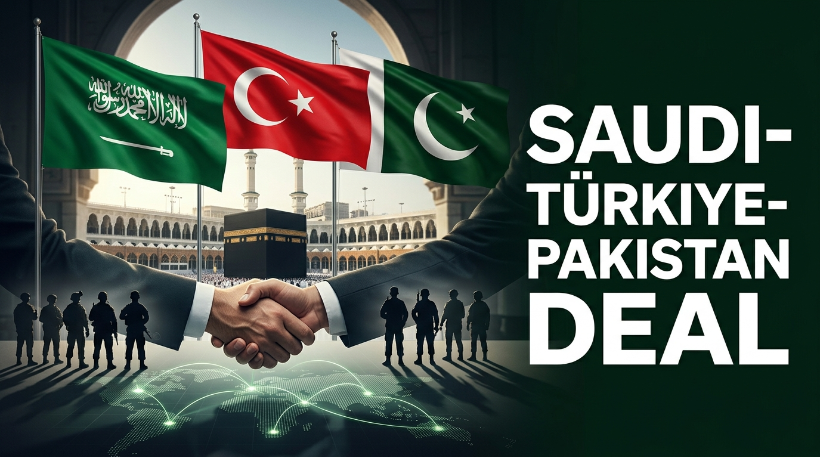
Saudi Arabia has described the newly signed Makkah Agreement with Türkiye and Pakistan as a long-term defence partnership designed to strengthen cooperation, collective security and regional stability. The agreement was signed in Makkah on August 7, 2026, by Saudi Crown Prince Mohammed bin Salman, Turkish President Recep Tayyip Erdoğan and Pakistani Prime Minister Shehbaz Sharif.
The announcement has attracted significant attention because it brings together three countries with different but complementary strategic capabilities. Saudi Arabia has major economic and regional influence, Türkiye has an increasingly sophisticated defence industry and military capabilities, while Pakistan has extensive military experience and longstanding security relationships with both countries.
Saudi King Salman bin Abdulaziz Al Saud said the Makkah agreement represents a long-term defence partnership that can help the three countries respond to regional challenges and contribute to security and stability.
What Is the Makkah Agreement?
The Makkah Agreement is a trilateral defence agreement involving Saudi Arabia, Türkiye and Pakistan. Its central principle is collective defence: an armed attack against one of the participating countries is to be treated as an attack against all three.
The agreement also aims to deepen defence cooperation, improve coordination and strengthen collective deterrence. The three governments have presented the arrangement as defensive in nature, emphasizing security, stability and cooperation rather than the creation of an offensive military bloc.
The agreement was signed during a trilateral summit in Makkah on August 7. The location itself carries considerable political and symbolic significance, particularly because Makkah is Saudi Arabia’s most important religious centre and one of the most significant places in the Muslim world.
For the three countries, however, the importance of the agreement extends beyond symbolism. It establishes a formal framework for cooperation that could shape their defence and strategic relationships for years to come.
Why Saudi Arabia Calls the Deal a Long-Term Partnership
King Salman’s description of the Makkah Agreement as a long-term defence partnership is important because it suggests that the arrangement is not intended to be a temporary response to one particular crisis.
Saudi Arabia has said the agreement should help address regional challenges while supporting security and stability.
A framework for deeper coordination
Saudi Arabia, Türkiye and Pakistan have maintained bilateral relations for decades. The new trilateral framework creates an additional mechanism through which those relationships can be coordinated.
That could involve more regular defence consultations, intelligence cooperation, military planning and joint training. It could also encourage the three countries to expand cooperation in defence technology and related industries.
In other words, the Makkah Agreement is significant not simply because of its collective-defence clause, but because it provides a broader platform for the countries to build institutional links.
Long-term cooperation rather than a short-term alliance
The wording used by Saudi leadership also matters. Describing the agreement as “long-term” indicates an ambition to develop sustained strategic cooperation rather than establish an arrangement that exists only while current regional tensions remain high.
That distinction could become increasingly important as the three countries determine how the agreement operates in practice.
What Each Country Brings to the Partnership
One of the most important aspects of the Makkah Agreement is the different strategic strengths of its members.
Saudi Arabia: Economic and regional influence
Saudi Arabia brings substantial economic resources, energy influence and a central position in Middle Eastern diplomacy.
The Kingdom has also been investing heavily in defence modernization as part of its broader national transformation agenda. Its ability to finance major defence projects and develop international partnerships gives it an important role in any long-term security framework.
For Riyadh, closer cooperation with Türkiye and Pakistan could provide additional strategic depth while supporting greater coordination with two major Muslim-majority countries.
Türkiye: Defence technology and military capabilities
Türkiye has developed a significant domestic defence industry, producing aircraft, drones, armoured vehicles, naval systems and other military technologies.
Its defence industry could become an important component of deeper trilateral cooperation. Greater collaboration could potentially create opportunities for joint development, procurement, training and technology partnerships.
Türkiye also occupies a strategically important geographical position connecting Europe, the Middle East and Asia, giving Ankara considerable diplomatic and military relevance.
Pakistan: Military experience and strategic relationships
Pakistan contributes decades of military experience and established defence relationships with both Saudi Arabia and Türkiye.
The country has historically maintained close security cooperation with Saudi Arabia and has also developed increasingly strong defence ties with Türkiye. The new agreement therefore builds on relationships that already exist rather than creating cooperation from scratch.
Pakistan’s participation could also strengthen the agreement’s credibility as a broader strategic partnership rather than a purely Gulf-focused arrangement.
Why the Agreement Matters for Regional Security
The Makkah Agreement comes at a time when security conditions across the wider Middle East remain volatile.
The three countries have said the pact is intended to strengthen collective security and promote stability.
A collective-defence commitment can influence regional calculations because potential adversaries must consider the possibility that military action against one member could trigger a coordinated response involving the other two.
That does not automatically mean that the three countries would deploy forces together in every crisis. The practical response to any future conflict would depend on political decisions, military circumstances and the specific terms under which the agreement is implemented.
Nevertheless, the commitment can have a deterrent effect simply by increasing the potential costs of attacking a member.
What Could Change in Defence Cooperation?
The agreement could eventually produce practical changes in several areas.
Joint military exercises
One possible area of expansion is joint training and military exercises.
Regular exercises could allow the three armed forces to improve communication, coordination and interoperability. These activities could cover areas such as air defence, maritime security, counterterrorism, logistics and emergency response.
Defence technology cooperation
Türkiye’s growing defence manufacturing sector could provide opportunities for expanded cooperation with Saudi Arabia and Pakistan.
Joint procurement or industrial partnerships could help the countries reduce duplication and strengthen their domestic defence capabilities. Saudi Arabia has also been seeking to develop its own defence-industrial base, making technology and manufacturing cooperation particularly relevant.
Intelligence and security coordination
Modern security threats are not limited to conventional military attacks. Terrorism, cyber threats, drone attacks, missile technology and other forms of asymmetric warfare can create challenges that require rapid information sharing.
A stronger trilateral security framework could make intelligence cooperation another important area of development.
The Economic Dimension Should Not Be Ignored
Although the Makkah Agreement is primarily a defence pact, closer strategic relations can also have economic consequences.
Defence partnerships frequently create opportunities for investment, manufacturing, technology transfer and long-term industrial cooperation.
Saudi Arabia already has significant economic ambitions involving Türkiye and Pakistan. In October 2025, Saudi Arabia and Pakistan agreed to launch an economic cooperation framework aimed at strengthening trade and investment ties.
Saudi-Türkiye economic cooperation has also expanded in areas such as real estate and investment. In November 2025, Saudi National Housing Company signed a development agreement with Türkiye’s Emlak Konut for a Makkah Gate project valued at more than SAR1 billion.
These developments demonstrate that relations between the three countries are not limited to military affairs. Defence cooperation can potentially reinforce wider diplomatic and commercial relationships.
How the Makkah Agreement Differs From a Traditional Military Alliance
It is easy to describe the Makkah Agreement simply as a NATO-style alliance, but such comparisons should be treated carefully.
The agreement contains a collective-defence principle, but its practical implementation will depend on how the three governments establish command structures, consultation mechanisms and military procedures.
The countries themselves have emphasized that the agreement is defensive and focused on security and stability rather than describing it as the creation of a broader military bloc.
Therefore, the real test of the Makkah Agreement will not be its announcement but how effectively the three countries translate the agreement into practical cooperation.
What Are the Main Challenges?
Despite its potential, the Makkah Agreement faces several challenges.
First, the three countries have different foreign-policy priorities. Saudi Arabia’s interests are heavily shaped by Gulf security and Middle Eastern diplomacy. Türkiye has strategic interests stretching across Europe, the Middle East, the Caucasus and Central Asia, while Pakistan’s security priorities are strongly influenced by South Asia.
Second, geographical distance could make military coordination more complicated. A common threat does not necessarily produce identical strategic responses from all three countries.
Third, the agreement’s credibility will ultimately depend on implementation. Regular exercises, institutional mechanisms, intelligence-sharing arrangements and clear decision-making procedures would be needed to turn political commitments into operational cooperation.
These challenges do not make the pact insignificant, but they show why its long-term impact should be judged by developments over the coming years rather than by the signing ceremony alone.
What the Makkah Agreement Means for Pakistan, Türkiye and Saudi Arabia
For Saudi Arabia, the agreement offers another layer of strategic cooperation and strengthens relationships with two influential Muslim-majority countries.
For Türkiye, it provides an opportunity to deepen defence and political ties with Riyadh and Islamabad while expanding its role in regional security.
For Pakistan, the agreement could strengthen its strategic relationships with two important partners and create additional opportunities for defence cooperation, technology and investment.
The three countries therefore have different reasons for supporting the agreement, but their interests overlap in the areas of security, defence cooperation and regional stability.
What Happens Next?
The most important developments to watch will be the practical steps taken after the signing.
Observers will likely pay attention to whether the countries establish permanent coordination mechanisms, expand joint military exercises, increase intelligence cooperation and announce new defence-industrial projects.
The development of these mechanisms will provide a clearer indication of whether the Makkah Agreement becomes a major long-term security framework or remains primarily a political declaration.
Regional reactions will also matter. Countries across the Middle East and South Asia are likely to assess how the new trilateral arrangement affects their own security calculations and diplomatic relationships.
Makkah Agreement and the Future of Regional Cooperation
The Makkah Agreement represents a significant development in relations between Saudi Arabia, Türkiye and Pakistan. Signed in Makkah on August 7, 2026, the pact establishes a collective-defence framework while seeking deeper cooperation and greater regional stability.
Saudi Arabia’s decision to describe the agreement as a long-term defence partnership highlights its intention to build cooperation that extends beyond the immediate security environment.
Its eventual impact will depend on implementation. If the three countries turn the agreement into regular military exercises, stronger intelligence coordination, defence-industry partnerships and sustained diplomatic consultation, it could become an important part of the region’s evolving security architecture.
For now, the Makkah Agreement signals that Saudi Arabia, Türkiye and Pakistan want to deepen their strategic relationship and develop greater collective capacity to respond to regional challenges. The coming years will show how far that ambition translates into concrete cooperation.