
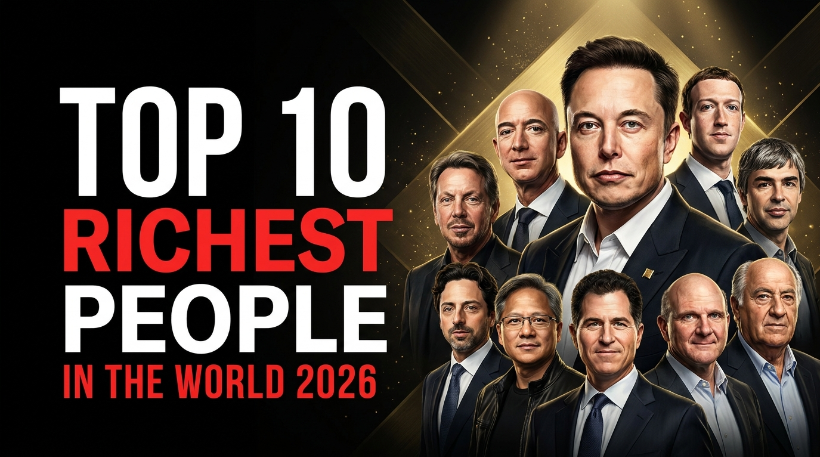
The world’s richest people have built extraordinary fortunes through technology, retail, investments, luxury goods, manufacturing, and other industries that influence billions of consumers. In 2026, the ranking of the top 10 richest people in the world continues to be dominated by entrepreneurs whose wealth is closely connected to the value of major global companies.
According to Forbes’ real-time billionaire rankings on August 12, 2026, Elon Musk remains far ahead of the rest of the field, while Larry Page, Jeff Bezos, Sergey Brin, and Michael Dell occupy the next positions. The ranking can change frequently because much of billionaire wealth comes from publicly traded shares whose prices move every day.
Here is a closer look at the 10 richest people in the world, their estimated fortunes, major businesses, and how they built their wealth.
Top 10 Richest People in the World in 2026
| Rank | Billionaire | Estimated Net Worth | Main Source of Wealth |
|---|---|---|---|
| 1 | Elon Musk | $883.2 billion | Tesla, SpaceX |
| 2 | Larry Page | $280.3 billion | |
| 3 | Jeff Bezos | $275.4 billion | Amazon |
| 4 | Sergey Brin | $258.6 billion | |
| 5 | Michael Dell | $253.9 billion | Dell Technologies |
| 6 | Mark Zuckerberg | $198.8 billion | Meta |
| 7 | Larry Ellison | $194.6 billion | Oracle |
| 8 | Jensen Huang | $193.5 billion | Nvidia |
| 9 | Steve Ballmer | $151.6 billion | Microsoft |
| 10 | Amancio Ortega | $147 billion | Zara |
Net worth figures are estimates and can change substantially with market movements. Figures above reflect Forbes’ real-time ranking checked on August 12, 2026.
1. Elon Musk — $883.2 Billion
Elon Musk is currently the richest person in the world by a significant margin. His estimated fortune of $883.2 billion is primarily connected to his ownership interests in Tesla and SpaceX. Forbes lists Tesla and SpaceX as his principal sources of wealth.
Musk has built businesses across electric vehicles, space technology, satellite communications, artificial intelligence, and other technology-related industries. Tesla helped make him one of the world’s most recognizable entrepreneurs, while SpaceX has become a major force in commercial spaceflight.
His position also demonstrates how quickly billionaire wealth can change. Forbes reported that Musk became the world’s first trillionaire in June 2026 before his fortune declined sharply as SpaceX’s valuation and related market conditions changed.
2. Larry Page — $280.3 Billion
Larry Page, co-founder of Google, ranks second among the world’s richest people in the latest Forbes real-time ranking.
Page co-founded Google with Sergey Brin while the company was still a young search-engine project. Google eventually developed into one of the world’s most influential technology companies, expanding far beyond search into advertising, cloud computing, smartphones, artificial intelligence, video, and other digital services.
Page’s enormous fortune largely comes from his long-term ownership of Alphabet, Google’s parent company. His story illustrates how building infrastructure used by billions of people can create extraordinary long-term wealth.
3. Jeff Bezos — $275.4 Billion
Jeff Bezos founded Amazon in 1994, initially operating the business as an online bookstore. Over the following decades, Amazon expanded into e-commerce, cloud computing, entertainment, logistics, advertising, and artificial intelligence.
With an estimated net worth of $275.4 billion, Bezos is currently the third-richest person in the world. Forbes reported that his fortune increased substantially during July 2026 as Amazon shares climbed, helping him move ahead of Google’s Sergey Brin.
Bezos’ success is a powerful example of the impact of long-term business expansion. Amazon did not remain focused on one product category; instead, it built an enormous ecosystem around online shopping and technology.
4. Sergey Brin — $258.6 Billion
Sergey Brin co-founded Google alongside Larry Page and remains one of the company’s largest individual beneficiaries.
His estimated fortune stands at approximately $258.6 billion in Forbes’ August 12 real-time ranking.
Google transformed how people find information online and created an advertising business capable of generating enormous revenues at global scale. Brin’s wealth, like Page’s, is largely tied to his ownership of the company that became Alphabet.
The two Google co-founders remain among the clearest examples of how technology entrepreneurship can produce generational levels of wealth.
5. Michael Dell — $253.9 Billion
Michael Dell ranks fifth on the current list of the world’s richest people, with an estimated fortune of $253.9 billion.
He founded Dell Technologies after recognizing the potential of selling personal computers directly to consumers. The company grew into a major global technology provider serving individuals, businesses, and large organizations.
Unlike several names near the top of the list whose fortunes come from internet platforms, Dell’s wealth is rooted in computer hardware, enterprise technology, infrastructure, and long-term investment.
His position in the 2026 ranking also highlights how fortunes outside the biggest consumer internet companies can become enormous when a business develops a strong global presence.
6. Mark Zuckerberg — $198.8 Billion
Mark Zuckerberg founded Facebook, which later became part of Meta, and is currently the sixth-richest person in the world.
Forbes estimates Zuckerberg’s fortune at $198.8 billion as of August 12, 2026.
Meta owns major social platforms and has invested heavily in artificial intelligence, virtual reality, augmented reality, and other emerging technologies. Zuckerberg’s wealth is primarily connected to his substantial ownership stake in Meta.
His rise is particularly notable because Facebook began as a social-networking project and eventually developed into one of the world’s largest technology companies.
7. Larry Ellison — $194.6 Billion
Larry Ellison is the co-founder of Oracle and one of the most influential figures in enterprise software.
With an estimated fortune of $194.6 billion, Ellison ranks seventh in the latest Forbes real-time billionaire list.
Oracle became a major provider of database technology, enterprise software, cloud infrastructure, and other business services. As companies around the world increasingly depend on digital infrastructure, enterprise technology has become an enormous industry.
Ellison’s fortune shows that businesses serving other businesses can create just as much wealth as consumer-focused technology companies.
8. Jensen Huang — $193.5 Billion
Jensen Huang, co-founder and CEO of Nvidia, has become one of the world’s richest people as demand for advanced computing and artificial intelligence infrastructure has surged.
Forbes currently estimates his wealth at approximately $193.5 billion.
Nvidia became particularly important to the modern AI boom because its processors are widely used for demanding artificial intelligence and high-performance computing workloads.
Huang’s rapid rise is one of the clearest examples of how a technological shift can dramatically change the fortunes of business leaders. AI has created huge demand for computing infrastructure, and Nvidia has been positioned at the center of that market.
9. Steve Ballmer — $151.6 Billion
Steve Ballmer, the former Microsoft CEO, ranks ninth with an estimated fortune of $151.6 billion.
Ballmer joined Microsoft during its early growth period and eventually became the company’s chief executive. His wealth is closely associated with his Microsoft holdings.
Microsoft’s expansion into software, cloud computing, enterprise services, gaming, and artificial intelligence helped make it one of the world’s most valuable technology companies.
Ballmer’s story also demonstrates that extraordinary wealth can come from a combination of executive leadership and long-term ownership of a highly successful company.
10. Amancio Ortega — $147 Billion
Amancio Ortega, founder of the fashion giant Zara, rounds out the top 10 richest people in the world.
Forbes estimates Ortega’s fortune at approximately $147 billion.
Ortega built his fortune through Inditex, the Spanish fashion group behind Zara and several other retail brands. His success is especially interesting because he achieved his position outside the technology sector that dominates much of the modern billionaire rankings.
Zara’s business model, rapid product cycles, international expansion, and ability to respond quickly to changing fashion trends helped turn Ortega into one of the wealthiest people in Europe.
What Do the World’s Richest People Have in Common?
Although their industries are different, the world’s richest people share several important characteristics.
They Own Valuable Businesses
The biggest common factor is ownership. Billionaire wealth is generally not sitting in a bank account as cash. Much of it comes from shares in companies.
When the value of those companies rises, the owner’s estimated net worth can rise by billions of dollars. Conversely, a falling share price can reduce a billionaire’s wealth rapidly.
Technology Continues to Dominate
Technology is particularly prominent among the world’s richest individuals. Google, Amazon, Meta, Oracle, Microsoft, Nvidia, Tesla, and SpaceX are all connected to people in the current top 10.
The 2026 rankings show how valuable software, artificial intelligence, computing infrastructure, digital advertising, e-commerce, and advanced engineering have become.
Long-Term Ownership Matters
Many of these fortunes were built over decades rather than overnight. Bezos built Amazon over more than 30 years. Page and Brin founded Google in the late 1990s. Zuckerberg launched Facebook in 2004.
Their stories demonstrate that maintaining ownership in a rapidly growing company can be more powerful than simply earning a high salary.
Why Do Billionaire Rankings Change So Often?
The top 10 richest people in the world is not a fixed list. Rankings can change from one day to another because billionaire wealth is heavily influenced by stock prices.
Forbes explains that its real-time platform updates public holdings regularly while markets are open.
For example, a billionaire holding a large percentage of a public company can gain or lose billions of dollars without buying or selling anything personally. The change simply reflects the changing market value of the assets they own.
This is why readers should always check the date attached to a billionaire ranking instead of assuming that an older list remains accurate.
How the 2026 Rich List Compares With Earlier Years
The composition of the world’s richest people has changed dramatically over the decades. In earlier billionaire rankings, fortunes were heavily associated with industries such as retail, manufacturing, finance, telecommunications, and traditional investments.
Today, technology companies occupy a much larger role. Forbes’ 2025 annual billionaire ranking counted 3,028 billionaires with a combined fortune of approximately $16.1 trillion, demonstrating the enormous scale of wealth accumulated by the global billionaire class.
The current ranking also shows that technology is not the only path to immense wealth. Ortega’s position demonstrates the continuing strength of global retail, while Dell represents the technology hardware and enterprise sector.
Final Thoughts on the Top 10 Richest People
The top 10 richest people in the world in 2026 represent a remarkable mix of entrepreneurs, technology pioneers, executives, and business founders. Elon Musk currently holds the number-one position by a huge margin, followed by Google’s Larry Page, Amazon founder Jeff Bezos, Google’s Sergey Brin, and Michael Dell.
What makes the list especially interesting is that these fortunes are not static. Stock prices, company valuations, business performance, and economic conditions can quickly change the rankings. The biggest lesson is that extreme wealth is often connected to ownership of scalable businesses rather than conventional employment income.
Whether you are interested in entrepreneurship, technology, investing, or global business, following the world’s richest people can provide useful insight into which industries are creating enormous economic value. For the most accurate rankings, always check the latest real-time data because the positions and net worth figures can change quickly.