

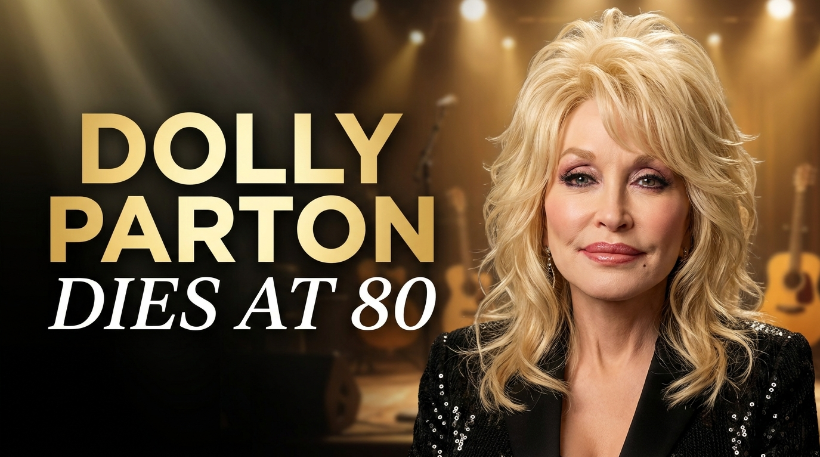
Dolly Parton, the beloved country music singer, songwriter, actress, entrepreneur, and philanthropist, has died at the age of 80. Her death was announced by her family on August 25, 2026, bringing an end to one of the most remarkable careers in American entertainment. Parton died peacefully in Nashville, Tennessee, according to her publicist. Her family has announced plans for a small, private service for immediate family members.
For more than five decades, Dolly Parton represented far more than country music. She became a cultural icon whose influence reached movies, television, business, children’s literacy, philanthropy, and generations of fans around the world. Her songs—including “Jolene,” “9 to 5,” “Coat of Many Colors,” and “I Will Always Love You”—became part of the American musical landscape.
Her passing has prompted an enormous wave of tributes from fellow musicians, actors, public figures, and fans who admired not only her talent but also her warmth, humor, generosity, and ability to remain authentically herself.
Dolly Parton Dies at 80: What We Know
Dolly Parton died Tuesday, August 25, 2026, in Nashville at age 80. Her family announced her death through a statement shared on her social media accounts, with her nephew Bryan Seaver speaking on behalf of the Parton and Owens families.
A cause of death was not initially disclosed by her publicist or family. Recent reports noted that Parton had experienced health challenges during the period leading up to her death, resulting in postponed appearances and changes to her professional plans.
The news came only days after Parton had spoken publicly about still wanting to accomplish more. Her death therefore came as a particularly emotional moment for fans who had continued to see her as an active creative force.
Who Was Dolly Parton?
Born in Tennessee in 1946, Dolly Rebecca Parton grew up in a large family with limited financial resources. She was one of 12 children and was raised in a deeply musical environment where church songs, Appalachian traditions, and storytelling influenced her early development.
Parton’s childhood circumstances later became an important part of her songwriting. Songs such as “Coat of Many Colors” drew directly from her upbringing and demonstrated her ability to transform personal experiences into stories that connected with millions of listeners.
She began performing while still a child and appeared at Nashville’s Grand Ole Opry at just 13 years old. After graduating from high school in 1964, she moved to Nashville to pursue music professionally.
That decision ultimately launched one of the longest and most influential careers in popular music.
Dolly Parton’s Rise to Country Music Stardom
Parton’s career gained momentum in the 1960s, particularly after she began appearing on The Porter Wagoner Show. Her partnership with country performer Porter Wagoner introduced her to a much larger audience and helped establish her as an important new voice in country music.
She eventually broke away from that partnership and built an enormously successful solo career.
Her songwriting became one of her greatest strengths. Parton had an extraordinary ability to tell emotionally powerful stories in simple, memorable language. Her songs could be deeply personal while still feeling universal.
By the 1970s, she had become one of country music’s biggest stars.
“Jolene” and “I Will Always Love You”
Two of Dolly Parton’s most famous songs demonstrate the range of her songwriting ability.
“Jolene” became one of her signature recordings, built around a desperate plea to another woman not to take away the singer’s relationship. Its emotional directness helped make it one of country music’s most recognizable songs.
“I Will Always Love You” was another landmark achievement. Parton originally wrote the song as a farewell connected to her professional relationship with Porter Wagoner. Her original recording became a country hit, but the song reached an entirely different level of worldwide recognition when Whitney Houston recorded it for The Bodyguard soundtrack in 1992.
The song’s continued popularity helped establish Parton not simply as a performer but as one of the most successful songwriters of her generation.
Dolly Parton’s Success Beyond Country Music
One reason Dolly Parton’s legacy is so significant is that she never remained confined to a single entertainment category.
She successfully crossed from country music into mainstream pop, Hollywood, television, theater, and business.
Her 1980 film 9 to 5, starring alongside Jane Fonda and Lily Tomlin, became a major cultural success. Parton also wrote and performed the movie’s famous theme song, earning an Academy Award nomination for Best Original Song.
She later appeared in films including The Best Little Whorehouse in Texas, Rhinestone, and Steel Magnolias. These roles helped introduce her personality and humor to audiences who may not have been regular country music listeners.
Her collaborations also demonstrated her versatility. Her work with Kenny Rogers produced the massive hit “Islands in the Stream,” while her collaboration with Emmylou Harris and Linda Ronstadt on Trio became a landmark project in country and roots music.
Dollywood Became Part of Her Lasting Legacy
Dolly Parton was also an accomplished businesswoman.
In 1986, she became involved with the Tennessee theme park that would eventually become Dollywood. Under her influence, the park expanded significantly and developed into one of the most recognizable attractions in the region.
Dollywood was particularly meaningful because it connected Parton’s international fame with her Appalachian roots.
Rather than distancing herself from where she came from, she turned her background into a central part of her brand. The result was a business empire that celebrated Tennessee culture while providing jobs, tourism, entertainment, and community investment.
Dolly Parton’s Philanthropic Legacy
For many people, Dolly Parton’s greatest achievement may not have been a Grammy, a hit song, or a movie role.
It was her philanthropy.
Through the Dollywood Foundation, Parton supported education and children’s literacy. Her most famous initiative, Dolly Parton’s Imagination Library, began in 1995 as a program providing books to children in her home region. It eventually expanded internationally and became one of the world’s most recognized children’s literacy programs.
The program was inspired partly by Parton’s father, who could not read or write. Her experience growing up in a poor family helped shape her belief that access to books could change a child’s future.
The scale of the program became enormous, with millions of books distributed to children each year across multiple countries.
Her COVID-19 Research Donation
Parton’s philanthropy also extended into medical research.
In 2020, she donated $1 million to Vanderbilt University Medical Center to support COVID-19 research. Her contribution became associated with research that helped support development of the Moderna vaccine.
The donation highlighted another side of Parton’s character: she was willing to use her wealth and influence to support causes beyond entertainment.
Dolly Parton’s Awards and Achievements
Across her career, Parton collected an extraordinary number of honors.
She won 11 Grammy Awards, including a Lifetime Achievement Award, and became a member of the Rock & Roll Hall of Fame. She also earned numerous country music honors and major recognition for her songwriting and recording career.
Her commercial achievements were equally impressive. Parton became one of the best-selling female country artists in history, with reported sales exceeding 100 million records. She also earned 25 U.S. country No. 1 singles during her career.
But statistics alone do not fully explain her impact.
Parton’s unusual ability to connect with different audiences allowed her to remain relevant across multiple generations. Her music could appeal to traditional country listeners, pop audiences, younger musicians, movie fans, and people who simply admired her personality.
Why Dolly Parton’s Legacy Will Continue
Dolly Parton’s influence is unlikely to disappear with her death.
Her songs will continue to be recorded by new artists. Her movies will remain part of American pop culture. Dollywood will continue operating. Her literacy programs will continue helping children. And her approach to combining entertainment with philanthropy will remain an example for future artists.
Perhaps most importantly, Parton demonstrated that success does not require abandoning your roots.
She transformed stories about poverty, family, heartbreak, ambition, faith, and perseverance into music that reached audiences around the world. At the same time, she maintained a distinctive public personality that was playful, glamorous, humorous, and unmistakably her own.
Her career also challenged the idea that artists must choose between commercial success and meaningful social impact. Parton managed to build an enormous entertainment business while directing substantial resources toward children, education, healthcare, and disaster relief.
Remembering Dolly Parton at 80
The news that Dolly Parton has died at 80 marks the end of an extraordinary chapter in American entertainment.
She was a songwriter who created timeless music, an actress who became a recognizable Hollywood presence, a businesswoman who built Dollywood into a major attraction, and a philanthropist whose work reached millions of children.
Yet her most enduring quality may have been her ability to make people feel connected.
Whether someone discovered her through “Jolene,” 9 to 5, I Will Always Love You, Dollywood, the Imagination Library, or one of her many television appearances, Dolly Parton created a connection that crossed generations.
Her death is a profound loss for country music and popular culture, but her work will continue to live through the songs she wrote, the performers she influenced, the children reached by her literacy programs, and the communities touched by her generosity.
Dolly Parton dies at 80, but the legacy she built over more than seven decades is far from over. Her music will continue to be played, her stories will continue to be told, and her example of turning personal success into opportunities for others will continue to inspire people around the world.