

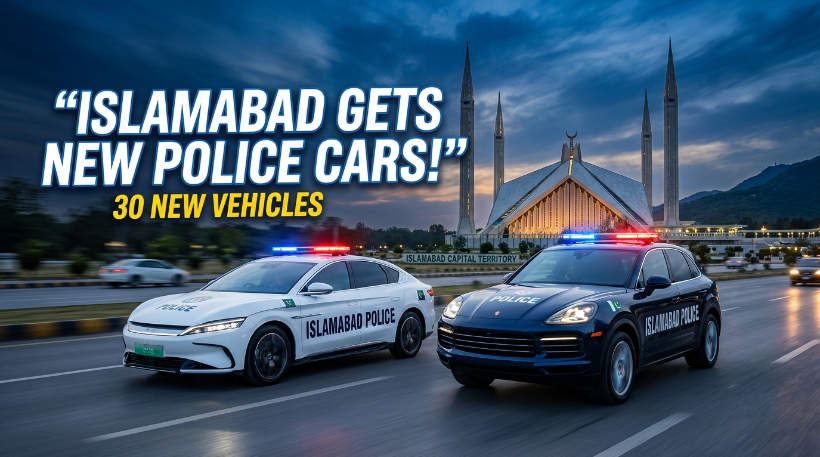
Islamabad is getting a major upgrade to its police fleet, with Islamabad new police cars becoming one of the latest signs of the capital’s push toward modern policing. In August 2026, 30 new vehicles were handed over to Islamabad Police for deployment across all 27 police stations, ending a reported 14-year gap in providing new station vehicles. The move is designed to improve police mobility, shorten emergency response times, and give officers more reliable transportation for daily operations.
The development is part of a broader transformation underway in the capital. Alongside conventional new vehicles, Islamabad Police and Islamabad Traffic Police have also been introducing electric vehicles, including BYD models, as authorities look to reduce fuel consumption and move toward cleaner transportation.
For residents, the important question is not simply what the new police cars look like. The real issue is whether these vehicles can help officers respond faster, patrol more effectively, and provide better security across Islamabad.
Islamabad Police Gets 30 New Cars After 14 Years
The most recent development came on August 15, 2026, when 30 new vehicles were handed over to Islamabad Police during a ceremony at Police Lines. The vehicles were distributed among the capital’s 27 police stations.
According to reports, Islamabad Police had been relying on vehicles that were around 14 years old. Aging vehicles can create obvious problems for a police force because patrol cars must operate for long hours, travel frequently, and remain available during emergencies.
Interior Minister Mohsin Naqvi said modern policing cannot be effectively carried out with outdated or non-functional vehicles. The government said the new vehicles are expected to improve police response time and help officers perform their duties more efficiently.
This is particularly important in a city like Islamabad, where police stations cover residential sectors, commercial areas, major highways, diplomatic zones, parks, and government districts.
Why New Police Cars Matter
A police vehicle is more than transportation. It is an operational tool.
When a station has a dependable vehicle available, officers can potentially reach an emergency more quickly, conduct routine patrols more consistently, and respond to complaints without depending on an unreliable vehicle.
For citizens, the benefits can include:
- Faster movement during emergencies
- More consistent police patrolling
- Better mobility for station officers
- Reduced downtime caused by vehicle maintenance
- Improved operational readiness
- Greater police presence in local communities
However, vehicles alone cannot transform policing. Their effectiveness depends on proper maintenance, trained personnel, fuel or charging infrastructure, dispatch systems, and efficient deployment.
Islamabad’s Shift Toward Electric Police Vehicles
The 30 newly provided vehicles are only one part of the larger fleet modernization taking place in Islamabad.
In 2026, Islamabad Police has increasingly turned toward electric police vehicles. In April, Islamabad Police became the first federal department in Pakistan to formally induct a New Energy Vehicle fleet, with BYD Atto 2 and BYD Sealion 7 electric vehicles introduced for traffic patrol and official mobility operations.
Islamabad Traffic Police also received 15 electric vehicles in April as part of the government’s push for cleaner and more efficient mobility. Officials said these vehicles were intended for deployment on major roads to support traffic management.
According to government information, the electric vehicles can travel approximately 350 to 400 kilometres on a full charge. Fast charging was reported to take around 60 to 90 minutes, while regular charging could require six to eight hours.
That range can make electric vehicles particularly useful for urban policing, although actual performance will depend on driving conditions, traffic, weather, vehicle load, and charging availability.
New Electric Cars Could Reduce Police Fuel Costs
One of the biggest potential advantages of electric police cars is operating cost.
Traditional police vehicles consume fuel while patrolling, idling, and responding to calls. Police vehicles can accumulate significant mileage because they are used much more heavily than ordinary private cars.
Electric vehicles can reduce dependence on petrol and may lower routine energy and maintenance expenses. Government estimates reported in April suggested that each electric vehicle could save roughly Rs. 0.5 million to Rs. 0.55 million per month compared with petrol-powered vehicles, with the initial cost potentially recovered within approximately 13 to 14 months.
These figures are official estimates rather than a guarantee of actual savings. Real-world costs will depend on electricity prices, charging arrangements, utilization, maintenance, and the specific vehicle.
Still, for a large government fleet, even modest savings per vehicle could become significant over time.
Capital Patrol Gets More Vehicles for Faster Response
Islamabad’s police modernization is also connected to the restructuring of its patrol operations.
In July 2026, the former Dolphin Squad was reorganized under the name Capital Patrol. Islamabad Police strengthened the unit with additional personnel and added 48 electric vehicles to its fleet. According to reporting, the Capital Patrol fleet reached 72 vehicles and 186 motorcycles after the expansion.
The restructuring is important because patrol vehicles are designed to put officers closer to potential incidents rather than keeping every response dependent on a police station.
A stronger patrol network can be particularly useful in areas with heavy traffic or large distances between police stations.
The official Islamabad Police website has also reported ongoing work connected with the Capital Patrol Unit, including the provision and maintenance of operational equipment.
What Makes the New Police Cars Different?
The biggest change is not necessarily a single feature or a particular car model. It is the direction of the overall fleet.
Traditional Patrol Vehicles
Conventional petrol-powered vehicles remain useful because they can generally be refuelled quickly and are familiar to police departments. They can also be easier to deploy in areas where charging infrastructure is limited.
Their main disadvantages include fuel costs, emissions, and potentially higher running expenses over long periods.
Electric Police Vehicles
Electric vehicles offer several advantages for city operations.
They produce no tailpipe emissions while driving, operate more quietly, and can reduce dependence on petrol. Their quiet operation may also make them less intrusive in residential areas.
The main challenge is charging. A police department cannot rely heavily on EVs without ensuring that charging stations are available where and when vehicles are needed.
Pickup and Utility Vehicles
Police operations sometimes require larger vehicles for supervisory duties, equipment transportation, or operations that demand additional cargo capacity.
The introduction of vehicles such as the RIDDARA RD6 into Islamabad Police operations in August 2026 is another example of the department exploring electric vehicles beyond conventional passenger cars. The vehicle was presented as an electric pickup suited to the demanding requirements of public-service operations.
How the New Cars Could Improve Islamabad’s Security
The most important measure of the new Islamabad police cars will be their effect on everyday policing.
Faster Emergency Response
A reliable vehicle can help officers reach an incident without delays caused by mechanical problems. Faster response can be especially important for accidents, theft reports, security incidents, and other emergencies.
Better Local Patrolling
Vehicles distributed among police stations can help officers conduct regular patrols in their assigned areas. Visible police presence can also improve public confidence.
More Reliable Operations
Old vehicles require more maintenance and can spend time off the road. Newer vehicles should generally provide better reliability when properly maintained.
Cleaner Urban Mobility
Electric patrol vehicles can contribute to lower local emissions and reduced fuel consumption, supporting Islamabad’s broader environmental objectives.
Are New Police Cars Enough to Modernize Islamabad Police?
Not by themselves.
Modern policing requires much more than a new fleet. Vehicles need to be combined with trained officers, effective communications, digital crime monitoring, surveillance infrastructure, emergency dispatch systems, and regular maintenance.
The government has also announced plans to recruit 9,000 additional personnel for Islamabad Police, while further expansion of the electric fleet has been discussed.
This suggests that the new police cars are part of a wider effort rather than an isolated purchase.
The challenge now is implementation. New vehicles need to remain operational years after their launch. That requires preventive maintenance, replacement parts, trained mechanics, charging infrastructure for EVs, and proper allocation of vehicles based on demand.
What Islamabad Residents Should Expect
For residents, the most noticeable change may simply be seeing newer police vehicles on the roads.
But the real impact should be measured through practical outcomes. Are police reaching emergency locations faster? Are patrols becoming more frequent? Are vehicles available when stations need them? Are electric vehicles being charged and maintained effectively?
These questions matter more than the appearance of the cars.
The recent addition of 30 vehicles to 27 police stations is significant because it addresses a basic operational need that had reportedly remained unresolved for years. At the same time, the growing electric fleet indicates that Islamabad Police is experimenting with a more modern approach to transportation.
The Future of Islamabad Police Vehicles
Islamabad appears to be moving toward a mixed fleet rather than replacing every conventional vehicle immediately.
Electric cars are likely to become increasingly useful for urban patrols and traffic operations, while conventional vehicles and larger utility vehicles may continue to serve roles where long-distance operation, rapid refuelling, or heavier workloads are important.
The next stage will likely focus on expanding charging infrastructure, improving fleet management, and ensuring that vehicles are assigned according to operational requirements.
If these improvements are properly managed, the Islamabad new police cars initiative could become more than a fleet replacement project. It could represent a broader shift toward faster, cleaner, technology-focused policing in Pakistan’s capital.
Final Thoughts on Islamabad New Police Cars
The arrival of 30 new police cars in Islamabad after a 14-year gap is an important development for the capital’s law-enforcement infrastructure. The vehicles are expected to improve mobility and response times across 27 police stations, while the growing use of electric vehicles shows that Islamabad Police is also looking toward cleaner and more modern transportation.
The combination of new station vehicles, electric patrol cars, Capital Patrol restructuring, and planned recruitment indicates a wider modernization effort.
Ultimately, the success of Islamabad’s new police vehicles will not be judged by their appearance or technology alone. Their true value will be measured by whether officers can respond faster, patrol more effectively, and provide better service to citizens.
For Islamabad residents, the arrival of these vehicles is therefore a promising step—but maintaining them, deploying them intelligently, and supporting them with modern policing systems will be the key to turning new cars into meaningful improvements in public safety.