
The artificial intelligence industry is entering a new phase, and Nvidia has just made a move that could reshape the competitive landscape.
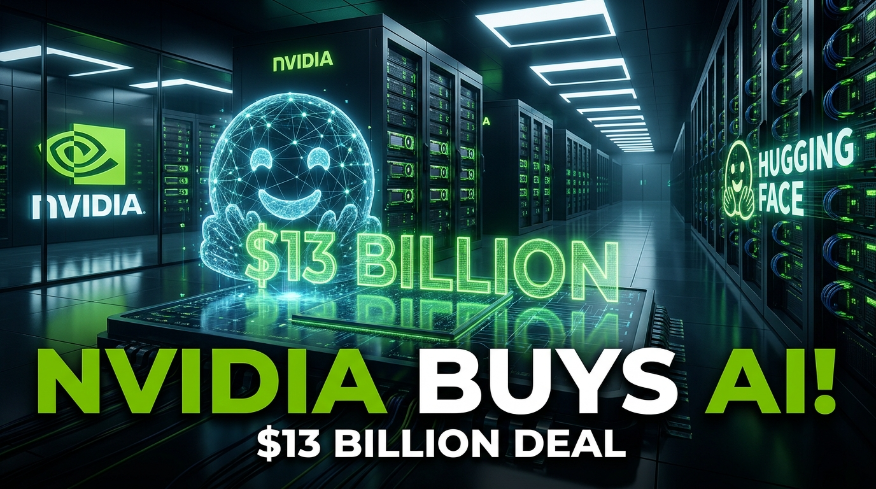
Nvidia is reportedly acquiring AI platform Hugging Face for approximately $13 billion, strengthening its position not only in AI hardware but also in the software and developer ecosystem that sits on top of it. The deal is one of the biggest signals yet that the AI competition is moving beyond chips and computing power toward complete AI infrastructure.
The development arrives during a period of enormous investment in artificial intelligence. Companies are competing to build larger models, faster AI systems and increasingly autonomous agents. But powerful models need more than GPUs. They also need software, developers, training tools, model libraries and infrastructure capable of turning research into products.
That is where Hugging Face becomes particularly important.
At the same time, the AI industry is undergoing a broader transformation. Nvidia’s move comes as investors increasingly view AI not only as a technology race but as a massive infrastructure opportunity. Recent market activity has also shown renewed optimism around companies successfully turning AI capabilities into commercial products.
Why Nvidia Wants Hugging Face
Nvidia has become one of the most important companies in the modern AI boom because its processors power a huge portion of AI computing infrastructure.
But chips are only one part of the equation.
Imagine building a powerful computer but having very little software to run on it. The hardware may be impressive, but its usefulness is limited.
AI works in a similar way.
Companies need models, frameworks, datasets, development tools and platforms that allow engineers to actually build applications.
Hugging Face has become one of the most recognizable names in that ecosystem.
Its platform is heavily associated with machine-learning models and tools used by developers and researchers. By acquiring Hugging Face, Nvidia would gain a stronger position closer to the people actually building AI applications.
That could be strategically important.
Rather than simply supplying the computing power behind AI, Nvidia would have a larger role in the software layer that helps developers use that computing power.
The AI Industry Is Becoming an Entire Stack
One of the easiest ways to understand the current AI race is to think about it as a stack.
At the bottom is computing hardware.
Above that is cloud infrastructure and data centers.
Then come AI frameworks and development tools.
Above those are foundation models.
Finally, there are applications used by businesses and consumers.
For years, Nvidia’s dominance was most obvious at the hardware level.
But the company’s Hugging Face move shows why the software layer is becoming equally important.
If Nvidia can connect its chips, infrastructure, software tools and AI models more tightly together, developers could potentially have a more integrated path from experimentation to deployment.
That could make Nvidia more difficult to compete with.
Why Hugging Face Matters to Developers
Hugging Face has become closely associated with the open AI and machine-learning community.
Its ecosystem allows developers and researchers to discover, share and work with AI models and related tools.
This matters because modern AI development is no longer restricted to a handful of giant technology companies.
Independent developers, universities, startups and smaller companies are increasingly experimenting with AI models.
An ecosystem that helps these groups access models and tools can accelerate innovation.
For Nvidia, that developer relationship is extremely valuable.
Hardware companies traditionally compete on specifications, performance and price.
AI changes the equation because software ecosystems can influence which hardware developers choose.
If developers become deeply integrated into a particular AI platform, switching infrastructure can become more difficult.
That creates a powerful competitive advantage.
Nvidia Is Moving Beyond Being a Chip Company
Nvidia’s growth during the AI boom has already changed how investors think about the company.
It is no longer viewed simply as a graphics processor manufacturer.
Its technology has become central to the infrastructure powering generative AI, large language models and advanced computing.
The Hugging Face acquisition would represent another step in that evolution.
The strategy is relatively straightforward: control more pieces of the AI ecosystem.
The more layers Nvidia can participate in, the less dependent its future becomes on selling individual chips.
This could also help Nvidia defend its position as competitors attempt to challenge its dominance.
Companies such as AMD, Google and other technology firms are developing competing AI hardware and infrastructure. Meanwhile, cloud providers are investing heavily in their own AI systems.
The competition is therefore becoming much broader.
The $13 Billion Price Tag Shows How Valuable AI Infrastructure Has Become
A $13 billion acquisition is significant even by the standards of the technology industry.
It sends a clear message about how valuable AI software infrastructure has become.
Only a few years ago, many investors primarily focused on AI model companies.
Today, the investment opportunity extends across almost every layer of the industry.
Data centers need enormous amounts of computing power.
AI models require specialized hardware.
Developers need software platforms.
Businesses need AI agents.
Consumers need AI applications.
All of these layers create opportunities for technology companies.
Nvidia’s reported acquisition of Hugging Face suggests that the company sees the developer ecosystem as strategically important enough to justify a massive investment. Recent reporting has described the transaction as strengthening Nvidia’s position in model development and developer engagement.
Could This Hurt the Open AI Ecosystem?
This is one of the most interesting questions surrounding the deal.
Hugging Face has strong associations with open-source AI and collaborative development.
Nvidia, meanwhile, is one of the world’s most commercially powerful AI infrastructure companies.
Putting the two together could produce enormous benefits.
Nvidia could provide Hugging Face developers with better access to computing infrastructure. Developers could potentially benefit from better optimized tools and models.
But there is also a legitimate concern about independence.
When an important developer ecosystem becomes part of a major hardware company, some people may wonder whether commercial priorities could eventually influence the direction of the platform.
The answer will depend heavily on how Nvidia operates Hugging Face after the acquisition.
If the platform remains broadly accessible and continues supporting a diverse AI ecosystem, the deal could accelerate innovation.
If the ecosystem becomes heavily tied to Nvidia’s commercial interests, competitors and developers may become more cautious.
AI Competition Is Becoming a Platform War
The biggest lesson from the deal may be that the AI race is no longer simply about having the smartest model.
It is becoming a platform war.
Think about the smartphone industry.
Companies did not compete only on hardware. They competed on operating systems, app stores, developer communities and services.
AI could follow a similar path.
The winning AI companies may eventually be those that control an ecosystem rather than a single product.
Nvidia has the hardware.
Hugging Face brings a massive developer and model ecosystem.
Cloud companies have infrastructure.
AI labs have foundation models.
Software companies have enterprise customers.
The competition will increasingly involve combining these pieces.
What This Means for Startups
For AI startups, the Nvidia-Hugging Face deal could have both positive and negative consequences.
On the positive side, stronger AI infrastructure can make it easier to build applications.
Better models, better hardware and better development tools can reduce the amount of technical work required to launch an AI product.
A small startup could potentially use existing models and infrastructure rather than building everything from scratch.
But the downside is increased competition.
If large companies control more of the AI stack, startups may find themselves competing against platforms that already have enormous computing resources, developer communities and distribution networks.
This means startups will need to focus heavily on differentiation.
Simply creating another general-purpose AI chatbot may not be enough.
Successful companies may instead specialize in specific industries, workflows or customer problems.
The Next AI Winners May Not Be the Companies You Expect
The AI market is changing so quickly that today’s obvious leaders may not necessarily dominate every layer of tomorrow’s ecosystem.
Hardware companies are moving into software.
Software companies are building AI models.
Cloud providers are creating custom chips.
AI labs are developing agents.
Traditional businesses are integrating AI into products that previously had nothing to do with artificial intelligence.
The boundaries are disappearing.
Nvidia’s reported Hugging Face acquisition is a perfect example.
A company famous for graphics processors is now making an enormous bet on a platform used by AI developers.
That tells us something important about where the industry is heading.
The most valuable companies may be those that connect multiple parts of the AI ecosystem together.
What Happens Next?
The biggest question is how Nvidia will integrate Hugging Face into its broader AI strategy.
If Nvidia successfully combines its hardware expertise with Hugging Face’s developer ecosystem, the company could create a powerful platform for AI development.
Developers could potentially gain easier access to models, optimized computing resources and tools for deploying AI applications.
For Nvidia, the benefits could go even further.
A stronger relationship with developers could help reinforce demand for Nvidia’s hardware.
The company would no longer simply sell the machines that power AI.
It could become part of the environment where AI itself is built.
That is a much bigger position.
The Bigger Picture
The Nvidia-Hugging Face deal represents something larger than one acquisition.
It shows how quickly artificial intelligence is becoming an entire technology industry rather than a single product category.
AI requires chips.
It requires data centers.
It requires software.
It requires models.
It requires developers.
It requires applications.
And increasingly, it requires autonomous agents capable of performing complex tasks.
Companies that control several of these layers may have an enormous advantage.
That is why Nvidia’s reported $13 billion move is attracting so much attention.
The real story is not simply that Nvidia is buying an AI platform.
The real story is that the AI industry is entering a stage where infrastructure, software and developer ecosystems are becoming just as important as the models themselves.
The next few years could determine which companies become the Microsofts, Apples and Googles of the AI era.
And Nvidia appears determined to make sure it is one of them.