

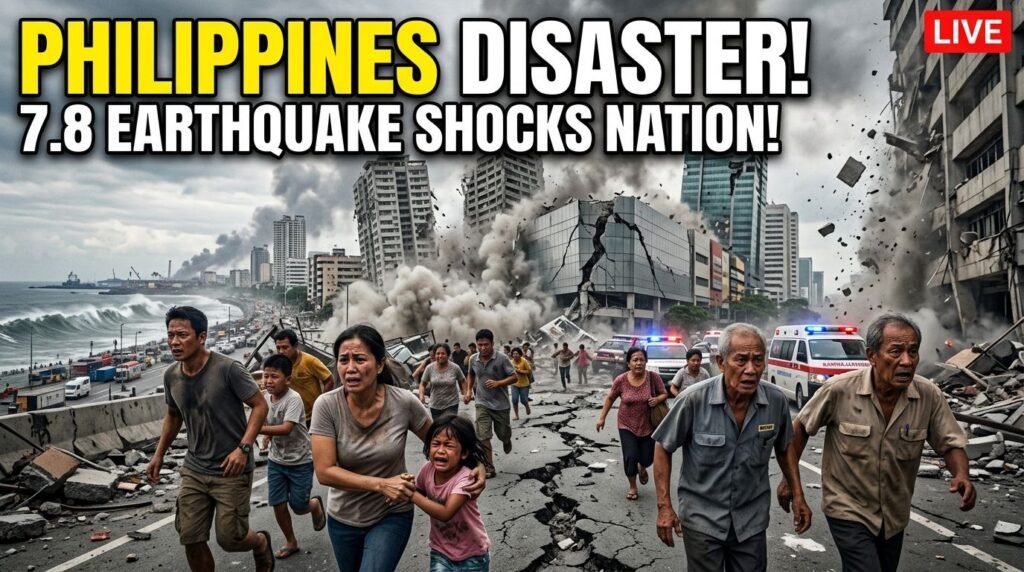
Philippines Rocked by a Devastating 7.8 Earthquake: The Shocking Disaster That Left Thousands in Fear
The Philippines has once again found itself at the center of a devastating natural disaster after a powerful 7.8-magnitude earthquake struck the southern region of the country. The massive quake triggered widespread panic, damaged infrastructure, caused multiple fatalities, injured hundreds of residents, and prompted tsunami warnings across parts of Southeast Asia.
As rescue teams continue searching through damaged structures and authorities assess the full scale of destruction, the earthquake has become one of the most significant seismic events to hit the Philippines in recent years. The disaster serves as a stark reminder of the country’s vulnerability due to its location along the Pacific Ring of Fire, one of the most active seismic zones on Earth. (The Guardian)
What Happened?
The powerful earthquake struck near the southern Philippine island of Mindanao during the morning hours, sending violent tremors across multiple provinces. Residents reported intense shaking that lasted for several seconds, forcing people to rush out of homes, offices, schools, and shopping centers. The epicenter was located near General Santos City, one of the largest urban centers in the southern Philippines. (The Guardian)
According to emergency officials, the earthquake was strong enough to be felt hundreds of kilometers away, including parts of neighboring Indonesia. Tsunami warnings were immediately issued following the quake, creating additional fear among coastal communities. Although most warnings were later lifted, authorities urged residents to remain cautious as aftershocks continued throughout the day. (The Guardian)
Earthquake At A Glance
Magnitude: 7.8
Affected Region: Mindanao, Southern Philippines
Epicenter: Near General Santos City
Reported Deaths: More than 30 people
Reported Injuries: Over 200 people
Tsunami Warning: Issued and later lifted in most areas
Aftershocks: More than 130 recorded aftershocks
Major Impact: Building collapses, landslides, infrastructure damage, power outages, and school closures. (The Guardian)
Death Toll and Human Impact
The human cost of the earthquake has been heartbreaking. Initial reports confirmed multiple fatalities, but as rescue teams gained access to affected areas, the death toll continued to rise. Hundreds of people suffered injuries ranging from minor cuts to severe trauma caused by collapsing buildings, falling debris, and landslides. (The Guardian)
Many families were forced to spend the night outdoors, afraid that damaged homes could collapse during aftershocks. Emergency shelters quickly filled with displaced residents seeking safety, food, water, and medical assistance. Schools and public buildings were converted into temporary evacuation centers to accommodate affected communities. (The Guardian)
Buildings Collapse Across Mindanao
One of the most alarming consequences of the earthquake was the collapse of several buildings across the affected region. Commercial establishments, residential structures, and public facilities sustained serious damage.
A well-known fast-food restaurant building partially collapsed, while several educational institutions reported structural damage. Roads cracked, power lines were disrupted, and communication networks experienced temporary outages, making rescue efforts more challenging. (The Guardian)
Engineers have been deployed to inspect damaged structures and determine which buildings remain safe for occupancy. Authorities have warned residents not to return to heavily damaged properties until safety inspections are completed. (Phys.org)
Tsunami Threat Creates Additional Panic
As if the earthquake itself was not enough, tsunami warnings triggered another wave of concern throughout the region. Disaster management agencies warned that waves could impact vulnerable coastal areas shortly after the quake.
Residents living near shorelines were instructed to evacuate immediately and move to higher ground. While tsunami activity ultimately remained less severe than initially feared, the warnings demonstrated how quickly secondary disasters can follow major seismic events. (The Guardian)
Smaller tsunami waves were recorded in neighboring regions, including parts of Indonesia and areas farther across the Pacific. (Phys.org)
Schools and Children Among the Most Affected
The earthquake struck as schools were reopening in several parts of the country. Reports and videos from affected regions showed terrified students running for safety as buildings shook violently.
Teachers and school staff immediately implemented emergency procedures, helping children evacuate classrooms and gather in designated safe zones. Many schools suspended classes as authorities assessed structural damage and ensured student safety. (New York Post)
The emotional impact on children is expected to last long after the physical damage has been repaired, with counselors and support services being deployed to help affected students cope with trauma. (The Guardian)
INFOGRAPHICS SECTION


Why the Philippines Experiences So Many Earthquakes
The Philippines is located along the Pacific Ring of Fire, a massive belt of tectonic activity that surrounds much of the Pacific Ocean. This region experiences frequent earthquakes, volcanic eruptions, and seismic events because several tectonic plates interact beneath the Earth’s surface.
As these plates shift and collide, enormous amounts of energy are released, producing earthquakes of varying intensity. While smaller tremors occur regularly, powerful events like the recent 7.8-magnitude quake can have catastrophic consequences. (The Guardian)
Rescue and Recovery Operations Underway
Emergency responders, military personnel, medical teams, and volunteers have been deployed across affected areas to assist survivors. Rescue crews continue searching damaged structures for trapped individuals while healthcare workers provide treatment to the injured.
Government officials have pledged support for rebuilding efforts and have mobilized resources to provide food, shelter, clean water, and medical care to affected communities. Recovery is expected to take weeks and possibly months in the hardest-hit regions. (The Guardian)
The Road Ahead
While the immediate danger from the earthquake has passed, significant challenges remain. Thousands of residents face uncertainty as aftershocks continue, damaged infrastructure requires repair, and communities begin the long process of rebuilding.
The disaster highlights the importance of earthquake preparedness, resilient infrastructure, and rapid emergency response systems in regions vulnerable to seismic activity. As the Philippines mourns the lives lost and supports those affected, the world watches closely as recovery efforts continue.
The 7.8-magnitude Mindanao earthquake will likely be remembered as one of the most significant natural disasters of 2026, leaving a lasting impact on communities throughout the southern Philippines. (The Guardian)