
The Biggest AI & Tech News Right Now: The Rise of AI Agents Is Changing Everything
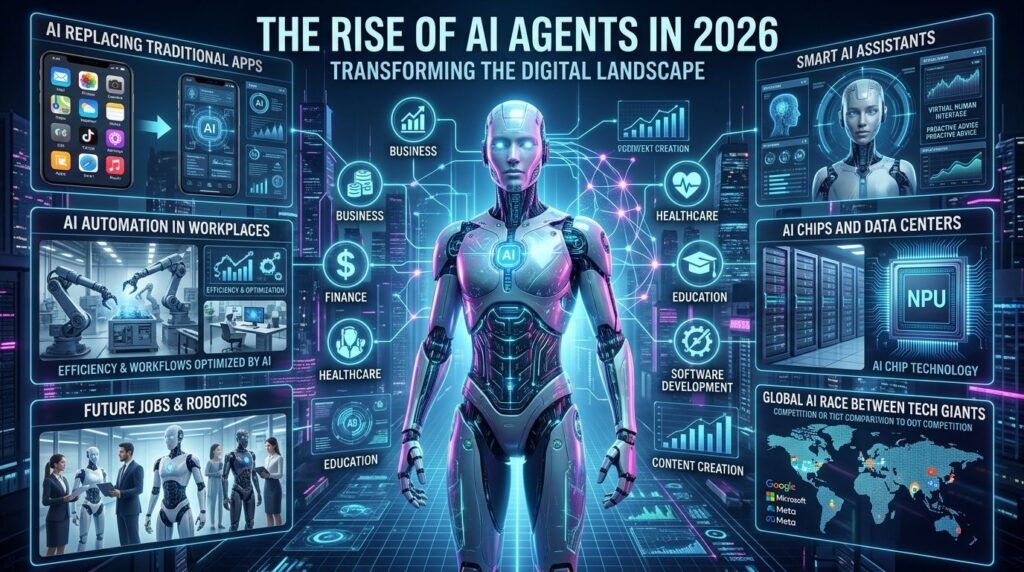
Artificial Intelligence is no longer just a chatbot that answers questions or writes emails. In 2026, AI has entered a completely new phase — the era of AI agents. Tech giants like OpenAI, Google, Anthropic, and Meta are now competing to build systems that can think, plan, automate tasks, and even work like digital employees.
This is currently the biggest story in the technology world because experts believe AI agents could transform business, education, jobs, healthcare, software development, and even governments faster than any previous technology revolution.
According to multiple industry reports and announcements released in recent weeks, the global AI race has officially shifted from “chatbots” to “autonomous AI systems.”
What Are AI Agents?
AI agents are advanced AI systems that do more than simply respond to prompts. Instead of waiting for instructions one-by-one, these systems can:
- Plan tasks independently
- Use tools and software
- Browse the internet
- Write and execute code
- Analyze data
- Automate workflows
- Make decisions with minimal human input
Think of them as digital workers instead of digital assistants.
For example, an AI agent could:
- Build a website
- Manage customer support
- Create marketing campaigns
- Handle scheduling
- Analyze financial reports
- Translate meetings live
- Research competitors automatically
This shift is so significant that many experts are calling 2026 “the year AI became infrastructure.”
Google and OpenAI Are Leading a Massive AI War
The competition between Google and OpenAI has intensified dramatically this year.
Google recently launched powerful new AI agent tools aimed directly at businesses and developers. These tools are designed to automate workflows, coding, customer service, and enterprise operations.
At the same time, OpenAI introduced new real-time voice and translation models capable of handling live multilingual conversations and agentic tasks.
Industry analysts believe the next phase of AI competition will not be about who has the smartest chatbot, but about who can create the most useful autonomous digital workforce.
This is why almost every major technology company is now investing billions into:
- AI infrastructure
- Custom AI chips
- Autonomous systems
- AI-powered productivity tools
- Smart assistants
- Robotics integration
Anthropic Is Quietly Becoming a Major AI Power
While OpenAI and Google receive most of the public attention, Anthropic has emerged as one of the strongest players in enterprise AI.
Its AI model, Claude, is rapidly being adopted inside corporations, banks, consulting firms, and financial institutions. According to recent reports, Anthropic expanded partnerships with major organizations to integrate AI deeply into corporate systems.
One reason for Anthropic’s rapid growth is its focus on:
- AI safety
- Reliable reasoning
- Enterprise-grade automation
- Long-context processing
- Coding assistance
Reports suggest many businesses are now prioritizing productivity-focused AI over consumer entertainment chatbots.
AI Is Starting to Replace Traditional Apps
One of the most shocking developments in tech right now is the growing belief that AI agents may eventually replace traditional apps and websites altogether.
Instead of opening separate apps for:
- Design
- Shopping
- Booking
- Research
- Writing
- Coding
Users may simply tell one AI agent what they want, and the AI will handle everything automatically.
For example:
“Book my flights, create my presentation, summarize today’s news, and email my team.”
The AI could complete all those tasks without the user manually opening different apps.
This idea is becoming increasingly popular among major tech companies.
AI Is Creating Fear About Jobs
As AI becomes more capable, concerns about job displacement are growing rapidly.
Executives from major financial and technology firms are openly discussing how AI agents could automate large parts of office work.
Jobs most likely to be affected include:
- Data entry
- Customer support
- Basic coding
- Administrative tasks
- Translation
- Content writing
- Research assistance
However, many experts also believe AI will create entirely new industries and careers.
New opportunities are already emerging in:
- AI automation
- Prompt engineering
- AI consulting
- AI video production
- AI marketing
- AI cybersecurity
- AI infrastructure management
This is why millions of people worldwide are now trying to learn AI-related skills.
Governments Are Becoming Worried About AI
Another major reason AI is dominating global headlines is because governments are becoming increasingly concerned about AI safety, misinformation, and cybersecurity.
According to recent reports, the United States and China are now discussing AI guardrails to prevent misuse of powerful AI systems.
Governments fear advanced AI could potentially:
- Generate cyberattacks
- Spread misinformation
- Manipulate elections
- Disrupt financial systems
- Create automated scams
- Be used in warfare
Because of this, regulators are pushing for:
- AI testing frameworks
- Transparency rules
- Safety evaluations
- Infrastructure monitoring
Many experts compare the current AI race to the early nuclear or internet era — a technology powerful enough to reshape the global balance of power.
AI Hardware Is Becoming the New Gold Rush
Another huge tech trend in 2026 is AI hardware.
Companies are spending massive amounts of money on:
- AI chips
- Data centers
- GPUs
- Cloud infrastructure
AI startup Cerebras recently launched one of the biggest IPOs of the year, showing how investors are aggressively betting on AI infrastructure.
Meanwhile, companies like:
- Nvidia
- Meta
- Microsoft
are all racing to build faster and more efficient AI systems.
The demand for AI computing power has become so intense that some analysts compare it to a modern-day oil boom.
Smart Glasses and AI Wearables Are Rising Fast
Another important development is the growth of AI-powered wearable devices.
Tech companies are now trying to move AI beyond phones and laptops into:
- Smart glasses
- Voice assistants
- Real-time translators
- AI cameras
- AR devices
Meta recently expanded its AI-enabled smart glasses lineup, while several companies are developing wearable AI assistants that could become the next major consumer technology category.
Some experts believe smartphones may eventually be replaced or heavily assisted by wearable AI systems.
Why This Matters for Ordinary People
Many people still think AI is mainly for tech companies or programmers, but that is no longer true.
AI is already impacting:
- Students
- Freelancers
- Businesses
- Designers
- Writers
- Developers
- Marketers
- Teachers
People who learn how to use AI effectively may gain major advantages in:
- Productivity
- Income generation
- Business automation
- Online work
- Content creation
At the same time, people who ignore AI entirely may struggle to compete in future digital economies.
This is why AI education has become one of the fastest-growing trends worldwide.
Final Thoughts
The biggest AI and tech story right now is not just a new chatbot or app — it is the transformation of AI into autonomous digital systems capable of performing real work.
The world is moving from:
- Search engines → AI assistants
- Apps → AI agents
- Manual workflows → automation
- Human-only productivity → AI collaboration
Whether this future becomes exciting, dangerous, or revolutionary depends on how governments, companies, and individuals adapt over the next few years.
One thing is clear: the AI race is accelerating faster than ever before, and 2026 may be remembered as the year everything changed.