

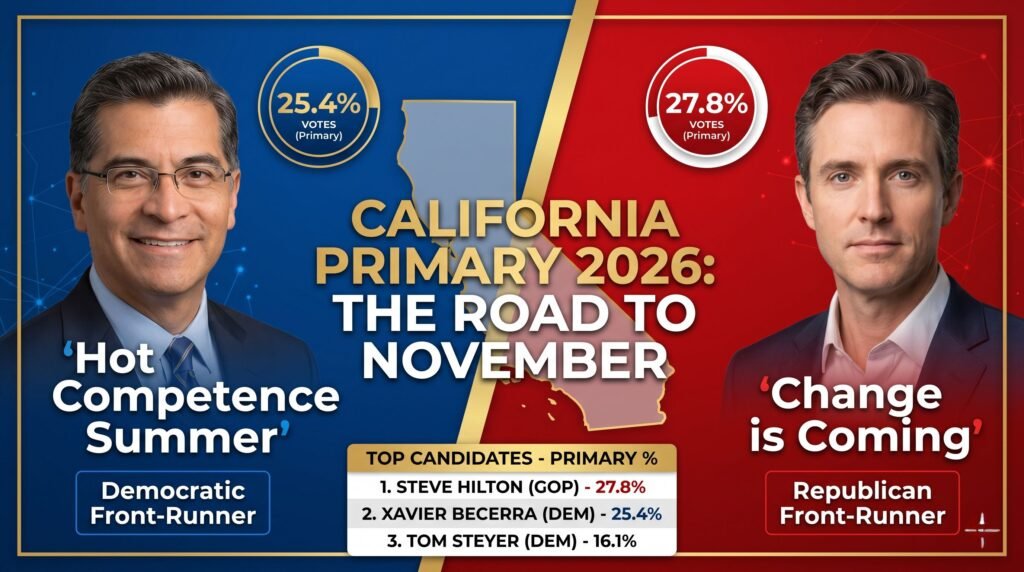
California Election Results 2026: Hilton and Becerra Lead Shocking Governor Race Primary
By Saad
California Election Results 2026: Live Primary Returns and Key Takeaways
The votes are rolling in for the highly anticipated 2026 California Primary Election, and the results are shaking up the political landscape of the nation’s most populous blue state. With the era of term-limited Governor Gavin Newsom officially drawing to a close, voters took to the polls to decide who will battle for the state’s highest office this November.
Thanks to California’s unique “jungle primary” system, where all candidates run on a single ballot regardless of party affiliation, the stakes couldn’t have been higher. Only the top two vote-getters advance to the general election. With the vote count crossing the 55%–60% mark, a fascinating, deadlocked battle has emerged between a Donald Trump-backed具 Republican outsider and a seasoned Democratic establishment favorite.
Live Return Standings: Who is Winning the California Governor Race?
As mail-in and drop-off ballots continue to slowly trickle in across the state, the top two spots have stabilized, though the race remains technically too close to officially call.
Here is how the front-runners stand in the live primary returns:
- Steve Hilton (GOP): 27.6% (1,421,466 votes)
- Xavier Becerra (Dem): 25.6% (1,318,536 votes)
- Tom Steyer (Dem): 19.8% (1,019,332 votes)
- Chad Bianco (GOP): 11.3% (580,389 votes)
High-Profile Democratic Contenders Concede Early
The initial results were decisive enough for several high-profile Democratic contenders to officially bow out of the race. Former U.S. Representative Katie Porter (4.6%), San Jose Mayor Matt Mahan (4.1%), and former Los Angeles Mayor Antonio Villaraigosa (1.3%) all formally conceded shortly after the polls closed on Tuesday night.
Candidate Profiles and Campaign Platforms
The 2026 race has evolved into a classic showdown between stability and systemic change. Each of the top three candidates represents a vastly different vision for California’s economic and social future.
1. Steve Hilton: The Populist GOP Disruptor
A British-born former political adviser to UK Prime Minister David Cameron and former Fox News host, Steve Hilton has ridden a wave of anti-incumbent sentiment. Propelled by an official endorsement from Donald Trump, Hilton successfully consolidated the conservative base away from Riverside County Sheriff Chad Bianco. His platform emphasizes a complete dismantling of institutional state policies to address the soaring cost of living.
2. Xavier Becerra: The Steady Establishment Hand
As the former federal Health Secretary under Joe Biden and former California Attorney General, Becerra represents deep governance experience. After polling low early in the spring, Becerra surged forward to become the Democratic establishment choice after Rep. Eric Swalwell exited the race. If he holds his spot and wins in November, Becerra would make history as California’s first Latino governor in more than a century.
3. Tom Steyer: The Billionaire “Class Traitor”
Billionaire environmental activist Tom Steyer ran a heavily self-funded progressive campaign, injecting a staggering $213 million of his own money into the race. Labeling himself a populist “class traitor,” Steyer focused on taking down corporate monopolies, expanding climate initiatives, and raising taxes on corporations and the ultra-wealthy.
Comprehensive Race Breakdown Matrix
| Candidate | Party Affiliation | Main Campaign Angle | Key Strength / Endorsement |
| Steve Hilton | Republican | Drastic reset of state governance; tackling cost of living | Endorsed by Donald Trump; Fox News visibility |
| Xavier Becerra | Democrat | Steady, defensive hand against federal overreach | Former Biden Health Secretary & CA Attorney General |
| Tom Steyer | Democrat | Progressive populist tackling monied special interests | Massive $213M self-funded media blitz |
| Chad Bianco | Republican | Tough-on-crime, law-and-order conservative | Prominent Southern California law enforcement profile |
Crucial Takeaways for the General Election
Money Can’t Always Buy California Votes
Tom Steyer’s quarter-billion-dollar campaign is tracking toward a disappointing return on investment. Political strategists note that self-funded blitzes can sometimes spark a voter backlash when media markets become over-saturated. The primary has proven that establishment ground games and media narratives still hold immense weight.
The Locked-Out Fear Has Faded for Democrats
Early in the 2026 cycle, California Democrats panicked over vote-splitting. Because a massive pool of Democrats initially crowded the ticket, party leaders worried they would fracture the progressive vote enough to let two Republicans (Hilton and Bianco) sneak into the top two spots. Trump’s late endorsement of Hilton cleanly unified the GOP base behind one man, inadvertently clearing a path for a clean Democrat-vs-Republican showdown in November.
A Long Counting Process Ahead
Veteran state election observers remind voters that it may take days or weeks to get the final official score. Because mail-in ballots postmarked by Election Day are valid, late-arriving drop-offs from deeply blue urban centers traditionally trend Democratic, meaning Becerra and Steyer’s percentages may grow as the remaining 40% of votes are processed.
Frequently Asked Questions (FAQs)
How does California’s jungle primary system work?
California uses a nonpartisan blanket primary system, often called a “jungle primary.” All candidates for a given office run on a single ballot, regardless of their party affiliation. The top two vote-getters advance to the general election in November, even if they belong to the same political party.
Who is running for Governor of California in 2026?
The leading candidates in the 2026 gubernatorial primary include Republican Steve Hilton, and Democrats Xavier Becerra and Tom Steyer. High-profile contenders like Katie Porter and Matt Mahan have conceded from the race.
Who endorsed Steve Hilton in the 2026 primary?
Steve Hilton consolidated the conservative voting base in California after receiving an official endorsement from former President Donald Trump.
Why does it take so long to count election votes in California?
California allows mail-in ballots postmarked by Election Day to be counted up to seven days after the election. Additionally, verifying signatures on millions of mail-in and drop-off ballots requires an extended, careful counting process.