

God of War Laufey: Release Window, Gameplay, Story, and Everything We Know About Santa Monica Studio’s Shocking New PS5 Spin-Off
By Saad
The gaming world has been set ablaze by an unexpected announcement. During PlayStation’s highly anticipated June 2026 State of Play livestream, Sony Interactive Entertainment and Santa Monica Studio pulled back the curtain on the next major chapter in one of gaming’s most legendary franchises.
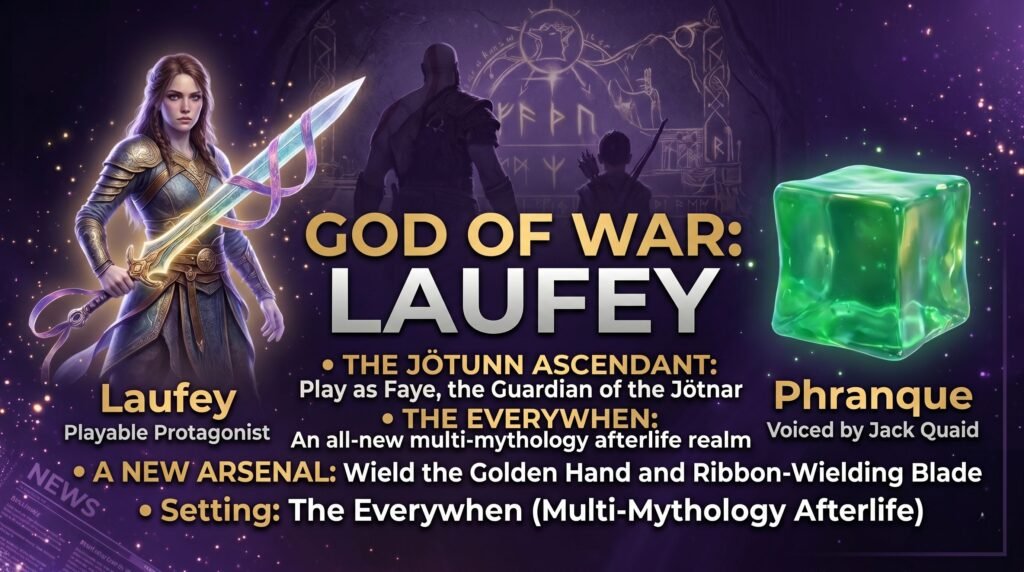
God of War Laufey, this upcoming action-adventure game marks a historic milestone for the IP: for the very first time in franchise history, Kratos will step aside as the primary playable protagonist. Instead, the spotlight shifts entirely to his late wife, the legendary Jötunn warrior Laufey the Just, better known to fans simply as Faye.
The reveal was anything but a standard cinematic teaser. Santa Monica Studio stunned audiences by closing the broadcast with an unbroken, 20-minute deep-dive gameplay showcase. It gave players a massive look at an all-new mythological realm, a radically reimagined combat engine, and a star-studded cast featuring major Hollywood talent.
This comprehensive, ultra-detailed guide breaks down everything revealed about God of War Laufey—from its speculative release date and narrative placement to its mind-bending combat mechanics, multi-mythology setting, and the unique behind-the-scenes production details.
The Big Reveal: Kratos Steps Aside for Faye
Since the original God of War debuted on the PlayStation 2 back in 2005, the franchise has been inextricably linked to Kratos. His journey of blood, vengeance, and eventual redemption across the Greek and Norse pantheons formed the spine of the entire series. However, God of War Ragnarök and its subsequent Valhalla DLC heavily hinted that Kratos’s arc as a roaming destroyer had come to a peaceful, contemplative resolution.
Enter God of War Laufey. Rather than pushing Kratos into another forced conflict, director Ariel Lawrence and the team at Santa Monica Studio are exploring the rich, untold history of the woman who shaped the entire Norse saga.
Faye’s death at the very beginning of God of War (2018) was the narrative catalyst that sent Kratos and Atreus on their journey to the highest peak in all the realms. While she appeared via flashbacks and dream sequences in Ragnarök, her true combat prowess, her political maneuvering against Odin, and her internal struggles were largely left to the player’s imagination or detailed via environmental lore.
God of War Laufey flips this dynamic entirely. Players will finally experience the sheer power, lethal agility, and complex emotional depth of the Guardian of the Jötnar firsthand.
The Plot: Awakening in “The Everywhen”
+-------------------------------------------------------------+
|                      THE TIMELINE GAP                       |
+-------------------------------------------------------------+
|                                                             |
|  [Faye's Funeral] ---> [Awakening] -------> [The Quest]      |
|  Cremated by Kratos    Wakes up in the     Escape the realm |
|  & Atreus (GOW 2018)   "Everywhen" afterlife  & return home |
|                                                             |
+-------------------------------------------------------------+
The game’s narrative premise is brilliant, filling a massive cosmic void within the series’ established lore. According to the official trailer and story descriptions shared by Sony, God of War Laufey begins precisely where her corporeal journey ended: at her funeral pyre at the start of God of War (2018).
Death is Just the Beginning
Faye’s body was burned by Kratos and Atreus, her ashes destined to be scattered across Jötunheim. However, death was not the end. Faye awakens confused, still wearing the charred, ash-stained remnants of her funeral garments, in a completely alien and ethereal landscape. This realm is officially known as The Everywhen.
What is The Everywhen?
The Everywhen is described as the ultimate afterlife exclusively reserved for deities and divine entities. When mortals in the God of War universe die, they head to standard afterlives like Helheim, Valhalla, or the Elysian Fields. But when a god or a powerful giant perishes, their soul is cast into the Everywhen.
Santa Monica Studio expands on this concept with a fascinating piece of lore:
“Odin was haunted by the prophecy of his demise during the events of Ragnarök, obsessively pursuing knowledge of something beyond the afterlives of mortals. In God of War Laufey, we explore the answer to that question: What happens to the gods when they die?”
A Multi-Mythology Power Struggle
Rather than being a peaceful resting place, the Everywhen is a sprawling, dangerous battleground where ruthless, fallen gods from various historical and geographical mythologies aggressively vie for power, territory, and control over ancient, volatile magic.
Faye’s central objective is intensely personal. She refuses to accept her separation from her family. Driven by an unyielding desire to protect Kratos and Atreus from the looming threats of the Norse realms, she sets out on a perilous quest to navigate the politics of dead gods, uncover the mysteries of the divine afterlife, and find a cosmic gateway to escape the Everywhen and return to her family.
Meet the Cast: A Brilliant Behind-the-Scenes Lineup
Santa Monica Studio has assembled a stellar cast to bring this new realm to life, blending returning voice actors with high-profile Hollywood stars who underwent extensive motion-capture work.
- Deborah Ann Woll as Laufey (Faye): Reprising her beautifully nuanced performance from God of War Ragnarök, the Daredevil and True Blood alumnus returns to voice and fully portray Faye. Woll brings a perfect balance of fierce warrior intensity and deep, maternal vulnerability to the role.
- Jack Quaid as Phranque: In the most surprising casting choice of the reveal, The Boys and Star Trek: Lower Decks star Jack Quaid plays an completely unique companion named Phranque. Far from a standard humanoid companion, Phranque is a floating, gelatinous, cosmic green cube.
- Perlina Lau as Rue: Joining the main traveling party is Perlina Lau, who voices and performs as Rue. Rue is not a physical being but a set of enchanted, sentient divine ribbons that wrap around Faye’s primary weapon, giving it unique tactical properties.
The Motion Capture for Phranque
One of the most entertaining aspects of the behind-the-scenes showcase was seeing how Jack Quaid brought a floating geometric cube to life. Behind-the-scenes footage revealed Quaid working in a state-of-the-art motion-capture warehouse wearing a specialized, rigid, square-shaped outer frame strapped around his midsection.
This “sandwich-board” style setup was designed to ensure that whenever Quaid interacted with Deborah Ann Woll on set, he physically occupied the exact dimensional space that the digital cube would take up in the final engine. This prevented any clipping bugs and allowed the digital animators to maintain perfect physical spacing during intense action blocks.
Gameplay Mechanics: Fluidity Over Brute Strength
The 20-minute uninterrupted gameplay demonstration showcased a radical and incredibly refreshing departure from the combat loop of the Norse duology. While Kratos’s combat was defined by heavy footwork, crushing shield blocks, and brutal, ground-shaking axe cleaves, Faye’s combat style is built completely around lethal agility, vertical mobility, and high-speed momentum.
+-------------------------------------------------------------------+
|                  KRATOS VS. FAYE COMBAT DYNAMICS                  |
+-------------------------------------------------------------------+
|  KRATOS (Norse Saga)              |  FAYE (God of War Laufey)      |
|  ------------------               |  ------------------------     |
|  * Grounded, deliberate pacing    |  * High-speed aerial freedom  |
|  * Heavy shield parries & blocks  |  * Double jumps & air dashes  |
|  * Crushing brute force strength  |  * High-tempo combo juggling   |
|  * Axe throws & physical tethers  |  * Soul manipulation mechanics|
+-------------------------------------------------------------------+
1. Aerial Combat and Freedom of Movement
Faye is incredibly nimble, easily moving across the battlefield in ways Kratos never could. The gameplay revealed that Faye possesses a natural double jump and a rapid air-dash mechanic, allowing her to easily transition from ground-based skirmishes directly into spectacular, extended aerial combos reminiscent of high-octane character action titles like Devil May Cry. She can launch enemies skyward, kick them across the arena mid-air, unleash a dizzying flurry of rapid-fire strikes, and slam them down to cause massive area-of-effect shockwaves.
According to the development team, this directional shift was completely intentional, describing the engine as a hybrid system that marries “the movement and fluidity of the classic Greek era games with the modern Norse era’s approach to deep world-building and close-up character camera work.”
2. The Golden Hand & Soul Manipulation
In addition to her traditional arms, Faye utilizes her glowing Golden Hand for both offensive pressure and defensive crowd control. The Golden Hand allows her to interact directly with the spiritual essence of her opponents.
During the gameplay demo, players saw Faye literally punch the soul clean out of a demon’s physical body. Once separated, she can attack the vulnerable soul directly to deal massive multiplier damage or telekinetically grab the soul and hurl it like a projectile into incoming groups of enemies to stagger them.
3. Weaponry: The Ribbon-Wielding Sword
Faye’s primary weapon in the Everywhen is a legendary, mysterious sword that she discovers embedded directly inside the gelatinous body of Phranque. Wrapped tightly around the blade is Rue, the sentient, magical ribbons.
This weapon combination functions dynamically:
- Standard Bladed Stance: Offers ultra-fast, precise slashing attacks that carve through armor.
- Whip/Tether Stance: Fueled by Rue’s divine ribbons, the sword can unravel on the fly, transforming into a sweeping whip weapon. This allows Faye to execute mid-range sweeping attacks, pull distant enemies close, or swing across environments using environmental grappling points.
Expanding the Lore: Crossing Into Other Mythologies
One of the most monumental revelations within the God of War Laufey gameplay showcase is that the series is finally breaking down its strict regional mythological barriers. For years, fans have wondered how and when Santa Monica Studio would introduce other pantheons, such as Egyptian, Japanese, or Celtic mythologies, which were teased via tablets in Odin’s hidden chambers.
Because the Everywhen serves as a universal dumping ground for dead deities from all corners of the cosmos, Faye will find herself locked in mortal combat with gods from completely different cultural pantheons.
The gameplay showcase explicitly revealed two major boss encounters that Faye faces early on in her journey:
1. Sekhmet (Egyptian Mythology)
Faye is seen navigating a beautifully shifting, sand-swept temple environment before being aggressively confronted by Sekhmet, the fierce Egyptian goddess of healing, hunting, and war. Depicted with her iconic, terrifying lioness head, Sekhmet utilizes devastating fire-based magic and solar solar beams, forcing Faye to make full use of her rapid aerial dodging maneuvers to survive.
2. Begtse (Buddhist/Mongolian Mythology)
In a completely unexpected and brilliant creative choice, the game introduces Begtse, a prominent dharmapala (protector god) from Tibetan and Mongolian Buddhist lore. In the gameplay reveal, Begtse is a massive, multi-armed, coral-red war deity wielding a massive scimitar and surrounded by an aura of protective cosmic energy.
This incredible inclusion confirms that God of War Laufey is going to be a massive, cross-cultural mythological melting pot, opening up endless narrative avenues for the future of the PlayStation franchise.
Speculative Release Date and Platform Exclusivity
The Targeted Launch Window
During the June 2026 State of Play presentation, Sony and Santa Monica Studio stopped short of giving a definitive, day-and-date release schedule, choosing instead to state that the game is “currently in active development and coming soon to PlayStation 5.”
However, major industry analysts and gaming journalists have carefully parsed the presentation to formulate a highly realistic release timeline. Given that Santa Monica Studio was fully confident enough to show off 20 solid, uninterrupted minutes of pristine, polished, in-engine gameplay, the game is clearly well past the early stages of pre-production.
The late-2026 gaming calendar is already incredibly packed with monumental industry heavyweights—including Grand Theft Auto VI, Marvel’s Wolverine, Control Resonant, and Silent Hill: Townfall. Because of this, industry consensus strongly points to a Q1 or Q2 2027 release window. This sweet spot gives the developers plenty of room to polish the later stages of the campaign while ensuring the spin-off gets the massive, uninterrupted cultural spotlight it deserves.
Platform Availability: Is It Coming to PC?
A very common question echoing throughout the PC gaming community is whether God of War Laufey will follow the trend of recent PlayStation ports and arrive on PC platforms alongside the console launch.
The definitive answer is no; God of War Laufey will launch as a strict PlayStation 5 console exclusive.
+-------------------------------------------------------------+
|               PLATFORM AVAILABILITY SUMMARY                 |
+-------------------------------------------------------------+
|  PlayStation 5 (PS5) |  CONFIRMED (Exclusive Launch)         |
|  PC (Steam / Epic)   |  NOT AVAILABLE AT LAUNCH             |
+-------------------------------------------------------------+
While Sony has found massive financial success porting older mainline entries like God of War (2018), God of War Ragnarök, and Ghost of Tsushima to PC, the company has recently adjusted its internal release strategies for core single-player experiences. According to statements from PlayStation leadership, high-profile single-player titles are being kept strictly exclusive to console hardware during their initial lifecycles to drive hardware sales and incentivize players to buy into the PS5 ecosystem. If a PC version ever happens, it likely won’t materialize until several years down the line.
Why Fans Are Extremely Divided Over “Phranque”
While the overall response to the gorgeous art design and fluid combat mechanics has been overwhelmingly positive, one specific element of the reveal has sparked intense debate across Reddit, ResetEra, and social media platforms: Jack Quaid’s character, Phranque.
The Criticism: “Too Quirky for God of War?”
A segment of the hardcore fanbase has expressed mild concern regarding Phranque’s visual design and dialogue style. The concept of a giant, floating, talking green gelatinous cube has struck some players as a bit too heavily influenced by modern tabletop fantasy roleplaying games (like Dungeons & Dragons) rather than matching the stark, gritty, and deeply somber tone of the historical God of War franchise.
Furthermore, some players noted that while characters like Kratos, Freya, and Mimir speak with a formal, historical cadence that fits the mythic setting, modern characters like Atreus, Odin, and now Phranque speak with a distinctly modern, casual Western vernacular. Some fear this could introduce an overabundance of “quips” or modern internet humor into a series celebrated for its deep, heavy dramatic moments.
The Defense: A Long History of Mythological Oddities
Conversely, many long-time fans and defenders have quickly pointed out that the God of War series has always embraced bizarre, highly unconventional fantasy elements. For example, God of War (2018) prominently featured Chaurli, an absolutely massive, magical, ancient turtle whose hollowed-out back served as Freya’s entire suburban house.
Others theorize that because Phranque is an inhabitant of the universal Everywhen, his strange aesthetic and unique vocabulary will be explained through clever cosmic lore—potentially revealing him to be an ancient fairy king, a creature from Celtic folklore, or an entity originating from a realm completely disconnected from the Earthly pantheons.
Final Thoughts: A Bold, Crucial Leap for Santa Monica Studio
God of War Laufey represents an incredibly brave and fascinating creative leap for Santa Monica Studio. Rather than safe, repetitive iterative design by keeping Kratos at the center of an artificial narrative loop, the developers are expanding the boundaries of their universe.
By putting players in control of Faye, the game honors the foundational lore of the Norse saga while completely breaking the mold with high-speed aerial mechanics and a mind-blowing multi-mythology setting.
Whether you are a hardcore lore enthusiast eager to see Faye fight legendary Egyptian deities, a combo-fiend looking to master the aerial juggling patterns of the Golden Hand, or a fan of elite cinematic storytelling, God of War Laufey is shaping up to be an absolute must-play milestone for the PlayStation 5 era.
What are your thoughts on the shocking reveal of God of War Laufey? Are you excited to step into the boots of Faye and explore the Everywhen, or are you going to miss Kratos’s classic axe-swinging gameplay? Let us know your theories and predictions in the comments section below!
🎥 Recommended Deep-Dive Showcase
For a closer look at the stunning visual style and behind-the-scenes production of this game, watch the God of War Laufey – Meet The Cast Behind The Scenes | State of Play 2026. This official PlayStation presentation offers an incredible look at Deborah Ann Woll and Jack Quaid performing their complex motion-capture routines in the studio warehouse.