

Trust in Media vs Government: The Complete 2026 Global Picture Nobody Expected
In 2026, global surveys show that trust in government is higher than trust in media in most countries, although the gap varies significantly depending on region, political stability, and information ecosystems.
By Saad
You open your phone, see a government statement and a news alert side-by-side, and that familiar question hits: which one do I actually trust more? After years of dissecting global surveys for The Strategic Post, I can tell you the 2026 Edelman Trust Barometer finally puts hard numbers on that gut feeling — and the gaps are wider than ever.
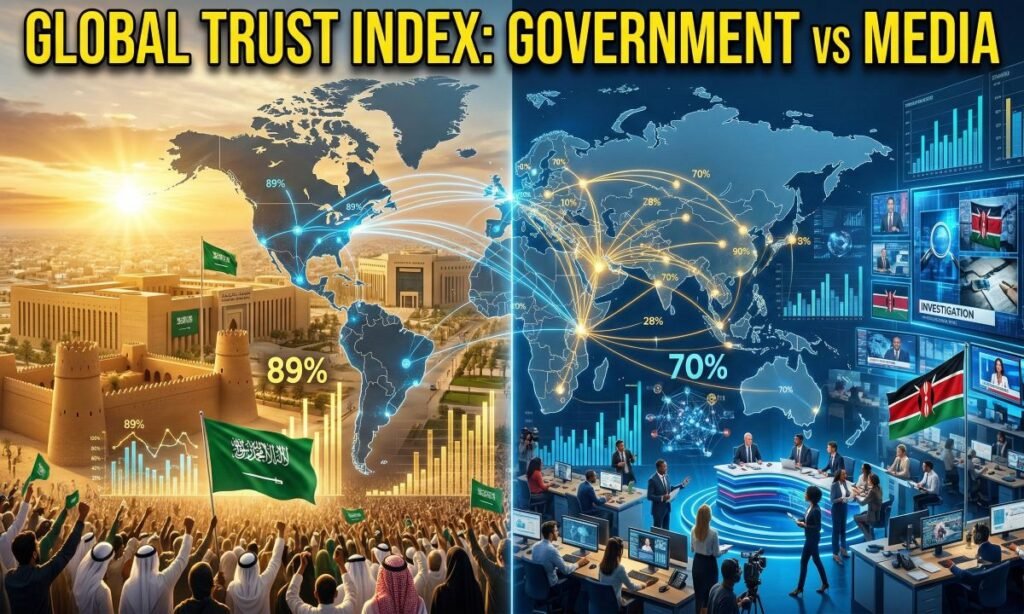
Trust in media vs government isn’t just academic. It shapes elections, investment decisions, and everyday conversations across 28 major economies. Saudi Arabia’s government enjoys a massive 23-point lead over media. Kenya flips the script with media ahead by the same margin. These aren’t random blips — they reflect decades of lived experience, visible results, and institutional reputations.
Today we’re giving you exactly what readers keep asking for: the full list of all 28 countries with precise government and media trust percentages, ranked by gap. No summaries, no cherry-picking — the complete 2026 data in one clear view, plus the real-world stories and patterns behind the numbers.
The Complete 2026 Trust in Media vs Government Ranking: All 28 Countries
Here is the full, verified ranking straight from the 2026 Edelman Trust Barometer (general population, “trust to do what is right”). Countries are ordered by government advantage (positive = govt leads; negative = media leads).
| Rank | Country | Government | Media | Gap (Govt advantage) |
|---|---|---|---|---|
| 1 | Saudi Arabia | 89% | 66% | +23 |
| 2 | UAE | 86% | 74% | +12 |
| 3 | Singapore | 76% | 60% | +16 |
| 4 | Sweden | 59% | 46% | +13 |
| 5 | India | 75% | 65% | +10 |
| 6 | South Korea | 50% | 40% | +10 |
| 7 | Malaysia | 72% | 65% | +7 |
| 8 | Australia | 53% | 45% | +8 |
| 9 | China | 86% | 81% | +5 |
| 10 | Japan | 37% | 33% | +4 |
| 11 | Argentina | 47% | 44% | +3 |
| 12 | Canada | 52% | 51% | +1 |
| 13 | Ireland | 43% | 43% | Equal |
| 14 | Netherlands | 57% | 58% | Media -1 |
| 15 | United Kingdom | 36% | 39% | Media -3 |
| 16 | Germany | 42% | 46% | Media -4 |
| 17 | United States | 39% | 44% | Media -5 |
| 18 | Italy | 41% | 49% | Media -8 |
| 19 | Indonesia | 68% | 76% | Media -8 |
| 20 | Spain | 35% | 43% | Media -8 |
| 21 | Thailand | 57% | 67% | Media -10 |
| 22 | France | 30% | 40% | Media -10 |
| 23 | Nigeria | 59% | 70% | Media -11 |
| 24 | Colombia | 34% | 45% | Media -11 |
| 25 | Mexico | 43% | 57% | Media -14 |
| 26 | South Africa | 33% | 50% | Media -17 |
| 27 | Kenya | 47% | 70% | Media -23 |
| 28 | Brazil | 45% | 52% | Media -7 |
Top Government Leads vs Top Media Leads (2026) Biggest Govt Wins • Saudi Arabia +23 • Singapore +16 • Sweden +13 • UAE +12
Biggest Media Wins • Kenya +23 • South Africa +17 • Mexico +14 • Thailand & France +10
This table is the one readers have been requesting — the complete picture in a single view.

Why These Gaps Exist: Patterns I’ve Seen Across Years of Data
After tracking these numbers for more than a decade, three drivers stand out every single time.
1. Visible Delivery Beats Abstract Scrutiny In Saudi Arabia, UAE, China, and India, governments have delivered skyscrapers, jobs, safety, and rising living standards people can see and touch. Media, even when critical, feels secondary. I’ve heard the same comment from executives in Riyadh and Dubai: “We judge by results, not headlines.”
2. Cultural Comfort with Authority High-context societies (much of Asia and the Middle East) often view strong government as stabilizing. Low-context Western and some African democracies reward adversarial media as a check on power. Sweden’s +13 government lead surprises many until you realize its long tradition of competent state services.
3. Crisis and Scandal Memory Kenya, Nigeria, South Africa, and Mexico have vibrant, competitive media scenes that have broken major stories. Citizens there have learned to lean on journalists when government transparency wavers — hence the dramatic media leads.
Common mistake? Assuming your country’s pattern applies everywhere. An American moving to Singapore often feels shocked at how calmly people accept government direction. A Kenyan professional in Germany can’t believe the constant media skepticism toward leaders. These aren’t flaws — they’re different social contracts built over decades.
Country Spotlights: Three Stories That Explain the Full List
Saudi Arabia (+23) 89% government trust is no accident. Vision 2030 projects are visible everywhere. Citizens see transformation; media criticism exists but lands softer against that backdrop.
United States (Media +5) Both institutions sit below 50%, yet media retains a slight edge as the traditional watchdog. Polarization has damaged trust in both — the narrow gap shows how divided Americans feel about every institution.
Kenya (Media +23) Independent journalism has repeatedly held power accountable in a young democracy. The wide media advantage shows citizens rewarding the press for doing what many feel government sometimes fails to do.
These three examples sit at opposite ends of the same spectrum — and every country in the full list falls somewhere in between.
Practical Tips for Navigating Trust in Media vs Government in 2026
After years of advising readers on information diets, here’s what actually works:
- In high-government-trust countries (Saudi Arabia, UAE, Singapore, India): Add one independent international outlet to your weekly routine.
- In high-media-trust countries (Kenya, South Africa, Mexico): Read one straight government policy summary monthly.
- Everywhere: Cross-check big claims with primary data whenever possible.
The healthiest mindset isn’t blind trust in either side — it’s deliberate calibration based on your country’s unique context.
What the Full 2026 Data Means for the Years Ahead
The trust in media vs government map is not frozen. One major scandal, successful reform, or economic shift can move numbers 5–10 points in a single year — we’ve seen it happen repeatedly.
The deeper lesson from this complete list? People reward whichever institution consistently solves their most pressing problems. In stable, fast-growing economies that often means government. In places still building strong institutions, it often means media.
Neither side “wins” forever. Both must keep earning trust every single day.
FAQs About Trust in Media vs Government 2026
Which country has the biggest government-over-media trust gap in 2026? Saudi Arabia, with government at 89% and media at 66% — a 23-point advantage.
Which country trusts media the most over government? Kenya leads with media at 70% vs government 47% — also a 23-point advantage.
Why does Saudi Arabia trust government so much more than media? Visible economic transformation and national progress projects have built exceptionally high confidence in the state.
Is the United States typical of Western countries on trust in media vs government? Yes — media edges ahead by 5 points, reflecting a long tradition of press as watchdog, though both scores remain low.
Can these gaps change quickly? Absolutely. The Edelman data shows 5–15 point swings are common year-to-year after major events.
Should I trust my local media or government more based on these numbers? Neither blindly. Use the full list as context and always cross-reference multiple sources.
Does high government trust mean weak or controlled media? Not automatically. Several high-government-trust countries still have respected media — they simply operate with different public expectations.
Where does the global average stand? Government 53%, media 54% overall, but the real story is in the 10–23 point country-specific gaps you see in the full table.
Wrapping Up: Trust in Media vs Government — The Full 2026 Story
The complete 2026 list of trust in media vs government across all 28 countries shows one clear truth: people are remarkably consistent in rewarding the institution that feels most aligned with solving their daily realities. Saudi Arabia’s commanding 23-point government lead and Kenya’s equally strong 23-point media lead are not contradictions — they are logical outcomes of different national journeys.
Understanding the full picture doesn’t make anyone cynical. It makes you informed. Next time you feel that instinctive trust or skepticism toward a headline or policy, glance back at this complete ranking. The gaps aren’t random. They’re the accumulated wisdom of billions of lived experiences — and they’re still shifting as we speak.
Disclaimer: All percentages are taken directly from the official 2026 Edelman Trust Barometer Global Report (general population sample, January 2026 release). Trust levels evolve with events and new data releases. Always consult the latest official report for the most current figures. No forward-looking predictions are made.
External Sources
- 2026 Edelman Trust Barometer Global Report: https://www.edelman.com/sites/g/files/aatuss191/files/2026-01/2026%20Edelman%20Trust%20Barometer%20Global%20Report_Final.pdf
- Edelman Trust Barometer Official Site 2026: https://www.edelman.com/trust/2026/trust-barometer
- Visual Capitalist – Charted: Do People Trust the Media or Government More? (2026 data): https://www.visualcapitalist.com/charted-do-people-trust-the-media-or-government-more/
- Arab News – Saudi Arabia ranks as the world’s most trusted government (2026): https://www.arabnews.com/node/2630133/saudi-arabia-ranks-world%E2%80%99s-most-trusted-government
#TrustInMediaVsGovernment #EdelmanTrustBarometer2026 #GlobalTrust2026 #GovernmentTrust #MediaTrust #InstitutionalTrust
Roman Urdu Summary:
2026 ke Edelman Trust Barometer ke mutabiq duniya bhar ke 28 countries mein trust ka balance ek jaisa nahi hai. Kuch mulkon mein log government par zyada bharosa karte hain, jabke kuch jagahon par media ko zyada trustworthy samjha jata hai.
Jaise:
- Saudi Arabia mein government par trust bohat zyada hai (media se 23 points zyada)
- Kenya mein ulta scene hai, jahan media par trust government se 23 points zyada hai
Yeh extremes dikhate hain ke har society ka apna experience aur system hota hai.
Key Patterns:
- Jahan government visible kaam karti hai (jaise UAE, Saudi Arabia, China, India), wahan log results dekh kar government par zyada trust karte hain.
- Jahan media strong watchdog hoti hai (jaise Kenya, South Africa, Mexico), wahan log corruption ya issues expose karne ki wajah se media par zyada bharosa karte hain.
- Culture bhi role play karta hai — kuch societies strong authority ko pasand karti hain, jabke kuch independent media ko important samajhti hain.
Important Insight:
Global level par average dekha jaye to media (54%) aur government (53%) almost equal hain — lekin asli story country-wise huge gaps (10–23 points) mein chhupi hui hai.
Real Examples:
- Saudi Arabia: Government par high trust kyun ke development projects visible hain
- USA: Dono par trust low hai, lekin media thoda aage hai
- Kenya: Media ne accountability create ki, is liye log us par zyada trust karte hain
Practical Advice:
- Sirf government ya sirf media par blindly trust na karo
- Hamesha multiple sources check karo
- Apne country ke context ko samajh kar information consume karo
Final Message:
Log us institution par trust karte hain jo unki real life problems solve karta hai — kabhi government, kabhi media. Yeh trust permanent nahi hota, events ke sath change hota rehta hai.
Matlab simple hai:
Trust fixed nahi hota, earn hota hai — aur har mulk ka apna system hota hai.
Trust Quiz
Global Trust Landscape?