

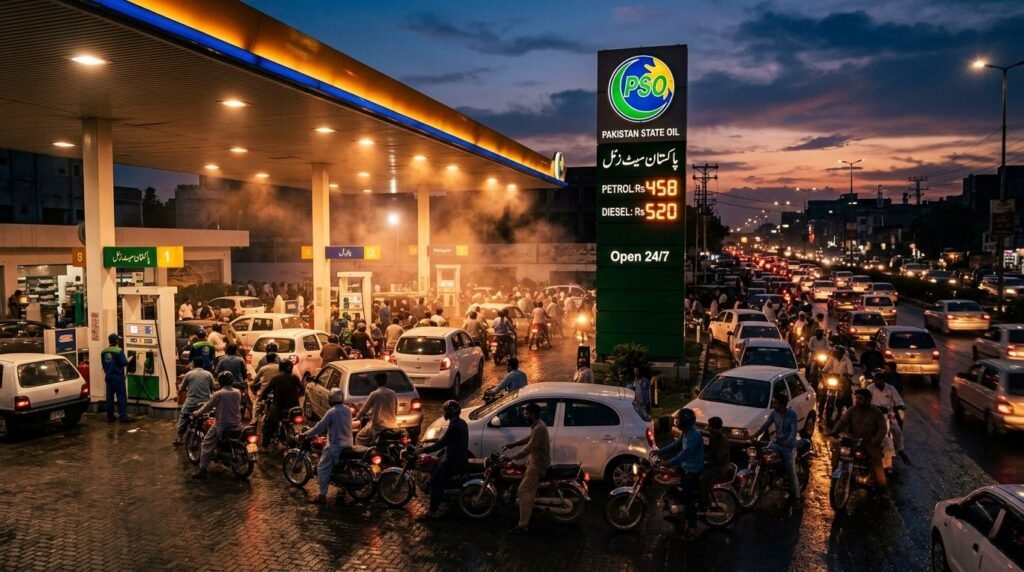
Pakistan Petrol Price Hike: Rs458 and the World on Fire
By Saad
Disclaimer: All data and figures cited in this article are based on verified government announcements, official press conferences, and credible international sources as of April 2, 2026. No speculative or unverified claims have been included. Market conditions are volatile; readers should consult official sources for real-time updates.
When the Pump Price Breaks Your Budget — and Your Expectations
There are moments in economic life when a number on a fuel pump stops being a statistic and becomes a personal crisis. April 2, 2026 is one of those moments for Pakistan.
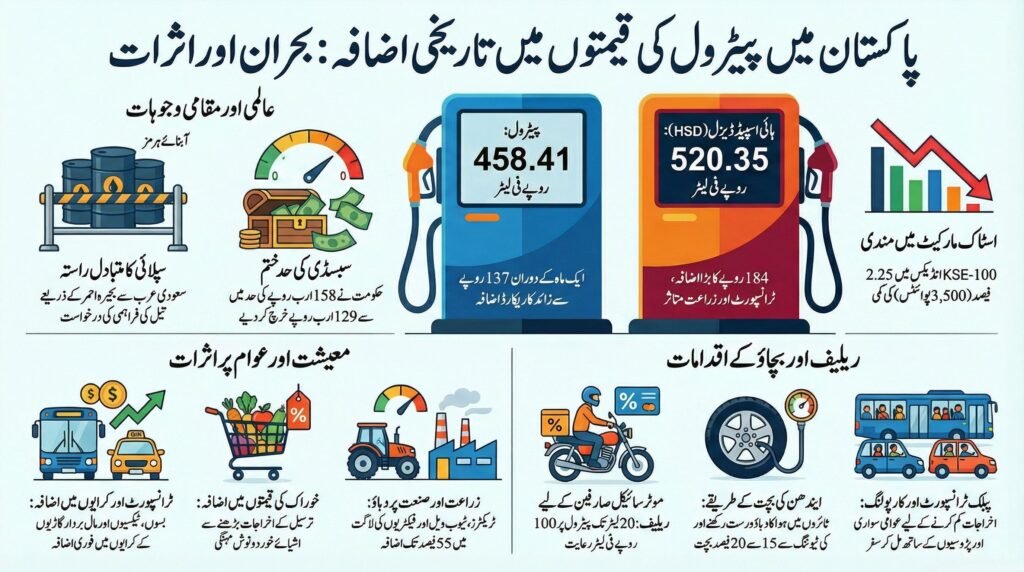
In a press conference that few Pakistanis wanted to watch and even fewer could afford to ignore, Petroleum Minister Ali Pervaiz Malik and Finance Minister Muhammad Aurangzeb announced that petrol prices in Pakistan would rise to Rs458.41 per litre and high-speed diesel (HSD) to Rs520.35 per litre. The announcement landed like a thunderclap — not just because of the numbers themselves, but because of how fast they arrived.
Just weeks ago, petrol was priced at Rs321.17 per litre and diesel at Rs335.86. The new figures represent an increase of over Rs137 per litre in petrol and Rs184 in diesel — numbers that many analysts are already calling one of the largest month-on-month fuel price increases in recent Pakistani history. HUM News
For a country where millions of people budget their commute down to the litre, this is not macroeconomic noise. This is a family sitting around a kitchen table recalculating what they can still afford.
How Did We Get Here? The Road From Rs258 to Rs458
To understand today’s crisis, you have to trace the arc backward — because this didn’t happen overnight.
As recently as early March, petrol was sitting around Rs258–Rs321 per litre. The March 6 revision had already shocked the public, driven by the US and Israeli attacks on Iran and Tehran’s retaliatory strikes on US bases and Israeli territory. Iran also announced the closure of the Strait of Hormuz — the critical waterway between the Persian Gulf and the Gulf of Oman — effectively triggering what the International Energy Agency has since called the largest supply disruption in the history of the global oil market. Wikipedia
The closure of the Strait of Hormuz removed close to 20 percent of global oil supplies from the market. Dallas Fed That’s not a rounding error — that’s a structural shock to global energy supply chains that forced prices higher across every import-dependent economy on earth.
Pakistan is, emphatically, one of those economies.
As early as March 4, Pakistan had officially requested that Saudi Arabia reroute oil supplies through the port of Yanbu on the Red Sea, with Saudi Arabia providing assurances and arranging at least one crude shipment to bypass the closed strait. Wikipedia It was a diplomatic scramble — pragmatic, necessary, and telling. When you’re asking allies to reroute your energy supply, you already know the prices are going one direction only.
PM Shehbaz Rejected the Summary Twice. Then Came Rs458.
Here is where the story gets politically interesting — and economically instructive.
For two weeks, Prime Minister Shehbaz Sharif had been sitting on summaries recommending a petrol price increase. He rejected them. Twice. He even addressed the nation publicly, saying he had declined a proposal to raise petrol by Rs95 per litre and diesel by Rs203 per litre — insisting the government would absorb the burden itself, citing a cost of around Rs56 billion.
The government had already spent over Rs129 billion in subsidies to keep petrol prices stable, against a cap of Rs158 billion, leaving almost no fiscal cushion remaining. Brandsynario
The math simply ran out. When the subsidy wall collapses, what’s on the other side is the market price — and the market had moved brutally.
There’s a pattern here that recurs in Pakistan’s economic history with painful regularity: delay, absorb, delay some more, then adjust sharply when the gap becomes unsustainable. The optics of gradual increases are worse than the optics of bold leadership — but the economics of sudden sharp hikes are devastating for those living on daily wages or fixed incomes. This tension never resolves cleanly, and it didn’t resolve cleanly today either.
The Global Context: A World Running on Empty
If you want to understand why Pakistan has almost no room to maneuver, you need to zoom out to the global picture — because what is happening in the Strait of Hormuz is genuinely historic in scale.
In conversations with more than three dozen oil and gas traders, executives, brokers, and advisers, one message was repeated: the world still hasn’t grasped the severity of the situation. Many drew parallels with the 1970s oil shock, warning a prolonged closure of the Strait of Hormuz would threaten an even bigger crisis. Bloomberg
Brent crude oil prices have surged well above $100 per barrel, while higher transport and insurance costs are adding to the strain. UN estimates indicate oil prices have risen by around 45 percent and gas by 55 percent since late February. UN News
Models suggest that a closure of the Strait of Hormuz is expected to raise the average WTI price of oil to $98 per barrel and lower global real GDP growth by an annualized 2.9 percentage points. Dallas Fed
For a country like Pakistan that imports nearly all of its petroleum needs, that global number translates directly into what you pay at the pump. There is no buffer. There is no domestic oil cushion. Every barrel has to be bought, shipped, insured, and refined — and right now, every part of that chain costs significantly more.
More than 80% of oil and LNG shipped through the strait went to Asian markets in 2024, with China, India, Japan and South Korea as primary destinations. World Economic Forum Pakistan, sandwiched into that Asian import-dependency map, is absorbing the full force of these disruptions.
What Rs520 Diesel Actually Means: The Ripple Effects
Let’s be concrete about where these price increases hit hardest — because the pump price is only the beginning.
Transport costs will rise immediately. Transport operators nationwide are expected to pass increased costs onto passengers, with buses, taxis, and ride-hailing services likely to raise fares. HUM News For the millions of Pakistanis who depend on public or informal transport to get to work, this is a direct income hit.
Food prices will follow. Nearly every fruit, vegetable, and packaged good in Pakistan moves by truck. Diesel at Rs520 per litre raises the cost of every kilometer that truck travels. That cost doesn’t evaporate — it gets passed to the shelf price, then to the consumer.
Industrial and manufacturing costs will climb. Generators, industrial machinery, agricultural equipment — the backbone of Pakistan’s productive economy runs on diesel. Businesses with thin margins will either absorb the hit or pass it forward.
Agriculture faces a particular pinch. Tractors, tube wells, and transportation of produce all run on HSD. A 55% increase in diesel cost at planting or harvesting season is the kind of shock that can change what farmers choose to grow and how much they’re able to produce.
The Motorcycle Relief Scheme: Smart Policy or a Sticking Plaster?
The one piece of relief announced alongside the hike is targeted: Finance Minister Aurangzeb confirmed that motorcycle users would receive subsidised petrol at Rs100 less per litre for up to 20 litres.
This is actually a thoughtful intervention in principle. Motorcycles are the workhorse of Pakistan’s lower-middle class — they are how millions of people get to work, deliver goods, and run small businesses. Protecting motorcycle users from the full brunt of the hike is an acknowledgment that a blanket price increase falls disproportionately on the most economically vulnerable.
The questions, of course, are operational: How will the subsidy be administered? How will usage be verified? Will petrol pump infrastructure support targeted pricing? These implementation questions will determine whether this relief actually reaches the people it’s designed to help, or whether it becomes another well-intentioned policy that struggles with execution.
KSE-100 Reacts: Markets Speak Before the Dust Settles
The stock market, which processes bad news with clinical speed, had already begun pricing in the anxiety before the official announcement. Analysts warned that with the new adjustments, this could become one of the largest month-on-month fuel price increases in recent history. HUM News
The KSE-100 index fell 2.25% on the day, shedding over 3,500 points. Energy-linked stocks, banks, and consumer-facing companies bore the brunt of selling pressure. A few sectors told a different story — TRG Pakistan surged over 10%, likely benefiting from tech-sector dynamics insulated from fuel pricing — but the broader market signal was unmistakably bearish.
This is the market’s way of saying: this is not a one-day story. Persistent fuel price increases feed into inflation, suppress consumer spending, raise corporate costs, and compress profit margins across nearly every sector of the real economy.
Pakistan’s Position in a Structurally Changed Energy World
The deeper question worth sitting with is not “why did petrol hit Rs458?” but “what does Pakistan’s structural energy vulnerability look like now?”
In Pakistan, fuel and grocery prices surged overnight and long queues were reported at petrol stations. Authorities introduced fuel conservation measures including a four-day work week, school closures and work-from-home policies. UN News
These are not the measures of a country with comfortable energy reserves. These are crisis-response tools — the kind of thing governments reach for when the margin is thin and the situation is moving faster than policy can adapt.
The medium-term outlook depends heavily on two variables entirely outside Pakistan’s control: how long the Strait of Hormuz remains commercially impaired, and how quickly international diplomatic and military efforts can restore oil flow. Oil executives and analysts warn that the Strait of Hormuz needs to be reopened by mid-April or oil-supply disruptions will get significantly worse. CNBC
If the strait reopens within weeks, global oil prices may pull back and Pakistan’s next price revision could offer some relief. If it doesn’t, the world will have to significantly reduce its oil and gas consumption — but not before prices spike to a level that forces consumers and businesses to fly, drive, and spend much less. Bloomberg
For Pakistan, already navigating a fragile macroeconomic recovery, that scenario is one it can ill afford.
What Can Ordinary Pakistanis Actually Do?
This is the part of the conversation that often gets lost in the policy analysis. Here is practical thinking for people trying to manage through this.
For vehicle owners: This is the moment to audit your fuel efficiency. Tire pressure, engine tuning, trip consolidation, and driving speed all materially affect fuel consumption. A well-maintained engine on inflated tires at steady highway speed can use 15–20% less fuel than the same car driven carelessly.
For small business owners: Fuel surcharges, delivery optimization, and consolidated logistics runs are not premiums anymore — they are survival tools. If you haven’t re-examined your supply chain for fuel efficiency, this is the prompt.
For households: The shift to public transport, even partial, can meaningfully reduce monthly expenditure. Shared ride arrangements with neighbours or colleagues are worth the coordination effort. This is exactly the kind of moment where community-level solutions — informal carpooling, consolidated shopping trips, neighborhood delivery pooling — emerge organically and stick.
For the economy broadly: The next several weeks will reveal how inflation expectations re-anchor (or don’t) and whether the motorcycle subsidy can be operationally delivered. Watch those two indicators closely.
FAQs: Pakistan Petrol Price Hike April 2026
1. What is the current petrol price in Pakistan as of April 2, 2026? The government has announced petrol at Rs458.41 per litre and high-speed diesel (HSD) at Rs520.35 per litre, effective April 2, 2026.
2. Why did Pakistan hike petrol prices so sharply? The primary driver is the global oil supply disruption caused by the US-Israeli military campaign against Iran and Iran’s effective closure of the Strait of Hormuz, which disrupted approximately 20% of the world’s daily oil supply. Pakistan, which imports nearly all of its petroleum needs, has absorbed the full impact of these global price increases.
3. Why did PM Shehbaz Sharif reject the price hike earlier but approve it now? PM Sharif rejected two earlier summaries recommending price increases while the government absorbed the subsidy gap. However, with subsidy spending exceeding Rs129 billion against a fiscal cap of Rs158 billion, the government’s ability to continue subsidizing prices was exhausted, forcing the revision.
4. Is there any relief for motorcycle users? Yes. Finance Minister Aurangzeb announced that motorcycle users will receive a discount of Rs100 per litre for up to 20 litres of petrol, as a targeted relief measure for this economically important segment of commuters.
5. How does the Strait of Hormuz closure affect Pakistan specifically? Pakistan depends on Middle Eastern crude oil imports for its energy needs. With the Strait of Hormuz disrupting approximately 20% of global oil supply, Pakistan requested Saudi Arabia reroute oil through Yanbu on the Red Sea. Longer shipping routes, higher insurance costs, and higher crude prices all feed into the pump price Pakistanis pay.
6. What will happen to food and transport prices as a result? Transport costs are expected to rise immediately as operators pass on higher diesel costs, increasing fares for buses, rickshaws, and ride-hailing services. Food prices typically follow within weeks as logistics costs are built into the supply chain.
7. Could petrol prices fall again soon? If the Strait of Hormuz is reopened and international oil prices stabilize, a downward revision remains possible. However, analysts warn that even after the conflict ends, elevated insurance premiums, geopolitical risk premiums, and restocking demand will keep prices elevated for some time.
8. How does this compare to historical petrol price levels in Pakistan? At Rs458.41, this represents one of the highest petrol prices in Pakistan’s recorded history and one of the sharpest single-revision increases. Historically, Pakistan’s petrol prices have reflected a combination of global crude prices, the rupee-dollar exchange rate, petroleum development levy, and government subsidy decisions.
The Bottom Line: Difficult Days Require Honest Accounting
Pakistan’s petrol price at Rs458 per litre is not a policy failure in isolation. It is the domestic face of a global energy crisis that is reshaping economies from Tokyo to London. The government delayed the inevitable — arguably too long, given the fiscal math — but the forces driving this increase are not made in Islamabad.
What matters now is execution: whether the motorcycle subsidy actually reaches those it’s meant for, whether inflation management tools are deployed swiftly, and whether Pakistan’s diplomatic and energy procurement efforts continue to find creative routes around a disrupted global supply chain.
For millions of Pakistanis, the next few weeks will be defined not by what the ministers said at the press conference, but by what a litre of milk costs, what the rickshaw driver charges, and whether the motorcycle subsidy shows up in practice rather than just in policy.
That is the real story behind Rs458.
External Sources
- HUM News English — Petrol price hike announcement: https://humenglish.com/latest/fares-likely-to-surge-nationwide-as-rs100-increase-in-petrol-price-in-pakistan-expected/
- Wikipedia — 2026 Strait of Hormuz Crisis: https://en.wikipedia.org/wiki/2026_Strait_of_Hormuz_crisis
- Dallas Fed Research — Economic impact of Hormuz closure: https://www.dallasfed.org/research/economics/2026/0320
- CNBC — Iran war and Hormuz oil price analysis: https://www.cnbc.com/2026/03/28/oil-gas-prices-iran-war-hormuz.html
- Bloomberg — Hormuz closure oil shock analysis: https://www.bloomberg.com/graphics/2026-iran-war-hormuz-closure-oil-shock/
- World Economic Forum — Global economic price tag of Middle East war: https://www.weforum.org/stories/2026/03/the-global-price-tag-of-war-in-the-middle-east/
- UN News — Middle East war shockwaves in Asia-Pacific: https://news.un.org/en/story/2026/03/1167167
- Stimson Center — Global markets and Strait of Hormuz: https://www.stimson.org/2026/global-markets-and-the-strait-of-hormuz-the-economic-shockwaves-of-the-iran-war/
- CNBC — Trump Iran war speech and oil market impact: https://www.cnbc.com/2026/04/02/trumps-iran-war-speech-oil-price-strait-hormuz.html
- Wikipedia — Economic impact of the 2026 Iran war: https://en.wikipedia.org/wiki/Economic_impact_of_the_2026_Iran_war
⛽ Pakistan Petrol Price Crisis Quiz
How Much Do You Actually Know?