

Why Dogs Lick Their Paws (And What Actually Helps)
By Saad
Last spring I was on a work call, camera off, mic on, and my dog Otis was under the desk doing that wet, rhythmic licking sound directly into my microphone. Lick, pause, lick, pause. Someone on the call asked if I had a leak somewhere. I did not have a leak. I had a beagle methodically attending to his left front paw like it owed him money.
I muted myself, looked down, and realized he’d been at it for a solid ten minutes. Not chewing, not limping, just licking, steady as a metronome. That was the first time I actually stopped and thought: why does he do this, and should I be worried.
Short answer: sometimes it’s nothing. Sometimes it’s something. The trick is knowing which one you’re looking at. If you like reading such blogs then bookmark Thestrategicpost.
The Normal Version of This
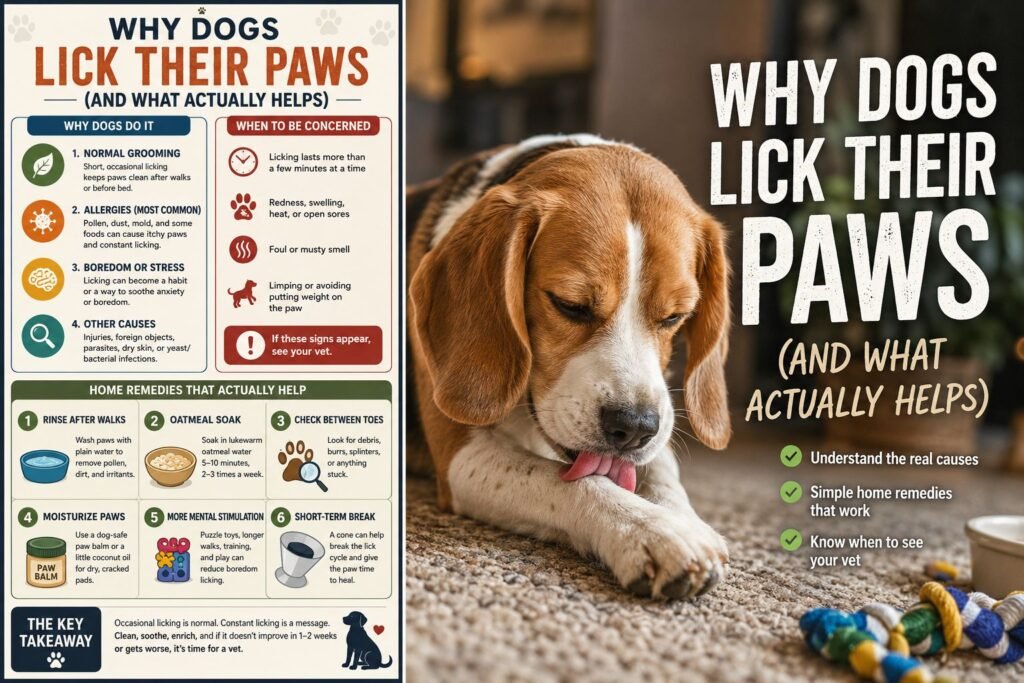
Dogs lick their paws the way people pick at a hangnail or crack their knuckles. It’s grooming. It’s low-level maintenance behavior. A dog’s paw picks up dirt, grass, dust, whatever’s on your floor, and a quick lick after a walk is no different than you wiping your feet before you come inside.
This kind of licking is short. A minute, maybe two. It happens after walks, after naps, sometimes right before bed like a closing ritual. Otis does a light paw-lick most nights before he curls up, always the same paw first, always brief. That’s not a symptom of anything. That’s just a dog doing dog things.
The line you’re looking for isn’t “does my dog lick its paws,” because basically all dogs do. The line is “does my dog lick its paws obsessively, in a way that doesn’t stop, doesn’t have an obvious trigger, and is starting to change the paw itself.”
Takeaway: occasional paw licking is grooming. Constant paw licking is a message.
Allergies Are the Most Common Cause, and Almost Nobody Guesses This First
Here’s the thing that surprised me when I actually looked into it: the number one cause of chronic paw licking in dogs isn’t anything to do with the paw. It’s allergies. Environmental ones, mostly — pollen, dust mites, mold, grass — the same stuff that gives people itchy eyes and a runny nose gives dogs itchy paws, because paws are one of the places where a dog’s skin is thin and exposed and easy to reach with a tongue.
Food allergies can do it too, though they’re less common than people assume. Vets call the whole itchy-allergic-skin picture “atopic dermatitis” (basically, allergy-driven skin irritation), and paws are one of its favorite targets, right up there with ears and armpits.
This is why paw licking often gets worse in specific seasons. If your dog turns into a paw-licking machine every April and calms down by July, that’s not a coincidence, that’s pollen. Otis does exactly this every fall, right when the ragweed shows up in our yard, like clockwork, same three weeks every year.
Nobody thinks twice when a person’s eyes water during allergy season. We just hand them a tissue and move on. It’s the same mechanism in a dog, just showing up somewhere less obvious.
Takeaway: if the licking is seasonal, you’re probably not looking at a paw problem. You’re looking at an allergy problem that happens to show up on the paw.
It Can Also Be Boredom, Stress, or Habit
Not every case is medical. Sometimes a dog licks its paws the way a person bites their nails, which is to say, out of boredom or stress rather than any actual physical trigger.
This tends to show up in dogs left alone a lot, or dogs going through some kind of disruption, a move, a new pet in the house, a schedule change. The licking becomes self-soothing. It releases endorphins the same way it does for us when we do a repetitive comforting motion, and over time it can turn into a genuine habit, separate from whatever started it.
I know a guy whose dog developed a paw-licking habit the month his kid left for college and the house got quieter. Nothing physically wrong with the dog. The vet checked. It was just an anxious dog filling a new kind of silence.
You can usually tell the difference from allergy licking because behavioral licking tends to happen in specific situations, like when you leave the house, or when things get too quiet, rather than being triggered by grass or seasons or a specific paw.
Takeaway: sometimes the paw isn’t the problem. The paw is just where the stress goes.
Other Causes Worth Knowing
A few other things can cause this, and they’re worth naming plainly rather than lumping into “allergies probably.”
Parasites, like fleas, can cause itching that shows up as paw licking, especially if a dog’s been scratching itself and then goes after the paw as an easier target. Injuries, a splinter, a small cut, a foreign object stuck between the toes, will cause focused licking on one specific paw rather than general licking across all four. Dry, cracked skin from hot pavement or cold, salted sidewalks can do it too, especially in winter.
And then there’s a smaller but real category, yeast or bacterial infection on the paw itself, which usually comes with a smell (a musty, slightly sweet smell, if you’ve ever noticed it, you know it) and sometimes a rusty-brown staining on light-colored fur from the licking itself.
The point isn’t to self-diagnose down to the exact cause. The point is that “why is my dog licking its paw” has more than one honest answer, and the right home remedy depends on which one you’re actually dealing with.
Takeaway: one paw, focused and sudden, means check for something physical. All four paws, gradual and chronic, means think allergy or habit.
Home Remedies That Actually Help
With the causes out of the way, here’s what’s worth trying at home, assuming there’s no open wound, no swelling, no limping, and no smell that makes you wrinkle your nose.
Rinse the paws after walks. This is the single most useful thing I do for Otis now, and it costs nothing. A quick rinse with plain water after a walk washes off pollen, grass residue, and whatever else is sitting on the paw before it has a chance to sit there all afternoon irritating him. I keep a shallow bowl by the door. Dip, wipe, done, fifteen seconds per paw.
Try a diluted oatmeal soak. Plain, unflavored, unsweetened oatmeal (the boring kind, not the packet with brown sugar in it) has mild anti-itch properties. Grind a cup into a fine powder, mix into a bowl of lukewarm water until it’s cloudy, and let the dog stand in it for five to ten minutes. It’s an old remedy, but it holds up, and it’s gentle enough to do a couple times a week without drying the skin out further.
Check between the toes for debris. Sounds obvious, but people skip it. Spread the toes and actually look. A burr, a splinter, a bit of gravel, these hide easily and cause exactly the kind of focused, one-paw licking that looks mysterious until you find the culprit.
Use a paw balm on cracked or dry pads. A plain, dog-safe paw balm (avoid anything with tea tree oil, which is toxic to dogs in concentrated form) can help with dryness from hot pavement, cold sidewalks, or salt in winter. Coconut oil in small amounts works in a pinch too, though it’s messier and dogs tend to just lick it straight off, which sort of defeats the purpose.
Add more mental stimulation if you suspect boredom. Puzzle feeders, a longer walk, more one-on-one time, this sounds almost too simple to be a “remedy,” but for behavioral licking it’s often the actual fix. Otis’s friend, the college-kid dog, mostly stopped once his owner started doing a twenty-minute training session every evening instead of just letting him wander the yard alone.
An Elizabethan collar for short-term breaks, the cone, basically, isn’t a long-term answer but it can give an irritated paw a few days to actually heal without being constantly re-licked, which matters because the licking itself can become the thing that keeps the irritation going, a loop where licking causes irritation which causes more licking.
None of these are exotic. They’re the kind of things you probably already have in your kitchen or your medicine cabinet, and that’s sort of the point.
Takeaway: most home remedies aren’t fixing the paw directly, they’re interrupting the loop that keeps the licking going.
The Honest Limit of Home Remedies
I want to be straightforward about something here, because a lot of pet blogs won’t be: if the licking has gone on for more than a couple weeks, if the paw is red, swollen, hot to the touch, has an open sore, or smells off, home remedies are not the move. That’s a vet visit, not a wait-and-see situation.
I made the mistake once of assuming Otis’s fall licking was “just the usual allergy thing” for almost a month before I actually looked closely and found a small yeast infection between two of his toes, which needed an actual prescription cream, not oatmeal water. The oatmeal wasn’t wrong, exactly. It just wasn’t enough, and I let it run longer than I should have because I wanted the simple answer to be the right one.
Home remedies are good for mild, early, low-grade irritation. They are not a substitute for diagnosis when something’s actually gone wrong. A vet can also do something you can’t do at home, which is figure out whether you’re dealing with allergies, parasites, infection, or anxiety, instead of guessing and hoping the oatmeal bath handles all four.
Takeaway: try the home stuff first, but give it a deadline. If it’s not working in a week or two, that’s information, not failure.
What I Do Now
These days, when Otis starts up on a paw, I don’t panic and I don’t ignore it either. I look at the paw. I check if it’s one foot or four. I think about the season. Most of the time it’s nothing, a quick after-walk cleanup and he’s done for the day.
But I watch it the way you’d watch a small, recurring thing in your own body, not with alarm, just with attention. A dog licking its paw is trying to tell you something. Most of the time the message is boring. Every so often it isn’t.
Either way, it’s worth listening before you assume you already know what it’s saying.


