

Why Your Dog Follows You to the Bathroom
By Saad
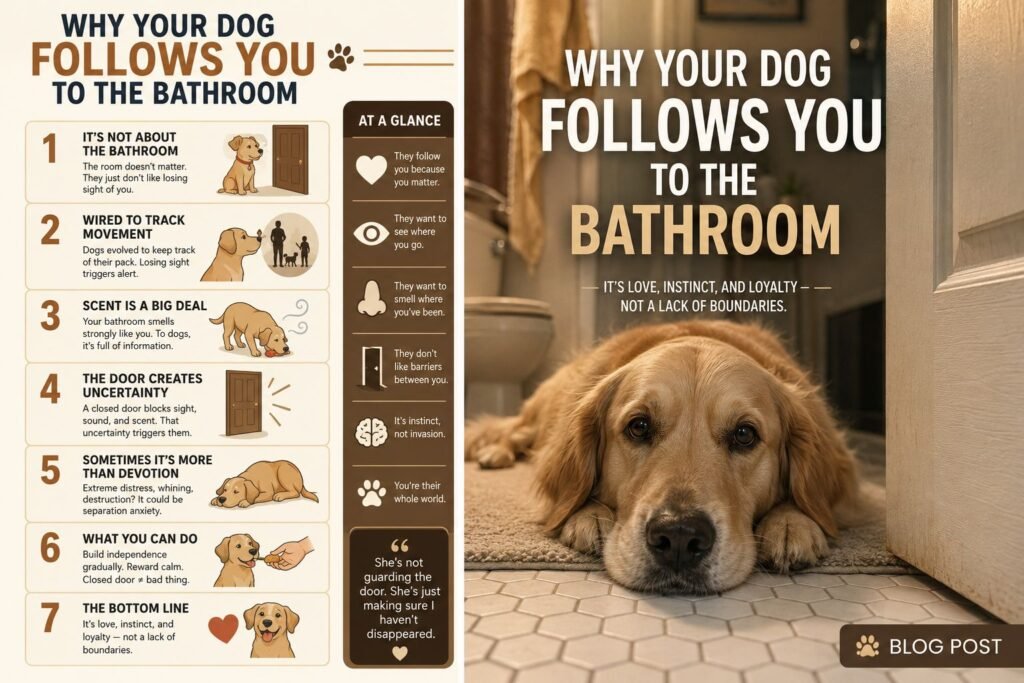
Last Tuesday I got up at 2 a.m. to pee, and by the time I sat down, Biscuit was already there, chin resting on the edge of the tub, watching me like I was about to announce something important. I hadn’t called her. I hadn’t even turned on the hallway light. She just appeared, the way she always does, and settled in like she had a reservation. If like Reading Blogs Like this Then BookMark Thestrategicpost
🐾 Dog Behavior Decoder
Tap on any behavior below to see what’s actually going on in your dog’s head. Decode all six to get your Dog Whisperer Score.
I used to think this was weird. Then I thought it was funny. Now, six years into owning this dog, I mostly think about it while it’s happening, which is its own kind of strange, sitting there being watched by a golden retriever at two in the morning, wondering what’s going on in her head.
Turns out there’s an actual answer. Several, actually. And once you know them, you stop feeling quite so surveilled.
It’s Not About the Bathroom
Dogs don’t care about bathrooms. They don’t know what a bathroom is for, not really — to them it’s just a small room you disappear into sometimes, and small rooms you disappear into are exactly the kind of thing a dog wants to keep an eye on.
This is the first thing to get straight. Your dog isn’t fascinated by plumbing or personally invested in your business. What’s actually happening is simpler and, honestly, a little more touching: you left their line of sight, and dogs don’t love that.
Biscuit doesn’t follow me to the bathroom because it’s the bathroom. She’d follow me into a closet. She followed me into a closet once, actually, when I was looking for a suitcase, and just stood there wagging her tail in the dark like we were doing something together.
The bathroom just happens to be the room where this shows up most, because it’s the one place in the house where humans reliably shut a door.
Takeaway: the room is incidental. The closing door is the actual event.

Dogs Evolved to Track Movement, Not Give You Privacy
Here’s where it gets a little more biological. Dogs are what’s called a “social species” (meaning they evolved to live and survive in groups, not alone) and for social species, keeping track of where the rest of the group is isn’t optional, it’s wired in. A dog that lost track of its pack ten thousand years ago didn’t get a snack and a nap, it got picked off by something bigger.
Your dog’s brain doesn’t know the difference between “the wolf pack scattered in the forest” and “the human went into the room with the tile floor.” Same circuit. Same instinct. Same low hum of where did they go.
I’ve seen people compare this to anxiety, like the dog is stressed out about losing you, and sometimes that’s true, there’s a real thing called separation-related behavior that vets take seriously. But most of the time it’s not that dramatic. It’s closer to how you might glance up when someone leaves a room mid-conversation, not because you’re worried, just because you’re tracking the scene.
Nobody accuses a person of having an attachment disorder because they notice a coworker stepped out for coffee. We just call that being aware of your surroundings. Dogs are aware of their surroundings, and their surroundings, as far as they’re concerned, includes you.
Takeaway: following you isn’t panic, it’s bookkeeping.
Scent, and Why Dogs Are Basically Obsessed With It
There’s a second layer here that people miss, which is that dogs experience the world through smell in a way we genuinely can’t relate to. A dog’s sense of smell is estimated to be somewhere between 10,000 and 100,000 times more sensitive than a human’s. I looked this up expecting the number to be exaggerated internet trivia and it isn’t, it shows up consistently in actual veterinary and olfaction research.
What that means practically is that a bathroom, to your dog, is not a small tiled room. It’s a room absolutely saturated with information about you, specifically. Your scent is strongest where you spend concentrated time, and there’s no room in most houses where a human sits still longer or more predictably than the bathroom.
So your dog isn’t just tracking your body. It’s tracking a room that smells overwhelmingly, specifically, unmistakably like you, at a moment when you’re sitting still and not doing anything else. From a dog’s point of view this might be one of the most “you” places in the entire house.
Biscuit sniffs the bath mat every single time before she lies down on it. Every time. Six years and she still checks.
Takeaway: to your dog, the bathroom smells like a diary you didn’t know you were keeping.
The Door Thing Specifically
I want to go back to that 2 a.m. moment, because I think the door is doing more work in this story than the room is.
Dogs don’t have doors in their instincts. There’s no evolutionary precedent for “the pack member is still nearby but there is a solid barrier between us and I cannot see, hear clearly, or smell them as well.” A closed door is a harder kind of absence than a dog just walking into another part of an open field would have been.
This is probably why some dogs get more insistent right at the threshold, pawing at it, whining a little, lying down directly against the crack at the bottom. It’s not that they think something bad is happening to you in there. It’s that the door represents a small, temporary version of the thing their whole nervous system is built to avoid, which is not knowing where you are.
I started leaving the bathroom door cracked a few months ago, mostly out of curiosity, to see if it changed anything. It did. Biscuit still comes in, but she doesn’t press against the door first. She just walks in like it’s any other room, because in a small way, I’d already answered the question before she had to ask it.
Takeaway: the door isn’t a privacy issue for your dog. It’s an uncertainty issue.
The Honest Downside Nobody Mentions
Here’s the part people skip when they write about this, because it’s less charming: sometimes this behavior isn’t sweet, it’s a problem, and it’s worth naming plainly instead of romanticizing it.
If your dog can’t be in a different room from you without pacing, whining, drooling, or destroying something, that’s not devotion, that’s a welfare issue, and it has a name — separation anxiety. It’s a real diagnosis, vets treat it, and it’s more common than people think. I know a woman whose dog chewed through a hollow-core door trying to get to the bathroom she was in. That’s not a heartwarming story. That’s a dog in genuine distress.
There’s a real difference between a dog that likes to know where you are and a dog that cannot function without knowing where you are every second. The first one is normal dog behavior, the kind I’m describing in the rest of this post. The second one needs help, sometimes training, sometimes medication, sometimes both.
I’d be lying if I said Biscuit’s bathroom habit was always convenient, too. There have been mornings I’ve stepped over her twice getting ready for work and nearly gone down. It’s not all soft-focus and devotion. Sometimes it’s just a large animal in a small room at the worst possible angle.
Takeaway: following you is normal. Falling apart without you isn’t. Know the difference.
So What Do You Actually Do About It
Mostly, nothing. If your dog trots along to the bathroom and lies on the mat and that’s the extent of it, this isn’t a behavior that needs fixing, it’s just a dog being a dog, the same species that’s lived alongside us doing exactly this for something like 15,000 years.
If you want a little more space, you can build it gradually, the same way you’d get a kid used to sleeping in their own room. Short separations first. A closed door with a treat on the other side. Rewarding calm instead of frantic scratching. None of this needs to be dramatic, and none of it means you’re rejecting your dog. You’re just teaching them that a door isn’t the end of the story.
But I’ll say this honestly: I don’t really want to train it out of Biscuit. There’s something in it I like. Not the mat-hogging, not the tripping-over-her part. Just the fact that a whole other creature, with its own brain and its own instincts built over thousands of years, has decided that the most important information in the world, at any given moment, is where I am.
That’s not a small thing to be somebody’s whole radar.
She’s not guarding the door. She’s just making sure I haven’t disappeared.
🐶 Dog Owner Quiz
Answer 4 quick questions and discover what your dog’s behavior says.
1. How long have you owned your dog?
2. Does your dog follow you around the house?
3. Does your dog wait outside your bathroom?
4. Which behavior best describes your dog?
Analyzing Your Answers…
Finding the best recommendation…
Your Dog Is Deeply Attached To You
Dogs often follow trusted family members because they see them as part of their pack. This behavior usually comes from loyalty, curiosity, affection, and the desire to stay close.