

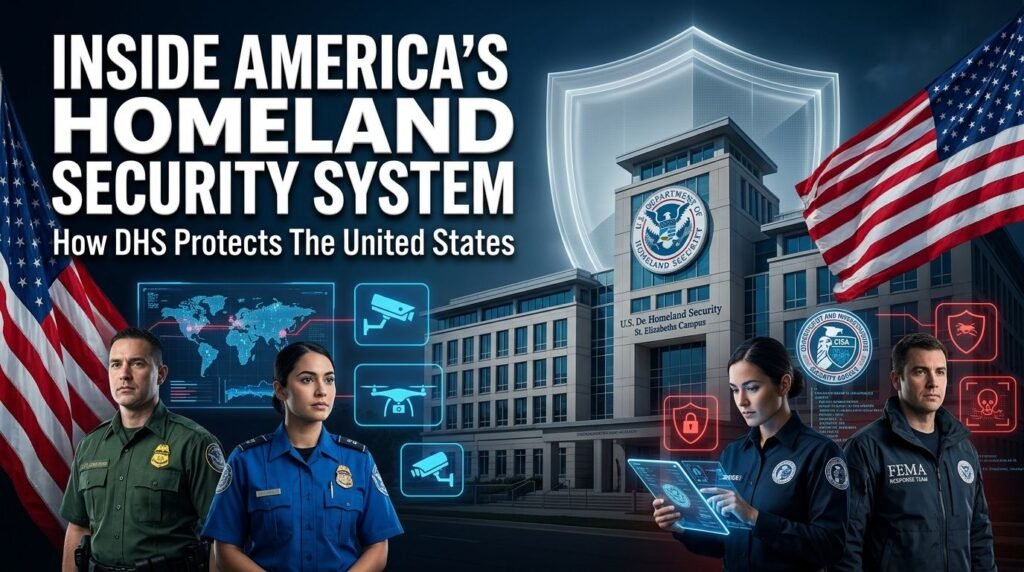
U.S. Department of Homeland Security (DHS): America’s Frontline Defense Against Modern Threats
The creation of DHS was driven by the need for a more coordinated national security framework following the devastating terrorist attacks of September 11, 2001. Prior to its establishment, many government agencies responsible for security, emergency management, immigration enforcement, and border protection operated independently. Recognizing the need for a unified approach, the U.S. government consolidated 22 separate federal agencies and offices into a single department, officially launching the Department of Homeland Security in 2003.
Today, DHS oversees several major organizations, including Customs and Border Protection (CBP), Immigration and Customs Enforcement (ICE), the Transportation Security Administration (TSA), the U.S. Coast Guard, the Secret Service, and the Federal Emergency Management Agency (FEMA). Together, these agencies work to secure the nation’s borders, protect transportation systems, prevent cyberattacks, combat human trafficking, respond to emergencies, and ensure the safety of millions of Americans every day.
As security challenges continue to evolve in the digital age, DHS has expanded its focus beyond traditional threats. Cybersecurity, critical infrastructure protection, election security, and resilience against emerging technologies have become key priorities. Through its broad range of responsibilities, the Department of Homeland Security remains a cornerstone of America’s efforts to protect its citizens, preserve national security, and maintain stability in an increasingly complex global environment.(Encyclopedia Britannica)
Today, the Department of Homeland Security stands as one of the largest and most complex federal departments in the United States, employing more than 260,000 personnel across a vast network of agencies, offices, and operational units. From border security officers and cybersecurity specialists to emergency management professionals and intelligence analysts, DHS personnel work around the clock to address a broad spectrum of threats facing the nation. The department’s responsibilities extend far beyond traditional law enforcement, encompassing disaster response, transportation security, immigration enforcement, infrastructure protection, counterterrorism efforts, and the defense of critical digital systems.
At its core, DHS is guided by a mission that is both straightforward and far-reaching: to protect the American people, secure the homeland, and uphold the nation’s values and way of life. Achieving this mission requires constant vigilance and adaptation, as security challenges continue to evolve in an increasingly interconnected world. Whether responding to natural disasters such as hurricanes and wildfires, combating sophisticated cyberattacks targeting government and private-sector networks, preventing acts of terrorism, or disrupting human trafficking and transnational criminal organizations, DHS plays a central role in safeguarding national security.
As emerging technologies, geopolitical tensions, and evolving criminal tactics create new risks, the department continues to modernize its strategies and capabilities. Through collaboration with federal, state, local, tribal, territorial, and international partners, DHS remains at the forefront of protecting the United States against both current and future threats while ensuring the safety, resilience, and prosperity of communities across the country. (Department of Homeland Security)
Why Was DHS Created?
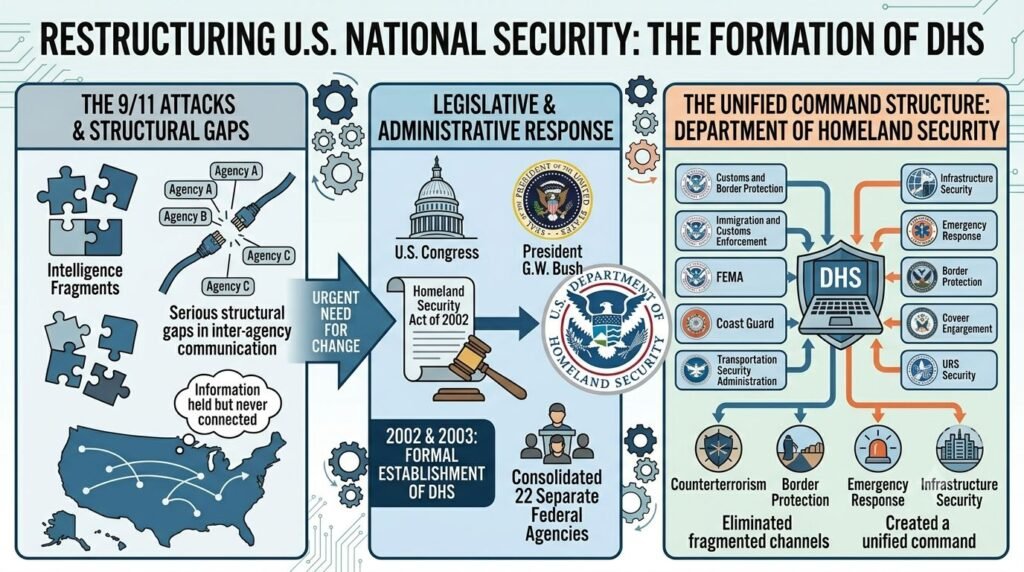
The September 11 attacks exposed serious structural gaps in U.S. national security architecture, particularly in intelligence sharing, inter-agency communication, and operational coordination. Information fragments that could have been critical to prevention were held across multiple agencies but were never effectively connected or acted upon in time. This systemic failure led to a sweeping federal response aimed at restructuring how homeland security was managed.
In response, the U.S. Congress passed the Homeland Security Act of 2002, and President George W. Bush formally established the Department of Homeland Security. The department began operations in 2003, marking one of the most significant government reorganizations in modern U.S. history.
The restructuring consolidated 22 separate federal agencies under a single umbrella organization, reshaping how the United States approached counterterrorism, border protection, emergency response, and infrastructure security. This integration was designed to eliminate fragmented communication channels and create a unified command structure capable of responding more efficiently to large-scale national threats.(Encyclopedia Britannica)
Core Mission Areas of DHS
DHS operates through several mission areas designed to address different aspects of national security.
1. Counterterrorism
Preventing terrorist attacks remains one of DHS’s primary responsibilities. The department monitors potential threats, shares intelligence with other agencies, and works with international allies to stop terrorist organizations from carrying out attacks on American soil. (Encyclopedia Britannica)
Counterterrorism activities include:
- Monitoring suspicious activities
- Intelligence sharing
- Protecting critical infrastructure
- Threat analysis
- International cooperation
2. Border Security
Securing America’s borders is a major focus area. DHS oversees efforts to prevent illegal immigration, drug trafficking, human smuggling, and other cross-border crimes. (USAGov)
Border security operations include:
- Monitoring land borders
- Inspecting cargo shipments
- Screening travelers
- Enforcing immigration laws
- Detecting illegal activities
3. Cybersecurity
As technology advances, cyber threats have become increasingly dangerous. DHS protects government systems, businesses, and critical infrastructure from cyberattacks. Power grids, communication systems, transportation networks, and financial systems are all potential targets for cyber criminals and hostile nations. (Encyclopedia Britannica)
Cybersecurity efforts involve:
- Threat detection
- Incident response
- Data protection
- Security advisories
- Collaboration with public and private organizations
4. Disaster Response and Emergency Management
DHS coordinates responses to natural disasters through emergency management systems. When hurricanes, floods, wildfires, or earthquakes strike, resources are mobilized to support affected communities. (Encyclopedia Britannica)
Key responsibilities include:
- Emergency preparedness
- Rescue operations
- Recovery assistance
- Resource allocation
- Infrastructure restoration
5. Transportation Security
Millions of Americans travel daily through airports, railways, and ports. DHS ensures transportation systems remain secure while allowing efficient movement of people and goods. Airport security procedures that people experience today are largely a result of DHS policies introduced after 9/11. (Encyclopedia Britannica)
Major Agencies Under DHS
Several well-known agencies operate under the DHS umbrella.
- Transportation Security Administration (TSA)
- Federal Emergency Management Agency (FEMA)
- U.S. Customs and Border Protection (CBP)
- U.S. Immigration and Customs Enforcement (ICE)
- U.S. Secret Service
- United States Coast Guard (Encyclopedia Britannica)
Each agency specializes in specific areas but works together to support the department’s broader mission.
Impact on Everyday American Life
Many people interact with DHS without realizing it.
Examples include:
Airport Security
Passengers undergo baggage screening, identity verification, and security checks before boarding flights. These measures became standard after 9/11. (Encyclopedia Britannica)
Passport and Immigration Services
Travelers entering the country pass through border inspections overseen by DHS agencies. (USAGov)
Emergency Disaster Assistance
Communities affected by hurricanes, floods, and wildfires often receive federal assistance coordinated through DHS. (Encyclopedia Britannica)
Cyber Protection
DHS works behind the scenes to help defend digital systems that support banks, hospitals, and utilities. (arXiv)
Recent Challenges Facing DHS
DHS faces several modern challenges that continue to evolve.
Cybersecurity Threats
Foreign governments and criminal organizations are constantly attempting to infiltrate critical systems. Cyber defense has become one of the department’s fastest-growing responsibilities. (arXiv)
Immigration Debates
Immigration policy remains one of the most politically sensitive issues in America. DHS often finds itself at the center of debates surrounding border management, asylum policies, and deportation practices. (Encyclopedia Britannica)
Major Event Security
In 2026, DHS intensified security efforts around the FIFA World Cup, including drone detection and temporary airspace restrictions around stadiums after numerous unauthorized drone incidents were reported. (Reuters)
Funding and Political Disputes
Budget disagreements in Congress have occasionally threatened DHS operations and slowed major security planning initiatives. (Reuters)
Leadership Structure
The department is led by the U.S. Secretary of Homeland Security, who is appointed by the President and confirmed by the Senate. The Secretary oversees all DHS agencies and advises the President on national security matters. (Wikipedia)
Future of DHS
The future of DHS will likely focus heavily on technology-driven threats. Artificial intelligence, cybersecurity, drone security, and digital infrastructure protection will become even more important in the coming years. Climate-related disasters and evolving global security challenges will also shape the department’s priorities. (Encyclopedia Britannica)
As threats become more sophisticated, DHS will continue adapting its strategies to protect the country while balancing security, privacy, and civil liberties.
Conclusion
The Department of Homeland Security stands as one of the most influential institutions within the United States federal system. Formed in the aftermath of the September 11 attacks, it was designed to consolidate national security functions that were previously scattered across multiple agencies, creating a unified structure to better anticipate, prevent, and respond to threats.
Today, DHS operates across a wide spectrum of responsibilities, including aviation and transportation security, border enforcement, disaster response, immigration services, and cybersecurity defense. Its mission extends beyond traditional physical security, now encompassing digital infrastructure protection and resilience against evolving technological threats. Agencies under its umbrella, such as the Transportation Security Administration and the U.S. Customs and Border Protection, reflect the department’s broad and integrated mandate.
Despite its scale and significance, DHS continues to face complex challenges, including balancing security with civil liberties, managing immigration pressures, and responding to rapidly advancing cyber threats. Ongoing political debate often surrounds its policies and operations, reflecting the high stakes involved in national security governance.
As global risks become more interconnected—spanning cyber warfare, climate-driven disasters, and transnational crime—the role of DHS is expected to expand further. Its future effectiveness will depend on its ability to remain agile, technologically advanced, and coordinated across both domestic and international security landscapes. (Encyclopedia Britannica)