

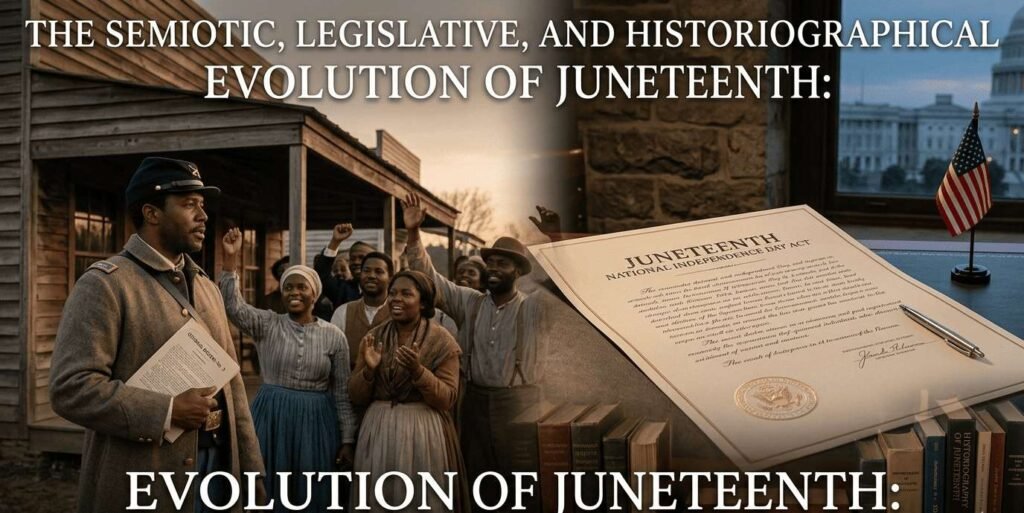
The Semiotic, Legislative, and Historiographical Evolution of Juneteenth: From Military Enforcement to Federal Commemoration
By Saad
The Semiotic, Legislative, and Historiographical Evolution of Juneteenth: From Military Enforcement to Federal Commemoration
What Is Juneteenth?
Juneteenth is a U.S. federal holiday celebrated on June 19 that commemorates the day in 1865 when enslaved African Americans in Texas learned they were free, more than two years after the Emancipation Proclamation.
The history of Juneteenth represents a complex intersection of military enforcement, legislative struggle, and cultural resilience. Far from being a simple, localized commemoration of delayed freedom, the holiday’s origin and subsequent evolution reveal a deep-seated contestation over the nature of American citizenship, labor structures, and the preservation of historical memory. This analysis explores the multi-layered history of June 19, 1865, tracing the physical, legal, and semiotic mechanisms that transformed a regional military decree into a national holiday, particularly as the United States approaches its Semiquincentennial in 2026.
The Historiographical and Legal Context of June 19, 1865
The Story of June 19, 1865
Many people assume that President Abraham Lincoln’s Emancipation Proclamation ended slavery throughout the country on January 1, 1863. That is not what actually happened. The proclamation applied only to states in rebellion against the federal government, and it required the presence of the Union Army to be enforced. It did not apply to border states such as Kentucky and Maryland, which had remained loyal to the Union. In areas still under Confederate control, the Union Army had no presence to enforce it. It was the Thirteenth Amendment, officially ratified on December 6, 1865, that legally abolished slavery across the entire country.
Texas was the westernmost state in the Confederacy and was largely removed from the main theaters of the Civil War. As a result, it became a haven for slaveholders. During the war, many enslavers relocated to Texas from the Deep South, bringing more than 150,000 enslaved people with them to escape the advancing Union Army and to preserve their claims to that labor.
It was not until Confederate General Robert E. Lee surrendered in April 1865, and the Confederate Trans-Mississippi Department surrendered the following month, that the federal government was able to send troops into Texas to enforce emancipation. On June 18, 1865, Major General Gordon Granger of the Union Army arrived in Galveston with 2,000 soldiers. The next morning, June 19, 1865, Granger issued an order declaring that the Emancipation Proclamation was now in effect in Texas. It was a momentous turning point for the enslaved people of the state: the Emancipation Proclamation was, at last, being enforced.
Table 1: Labor and Civil Rights Clauses of General Order No. 3 (June 19, 1865)
| Structural Category | Exact Text from General Order No. 3 | Immediate Sociological and Legal Impact |
|---|---|---|
| Declaration of Emancipation | “The people of Texas are informed that, in accordance with a proclamation from the Executive of the United States, all slaves are free.” | Officially nullified Confederate property claims over approximately 250,000 human beings in Texas. |
| Redefinition of Rights | “This involves an absolute equality of personal rights and rights of property between former masters and slaves…” | Established a federal mandate for equal protection, laying the early groundwork for the Fourteenth Amendment. |
| Reconstruction of Labor | “…and the connection heretofore existing between them becomes that between employer and hired labor.” | Attempted to rapidly transition a pre-capitalist plantation agricultural economy into a formal capitalist wage-labor system. |
| Mobility Control and Pacification | “The freedmen are advised to remain quietly at their present homes and work for wages.” | Sought to prevent massive migrations of freed people, signaling the federal government’s desire to stabilize agricultural output. |
| Restriction of Federal Dependency | “They are informed that they will not be allowed to collect at military posts and that they will not be supported in idleness either there or elsewhere.” | Criminalized vagrancy and restricted the spatial mobility of Black Americans, foreshadowing the restrictive labor laws of the Jim Crow era. |
The legal text of General Order No. 3 reveals a highly complicated transition. While it guaranteed “absolute equality of personal rights,” it simultaneously sought to pacify the newly liberated population by advising them to “remain quietly at their present homes and work for wages.” This juxtaposition highlights the federal government’s primary concern with maintaining economic stability and preventing agricultural collapse in the South.
By discouraging freed people from gathering at military posts and warning them against “idleness,” the order sought to limit physical mobility and transition Black labor from forced servitude to tightly controlled contractual agricultural work. This linguistic and regulatory framework foreshadowed the state-sanctioned Black Codes and sharecropping systems that would dominate the post-Reconstruction South.
Furthermore, the document itself has a unique archival history. While several contemporary printed versions circulated in regional papers such as the Galveston Tri-Weekly News on June 20, 1865, and The New York Times on July 7, 1865, the original handwritten official record was long hidden from public view. This original document, recorded by Assistant Adjutant General Major Frederick W. Emery in a bound army record book, was digitized and made public by the National Archives and Records Administration on June 18, 2020. It is maintained within Record Group 393: Records of U.S. Army Continental Commands.
The dissemination of this order was uneven; for example, in East Texas, Logan Stroud—one of the region’s largest enslavers, who held more than 150 enslaved people—delayed announcing the order’s provisions until he was forced to do so by the physical approach of federal authority, illustrating how news traveled slowly and depended entirely on military enforcement.
The Etymological Evolution and Earliest Print Records of “Juneteenth”
To understand why the holiday is called Juneteenth, one must examine the linguistic synthesis that occurred within the newly freed communities of Texas. The term is a portmanteau of “June” and “nineteenth.” The word’s meaning reflects a deliberate blending of a calendar date with a highly specific historical event. Rather than adopting a formal, state-sanctioned title like “Emancipation Day” or “Freedom Day,” the colloquial language of the freed people created a word that was both unique to their dialect and easy to pass down through oral tradition.
For decades, scholars debated exactly when the name “Juneteenth” first came into use. Early print archives indicate that while the first broad celebrations began in 1866 under the name “Jubilee Day,” the portmanteau “Juneteenth” began appearing regularly in print by the late 19th century.
Table 2: Earliest Print Records of the Term “Juneteenth” in American Newspapers
| Publication Date | Newspaper and Location | Documented Historical Excerpt | Linguistic and Cultural Context |
|---|---|---|---|
| June 22, 1895 | Parsons Weekly (Parsons, KS) | Describes a community’s “first Juneteenth celebration.” | Demonstrates that the portmanteau had traveled beyond Texas via migration networks by the late 19th century. |
| June 27, 1908 | Freeman (Indianapolis, IN) | References a Juneteenth gathering at a school’s grounds. | Illustrates the institutionalization of the celebration in educational and community spaces. |
| July 3, 1915 | Chicago Defender (Chicago, IL) | Explains “Juneteenth” as the day news of emancipation reached Texas. | Reflects the integration of the term into major northern Black media outlets during the early Great Migration. |
This chronological print trail indicates that the term evolved from informal regional slang into a widely recognized noun. The linguistic transition reflects a broader social phenomenon: as Black Texans migrated to neighboring states such as Louisiana, Oklahoma, and Arkansas, and eventually to northern industrial hubs during the Great Migration, they carried their linguistic patterns and celebrations with them. This decentralized migration of people and words laid the foundation for the eventual nationalization of the holiday.
Armed Emancipation: The Crucial Vanguard of the United States Colored Troops
While popular historical accounts frequently focus on Major General Granger, a white officer, as the primary agent of liberation in Texas, historical research emphasizes that the actual work of enforcing General Order No. 3 fell heavily on the United States Colored Troops (USCT). Granger arrived in Galveston with several USCT regiments, including the 20th, 28th, 29th, 31st, and 116th. Many of these soldiers were seasoned veterans who had participated in the fall of Richmond, the Confederate capital, and had witnessed Robert E. Lee’s surrender at Appomattox.
The physical presence of armed Black men wearing the uniform of the United States military was a powerful psychological and political catalyst for the newly emancipated population of Texas. For enslaved children and adults, seeing Black soldiers arrive with military equipment and the letters “U.S.” on their gear directly challenged the foundational tenets of white supremacy.
As Texas historian Sam Collins has noted, the Union could not have secured victory in the Civil War without the enlistment of the USCT, who ultimately made up approximately 10 percent of the entire Union Army. Collins emphasizes that these soldiers brought invaluable tactical intelligence to the Union war effort. Because many USCT soldiers were former enslaved people who had escaped Southern plantations, they possessed intimate knowledge of the Southern landscape.
They knew the locations of hidden creeks, shallow river crossings, and Confederate supply caches. This intelligence-gathering capacity, combined with their labor and combat contributions, proved decisive. In total, approximately 186,000 Black soldiers served in the Union Army during the Civil War, and 38,000 lost their lives.
When these battle-tested veterans marched into Galveston on June 19, 1865, they did so not merely as witnesses to emancipation, but as the primary agents who had fought to secure it.
The Violent Transition: Labor Conflict, Retributive Terror, and the Freedmen’s Bureau
The immediate reaction of many freed people in Texas upon learning of their emancipation was to leave the plantations—a movement historically referred to as the “scatter.” This movement was not driven by a desire for “idleness,” but rather by a systematic effort to find family members who had been sold away, to seek physical safety from hostile former enslavers, and to establish spatial autonomy.
However, this assertion of freedom was met with a wave of violence from white Texans, who resented federal intervention and refused to accept a new racial hierarchy. Because Texas had not been physically devastated by the war’s battles, its agricultural infrastructure and white-dominated civil institutions remained largely intact. This allowed white landowners and Confederate veterans to organize a systematic campaign of terror aimed at preserving antebellum labor practices by force.
Archives from the Bureau of Refugees, Freedmen, and Abandoned Lands (the Freedmen’s Bureau), which operated in Texas from 1865 to 1868, document the extreme physical danger faced by Black people attempting to exercise their rights. During this three-year period, Bureau agents recorded more than 2,200 violent acts committed by whites against Black Texans, including 1,698 incidents resulting in severe injury and nearly 900 documented murders.
Table 3: Documented Patterns of Racial Violence in Reconstruction Texas (Summer–Fall 1865)
| Nature of Conflict | Documented Historical Incident | Systematic Purpose of Violence |
|---|---|---|
| Retaliation for Reporting Abuse | An enslaved man named Oliver was beaten and shot to death in Montgomery County after traveling to Houston to report non-payment of wages. | Deterred freed people from seeking federal legal recourse or reporting economic exploitation. |
| Enforcement of Labor Submission | Stephen Bryant and his wife were handcuffed and beaten in Liberty County because their sons had left the plantation without permission. | Preserved control over Black labor and prevented the physical mobility of families. |
| Retaliation for Leaving an Enslaver | A freedman named Leton was whipped and forced to wear a heavy iron chain in Montgomery County after refusing to remain on the plantation. | Terrorized workers who attempted to leave agricultural servitude to find other work. |
| Assault on a Pregnant Woman | Amanda Reynolds, a pregnant Black woman, was whipped 150 times in Fort Bend County. | Exerted physical dominance and maintained racial hierarchy through extreme trauma. |
| Violence Over Wage Disputes | An elderly freedman, Robert Jones, was struck in the mouth with a revolver during a dispute over agricultural wages. | Denied Black laborers their earned compensation through physical intimidation. |
These acts of terror were not random; they were structured around labor, politics, and social autonomy. White landowners regularly used severe physical punishment, including whippings and lynchings, to coerce freed people into signing highly exploitative labor contracts.
Despite the presence of the Freedmen’s Bureau and federal troops, the sheer size of Texas and the limited number of federal personnel meant that most perpetrators of anti-Black violence faced no legal consequences. Local civil courts, dominated by white former Confederates, consistently refused to prosecute white defendants for crimes against Black citizens while routinely convicting Black people of minor or fabricated offenses.
This hostility was underscored in the 1866 congressional testimony of Major General George Armstrong Custer before the Joint Committee on Reconstruction. Custer testified that a profound animosity persisted among white Texans, who viewed freed people as the cause of their diminished economic circumstances. He noted that Black people were being murdered on a weekly, if not daily, basis.
Custer warned that if federal troops were withdrawn and the white population was left to govern freed people without federal oversight, they would pass laws designed to restore near-total control over Black labor, creating a system of oppression nearly as severe as slavery itself. This breakdown in local civil authority forced Black communities to build highly resilient internal support networks to survive the post-emancipation era.
Claiming Spatial Autonomy: The Construction of Emancipation Parks and Early Civil Rights Networks
Faced with a hostile state apparatus and segregationist laws that barred Black Americans from public assembly and recreation spaces, early Black communities in Texas recognized that preserving the memory of June 19, 1865, required outright ownership of land. The first official anniversary of General Order No. 3 took place on June 19, 1866, and was celebrated as “Jubilee Day.” These early gatherings featured prayer services, the singing of spirituals, and political rallies aimed at educating the newly freed population about their voting rights.
To secure safe spaces for these annual gatherings, Black leaders organized land acquisition campaigns. The most prominent of these efforts occurred in Houston in 1872, led by the Reverend Jack Yates, a formerly enslaved man who had become an influential Baptist minister. Yates, born in Gloucester County, Virginia, in 1828, had learned to read in secret by the light of a pine knot. He moved to Houston in 1865, where he worked as a drayman by day and preached by night, eventually becoming the first pastor of Antioch Missionary Baptist Church in 1866.
Yates, together with Richard Allen, Richard Brock, and Elias Dibble, representing the congregations of Antioch Missionary Baptist Church and Trinity Methodist Episcopal Church, formed the Colored People’s Festival and Emancipation Park Association. Together, they raised $800 to purchase ten acres of land in Houston’s Third Ward. The land was named Emancipation Park to permanently commemorate the end of slavery.
Richard Brock, one of the co-founders, was an esteemed landowner who later became one of Houston’s first Black aldermen after Governor E.J. Davis appointed him to represent the Fourth Ward in 1870. The acquisition of Emancipation Park was a monumental achievement in self-determination.
Because municipal authorities across the South actively worked to suppress Black political organizing and cultural expression, owning this private property allowed Black Houstonians to build community wealth, host educational forums, and celebrate Juneteenth free from the threat of white interference.
Table 4: Comparative History and Development of Houston’s Emancipation Park
| Historical Period | Structural Development and Social Significance |
|---|---|
| Founding (1872) | Purchased for $800 by formerly enslaved people led by Reverend Jack Yates; served as the primary, safe gathering space for annual Juneteenth celebrations. |
| Jim Crow Segregation (1922–1940) | Became a municipal park in 1918. Following the city’s 1922 segregation laws, it was the only public park open to African Americans in Houston. |
| Infrastructure Expansion (1938–1939) | Gained a recreation center, swimming pool, bathhouse, and outdoor athletic facilities designed by Houston architect William Ward Watkin. |
| Revitalization (2014–Present) | Managed by the Emancipation Park Conservancy under a 30-year agreement with the city; received a $33 million renovation and was designated a UNESCO “Site of Memory.” |
The park’s mid-century expansion under architect William Ward Watkin provided world-class recreational facilities for the Black community during the height of segregation. Yates’s legacy extended to education and civic leadership: he founded the Houston Academy in 1885 and helped establish Bishop College. His descendants continued his work, establishing major printing operations and farming enterprises in Texas. This model of land acquisition was replicated by Black communities across the state, cementing the link between property ownership and civil rights.
The Legislative Trajectory: From Ashton Villa to the Halls of Congress
The journey of Juneteenth from a regional cultural celebration to a formal state and federal holiday was long and politically contentious. While the holiday had been celebrated continuously for over a century, interest declined somewhat during the mid-20th century as the Great Migration reshaped Black demographics. The Civil Rights Movement of the 1960s, however, sparked a major revival of interest, as activists drew clear connections between the delayed freedom of 1865 and the ongoing struggle for desegregation and voting rights.
The legislative push for formal government recognition began in Texas, led by Representative Al Edwards, a Democrat representing Houston’s District 146. Elected in 1978, Edwards arrived in Austin determined to codify Juneteenth into state law. In 1979, he authored and sponsored House Bill 1016, which sought to establish June 19 as an official, paid state holiday. Edwards faced significant opposition from conservative legislators who questioned the holiday’s historical significance and argued that a new paid holiday would be too costly for taxpayers.
Edwards overcame this opposition by lobbying colleagues individually, arguing that the end of slavery was a triumph of freedom belonging to all Texans. HB 1016 passed and was signed into law by Republican Governor William P. Clements on June 13, 1979, taking effect January 1, 1980. This made Texas the first state in the country to recognize Juneteenth as an official state holiday.
Edwards also established an annual prayer breakfast and commemorative celebration on the grounds of the 1859 Ashton Villa in Galveston, a site closely associated with the early reading of the emancipation order. A nine-foot bronze statue of Edwards now stands near Ashton Villa, depicting him holding a copy of the landmark legislation.
On the national stage, the campaign for federal holiday status was championed by activist Opal Lee, widely known as the “Grandmother of Juneteenth.” Born in Marshall, Texas, in 1926, Lee experienced racial terror firsthand when a white mob of roughly 500 people burned down her family’s home in Fort Worth on June 19, 1939. This traumatic event left her with a lifelong commitment to the date and its deeper meaning.
In 2016, at age 89, Lee launched a highly publicized campaign to make Juneteenth a national holiday. She organized a symbolic walk from her home in Fort Worth to Washington, D.C., covering the distance in 2.5-mile increments to represent the two and a half years enslaved Texans had to wait for their freedom. Her efforts drew national attention and produced a petition with more than 1.5 million signatures, which she personally delivered to Congress.
The momentum culminated on June 17, 2021, when President Joe Biden signed the Juneteenth National Independence Day Act (Senate Bill S. 475) into law, establishing June 19 as the eleventh official federal holiday. The bill passed the Senate unanimously but encountered some opposition in the House of Representatives.
Table 5: Key Dissenting Arguments Against the 2021 Federal Act
| Representative | State | Party | Primary Ideological Objection to the Bill |
|---|---|---|---|
| Chip Roy | Texas | Republican | Argued that the official name (“Juneteenth National Independence Day”) was divisive because it created a separate, race-based independence celebration rather than unifying the nation under the Fourth of July. |
| Ronny Jackson | Texas | Republican | Raised fiscal concerns, arguing the U.S. already had too many federal holidays and that adding another would impose unnecessary costs on taxpayers. |
| Tom Tiffany | Wisconsin | Republican | Voted against the measure as part of broader opposition to what some conservative politicians characterized as a “woke” revision of American history. |
The remaining eleven House members who voted against the bill were Mo Brooks (AL), Andy Biggs (AZ), Scott DesJarlais (TN), Doug LaMalfa (CA), Mike Rogers (AL), Ralph Norman (SC), Paul Gosar (AZ), Tom McClintock (CA), Matt Rosendale (MT), Thomas Massie (KY), and Andrew Clyde (GA).
Despite these 14 dissenting votes, the bill passed the House by a sweeping 415–14 margin, reflecting broad bipartisan consensus that the end of legal slavery was a foundational milestone in American history.
The Semiotic Struggle: Iconography, Flag Design, and the Pitfalls of Corporate Commodification
As Juneteenth transitioned from a communal event to a national holiday, it became a semiotic battleground—most visibly in the debate over which symbol should represent it: the official Juneteenth Flag or the Pan-African Flag.
The official Juneteenth Flag was designed in 1997 by community organizer Ben Haith (known as “Boston Ben”) and later refined in 2000 by illustrator Lisa Jeanne Graf. The flag uses the red, white, and blue of the U.S. flag—a deliberate choice. Haith wanted to assert that Black Americans descended from enslaved people are, and have always been, American citizens entitled to the full rights and protections of the Constitution.
Table 6: Symbolic Elements of the Official Juneteenth Flag
| Visual Element | Design Detail | Symbolic Meaning |
|---|---|---|
| Central Star | A five-pointed white star | References Texas (the “Lone Star State”), where the holiday began, while also representing freedom for African Americans across all 50 states. |
| Surrounding Nova | A 12-pointed burst around the star | Inspired by an astronomical nova, symbolizing a new beginning for the nation. |
| The Arc | A curved line dividing the flag | Represents a new horizon of opportunity and progress for future generations. |
| Red and Blue Halves | Divided horizontally by the arc | Blue represents the sky; red represents the ground soaked with the blood of enslaved Black Americans who built and defended the nation. |
| The Date | “June 19, 1865,” added in 2004 | Ensures the historic event is never forgotten. |
In contrast, many celebrations use the Pan-African Flag (also known as the Black Liberation or UNIA flag), created in 1920 by Marcus Garvey’s Universal Negro Improvement Association. Its colors—red, black, and green—carry different meanings: red for the blood shed in liberation struggles, black for the African people, and green for the soil and natural wealth of Africa.
Some argue the Pan-African Flag is a more fitting symbol for Juneteenth because it emphasizes global Black solidarity, whereas the official flag uses the colors of the nation that historically enslaved Black Americans. Others use a red, yellow, and green scheme rooted in the flag of Ethiopia, the only African nation to successfully resist European colonization during the Scramble for Africa.
These disagreements are compounded by the rapid commercialization of the holiday. Following its 2021 federal designation, Juneteenth was quickly targeted by corporate marketing departments. This reached a flashpoint in May 2022, when Walmart released a “Juneteenth”-branded ice cream under its Great Value label. The red velvet and cheesecake–flavored product featured packaging urging customers to celebrate African American culture and emancipation.
The product sparked immediate public backlash. Critics noted that Walmart—a multi-billion-dollar corporation controlled largely by a wealthy white family—appeared to be profiting from a holiday commemorating the end of chattel slavery.
Adding to the controversy, Walmart placed a trademark symbol next to the word “Juneteenth” on the label, which many viewed as an offensive attempt to commodify a historic act of liberation. Its product also directly competed with Creamalicious, a Black-owned ice cream brand that already sold a red velvet cheesecake flavor.
Faced with accusations of “racial capitalism,” Walmart apologized and pulled the product from shelves. The episode highlighted a broader concern within Black communities: that shallow corporate marketing often displaces genuine historical education and substantive support for Black-owned businesses.
Culinary Traditions: West African Botanical Roots and the Ritual of the “Red Drink”
At the heart of traditional Juneteenth celebrations is the consumption of red foods and beverages, including barbecue, red velvet cake, strawberry pie, watermelon, and various red drinks. While often treated as simple picnic fare, culinary historians trace these choices to West Africa, framing them as a form of cultural preservation.
The significance of the “red drink” traces to the roselle plant (Hibiscus sabdariffa), native to West Africa and India. For centuries, West Africans boiled the plant’s calyces to create traditional beverages known as bissap in Senegal, sobolo in Ghana, and zobo in Nigeria. During the transatlantic slave trade, enslaved Africans brought roselle seeds with them to the Americas, cultivating the plant alongside other African crops such as okra and black-eyed peas.
Table 7: The West African Hibiscus Lineage and Diasporic Adaptations
| Regional Name | Geographic Origin | Key Flavor Profile | Cultural Context |
|---|---|---|---|
| Bissap | West Africa (Senegal) | Hibiscus, mint, sometimes orange or vanilla; served chilled | A traditional beverage of hospitality and celebration. |
| Sobolo / Zobo | West Africa (Ghana / Nigeria) | Hibiscus, ginger, cloves, and hot spices | Consumed for its medicinal properties and at social gatherings. |
| Sorrel | Caribbean (Jamaica) | Hibiscus, ginger, cinnamon, cloves, allspice, and rum | Closely associated with Christmas and ancestral celebrations. |
| Agua de Jamaica | Latin America (Mexico) | Hibiscus calyces boiled with sugar, served ice-cold | A staple of community markets and family meals. |
| Juneteenth Red Drink | Southern United States | Historically wild hibiscus tea; evolved into red lemonade, red soda (e.g., Big Red), and Kool-Aid | Consumed to celebrate freedom and honor ancestors. |
In the American South, enslaved people continued making hibiscus-based drinks, which became a staple of holiday celebrations. According to oral tradition, newly freed people in Texas marked their emancipation by drinking wild hibiscus tea.
Over time, as the roselle plant became harder to source in urban areas, other red beverages took its place. Red lemonade became popular in the late 19th century, followed by red sodas such as Big Red (manufactured in Waco, Texas) in the early 20th century, and later powdered drinks like red Kool-Aid.
Red carries a dual symbolic weight in these celebrations: it connects African Americans to their West African roots, and it serves as a solemn tribute to the blood shed by enslaved people during the transatlantic slave trade and centuries of forced labor. Consuming red foods and drinks on Juneteenth is therefore both a celebration and an act of remembrance.
The Confluence of Anniversaries: Juneteenth 2026 and the American Semiquincentennial
The year 2026 marks a critical moment for national reflection. On July 4, 2026, the United States will celebrate its Semiquincentennial—the 250th anniversary of the Declaration of Independence—coinciding with the fifth anniversary of Juneteenth as a federal holiday, and underscoring a deep historical tension between the two dates.
This convergence is formalized through the “Civic Season,” a nationwide initiative designed to engage young adults, particularly Gen Z, in civic participation and historical education. Running annually from June 19 (the newest federal holiday) to July 4 (the oldest), the Civic Season links the end of slavery to the founding of the republic, encouraging reflection on the gap between American ideals and historical realities.
Table 8: Major Cultural and Educational Initiatives for Juneteenth 2026
| Institutional Partner | Location / Platform | Key Program | Historical or Civic Focus |
|---|---|---|---|
| Colonial Williamsburg | Williamsburg, VA | Restoration of the Williamsburg Bray School; 250th anniversary of the First Baptist Church | Early Black education and religious independence in colonial America. |
| Museum of the American Revolution | Philadelphia, PA | First-person performance of Elizabeth Freeman; “Black Voices of the Revolution” tours | Enslaved people who sued for their freedom during the Revolutionary era. |
| Made By Us (Civic Season Coalition) | Nationwide / Online | “Wish Wall for America’s 250th”; “Letters to America” youth video campaign | Engaging young people around the next 50 years of American democracy. |
| The Henry Ford Museum | Dearborn, MI | “250 Years of American Innovation Tour”; interactive “Recipe Swap” programs | Linking industrial history with grassroots social justice movements. |
These collaborative projects underscore competing meanings of freedom in American history. In 1776, the authors of the Declaration of Independence declared that “all men are created equal,” yet continued to hold hundreds of thousands of Black people in bondage. For Black Americans, that founding promise was not realized in 1776 but on June 19, 1865, when Union military force finally enforced emancipation in Texas.
Juneteenth 2026 serves as a reminder that American democracy is a continuous, self-correcting struggle to align the nation’s actions with its founding ideals. It invites citizens to view the end of slavery not as a historical footnote but as a second founding of the United States—one that extended the promise of liberty to those who had been systematically excluded. By engaging with the history of delayed emancipation, the USCT, and the ongoing struggle for civil rights, modern citizens can work toward a more perfect and inclusive union.
Conclusion: Synthesizing Memory and Progress
The evolution of Juneteenth from a regional military decree into a standardized federal holiday demonstrates the power of community memory and persistent activism in the face of structural oppression. General Order No. 3, enforced by veterans of the United States Colored Troops, marked the beginning of a long and often violent transition toward labor autonomy and civil equality in Texas. This history was preserved not by the state but by freed people themselves, who built independent institutions, purchased community spaces such as Emancipation Park, and established oral and print traditions that carried the date into the national vocabulary.
As the United States prepares to mark its Semiquincentennial in 2026, the intersection of Juneteenth and Independence Day offers a unique opportunity for critical reflection. Rather than treating these two dates as mutually exclusive, the Civic Season framework invites an understanding of American history as an ongoing journey. Juneteenth’s legacy reminds the nation that the expansion of freedom and the defense of civil rights have never been given freely; they are won and preserved through continuous civic engagement, cultural remembrance, and collective action.
Juneteenth: The Armed Emancipation
An interactive exploration of June 19, 1865, dissecting the raw legal mechanics, military intelligence, structural violence, and cultural lineage of America’s Second Founding.
The Historiographical Context of 1865
The Emancipation Proclamation did not instantly release enslaved populations. Geographically isolated and insulated from direct warfare, Texas became a sanctuary for white enslavers migrating to evade Union lines.
Only physical enforcement by the Union Army under Major General Gordon Granger activated emancipation. Even then, Granger’s order framed liberation around strict, immediate labor stability.
Neither the Emancipation Proclamation (1863) nor General Order No. 3 legally abolished slavery nationwide. This was only realized with the ratification of the 13th Amendment in December 1865.
General Order No. 3: Structural Analysis
A thematic evaluation of the actual text mechanics and operational intentions.
The Etymological Evolution of “Juneteenth”
A portmanteau of “June” and “nineteenth,” the term emerged through oral tradition within freed communities rather than institutional naming. Here is the verified historical trail of how “Juneteenth” entered the written record and migrated northwards during the Great Migration.
First Known Print
Parsons Weekly (Kansas)
“Highly pleased with their first Juneteenth celebration.”
Statewide Integration
The Freeman (Indiana)
Reports on organized, large-scale celebrations throughout Texas communities.
Great Migration Wave
Chicago Defender (Illinois)
“Or, as it is humorously referred to, ‘Juneteenth’.” enters metropolitan print.
Depression Era Catalyst
Regional Media Networks
Becomes a cultural anchor for labor rights and political rallying points.
First State Holiday
Texas Legislature
Representative Al Edwards successfully legislates state recognition.
Armed Emancipation: Tactical Vanguard
Armed Enforcement
Major General Granger spearheaded the physical presence in Galveston, but the tactical muscles were the 2,000 soldiers of the USCT (Regiments 20, 28, 29, 31, and 116).
For enslaved people, seeing armed Black men in military uniform marching through the South served as a rapid psychological shock, solidifying the new reality of constitutional citizenship.
USCT Operational Intelligence Cycle
How tactical intelligence supported direct armed liberation.
Local Reconnaissance & Geographic Intel
USCT units, leveraging local escapee networks, systematically mapped backwater escape routes and Confederate supply stores across Texas’ bayous.
The “Scatter-Out” Logistics Support
Providing safe transit, immediate rations, and legal alignment coordinates for families searching for separated relatives.
Physical Disarmament & Civil Authority Handover
Neutralizing hostile rebel groups, disarming unyielding slave owners, and establishing provisional military-judiciary outposts.
Racial Violence in Reconstruction Texas (1865-68)
Incidents logged by Freedmen’s Bureau commissioners documenting physical backlash against Black freedom.
Counter-Reconstruction Terror
The proclamation of liberty was met immediately with organized, white-led terror. Because Texas was physically spared from destructive combat operations, its pre-war civil, legal, and white supremacist networks remained structurally intact.
“Scatter-out” movements—where newly freed people traveled across the state to consolidate families—were systematically intercepted by armed militias to coerce them back into slave-like labor systems.
“The local civil authorities are completely hands-tied, if not actively cooperative with those attempting to force the freed people into submission.” — Bureau Commission Report, 1867
Emancipation Park, Houston
True memory required protected spaces. Recognizing that public celebrations were vulnerable to white supremacist violence and municipal bans, Reverend Jack Yates and local leaders purchased 10 acres of land in 1872 for $800.
This strategic parcel became the sole public park in Houston open to Black citizens during the long, repressive Jim Crow era.
Spatial Autonomy Timeline
Historical growth phases of Emancipation Park as a hub of civic agency.
The Semiotic Struggle
The Flag: Dualistic Symbolism
Created in 1997 by Ben Haith, the official Juneteenth Flag is encoded with profound constitutional arguments. By intentionally mirroring the red, white, and blue of the United States Flag, it declares that newly freed citizens were and are fully entitled to the complete spectrum of American liberties.
The Curved Horizon Arc
Represents the dual reality of an active future and the promise of uncharted opportunity.
The 12-Pointed Nova Star
Symbolizes a supernova of freedom, illuminating a new epoch for all fifty states.
Racial Capitalism & Commodification
Following the 2021 federal holiday designation, the holiday entered a complex struggle with corporate commodification. The rapid commercialization by mass retailers represents the paradox of “racial capitalism”—profiting from cultural memory while ignoring structural equity.
Case Study: The 2022 Retail Controversy
The attempted commercialization of branded “Juneteenth Ice Cream” triggered immediate national backlash, leading to public corporate apologies and rapid product withdrawals.
The Ritual of the “Red Drink”
Instead of simple custom drinks, the classic “Red Drink” served at celebrations traces a direct botanical lineage back to West Africa. It follows the resilience of Hibiscus sabdariffa (Roselle) across slave trade route nodes.
Indigenous domestic plant used for critical restorative medicinal infusions.
Spiced drinks integrating ginger and local peppers for trade-guild rituals.
Traditional deep crimson brew sweetened with native fruits and spices.
Cultivated in secret provision grounds during the Middle Passage transition.
Migrated via trade networks, becoming a cultural staple of Afro-Mexican groups.
Reconstructed on Texas soil, cementing the color red as a symbol of ancestral resilience.
The Semiquincentennial Confluence
The year 2026 marks the 250th anniversary of the founding of the United States. Integrating Juneteenth into the “Civic Season” (the span of weeks from June 19 to July 4) bridges the gap between historical compromises and constitutional realization.
The Civic Core
“The promise of 1776 was not legally or physically realized until June 19, 1865, when the federal government deployed armed military personnel to enforce basic human rights.”