

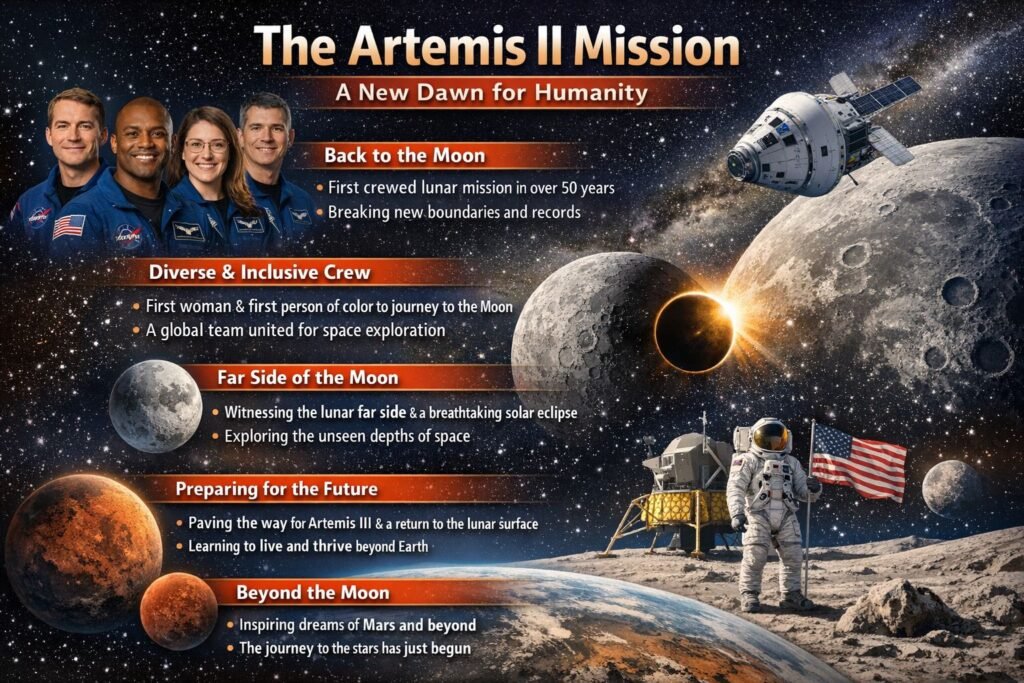
NASA’s New Artemis II Astronauts’ Moon Mission

For over fifty years, the Moon has been a silent witness to our progress, a pale orb hanging in the night sky that once felt like a reachable neighbor and then, for decades, became a distant memory. But as of April 2026, the silence has been broken. The Artemis II mission is currently making history, not just as a feat of engineering, but as a deeply human story of four individuals carrying the hopes of eight billion people into the dark.
This is the story of the Artemis II astronauts—the pioneers who are, at this very moment, rewriting our record books and reclaiming our place among the stars.
The Crew: Four Faces for One Humanity
When NASA and the Canadian Space Agency (CSA) selected the crew for Artemis II, they weren’t just looking for pilots and scientists. They were looking for a team that represented the evolution of human exploration. Unlike the Apollo missions, which were born of a Cold War race, Artemis is about staying, learning, and including.
Reid Wiseman: The Commander
A veteran of the International Space Station, Reid Wiseman brings a calm, measured leadership to the Orion spacecraft. Born in Baltimore, Wiseman’s journey to the Moon wasn’t a straight line—it was fueled by a childhood spent watching the Blue Angels and a dogged persistence that saw him through naval flight training and eventually to the top of the NASA Astronaut Office. As he radioed back to Earth today, his voice cracked with a childlike wonder: “The way we are responding to what we’re seeing out the window… we’re just like a bunch of kids up here.”
Victor Glover: The Pilot
Victor Glover, a Naval Aviator with 24 combat missions under his belt, is the first person of color to go on a lunar mission. For Glover, this isn’t just about flying; it’s about representation. He often speaks of wearing the American flag on his suit but representing the entire planet Earth. His role is critical—testing the manual handling of the Orion spacecraft to ensure that when we eventually land on the Moon again, we can do so with precision.

Christina Koch: The Mission Specialist
Christina Koch is no stranger to breaking records. She holds the record for the longest single spaceflight by a woman. On Artemis II, she becomes the first woman to ever venture into deep space. Her expertise in electrical engineering and her experience during long-duration stays on the ISS make her the perfect guardian of Orion’s life-support systems.
Jeremy Hansen: The International Partner
Representing Canada, Jeremy Hansen is a former fighter pilot who has spent years waiting for this moment. As the first non-American to leave Low Earth Orbit, his presence signifies that the Moon belongs to all of us. His inclusion marks the beginning of a new era of “Space Diplomacy,” where nations collaborate rather than compete.
Breaking the Apollo 13 Record
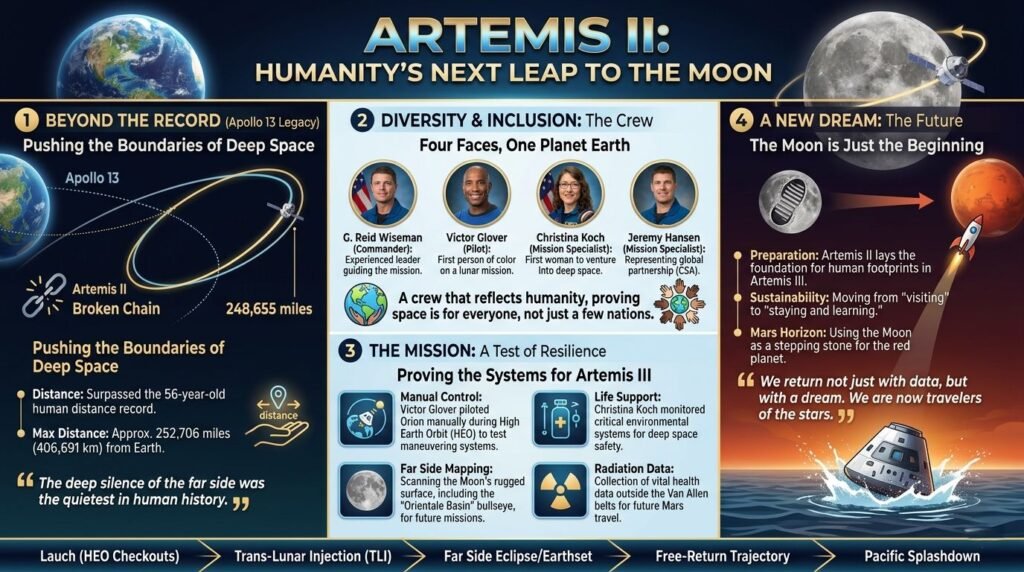
On Monday, April 6, 2026, the world held its breath as Artemis II surpassed a milestone that had stood for 56 years. The crew of Apollo 13, during their famous “successful failure,” reached a distance of 248,655 miles from Earth.
As of today, the Artemis II crew has shattered that record, reaching a maximum distance of approximately 252,706 miles (406,691 km). They have officially traveled farther into the cosmos than any human being in history.
This wasn’t just a numerical victory. To mark the occasion, the crew played a pre-recorded message from the late Jim Lovell, the commander of Apollo 13, who passed away only months ago. “Welcome to my old neighborhood,” Lovell’s voice echoed through the Orion cabin. It was a baton-passing moment, a bridge between the legendary pioneers of the 20th century and the explorers of the 21st.
The Journey: Ten Days of Tension and Triumph
The mission, which launched on April 1, 2026, is a high-stakes “free-return trajectory.” This means the spacecraft uses the Moon’s gravity as a slingshot to pull it back toward Earth without needing a massive engine burn to return.
The First 24 Hours: High Earth Orbit
Before they could head for the Moon, the crew had to survive a rigorous “checkout” phase. They spent the first day in a highly elliptical High Earth Orbit (HEO). During this time, Victor Glover took manual control of the spacecraft, performing “proximity operations” near the rocket’s upper stage. This was to prove that Orion could be steered manually if automated systems failed—a lesson learned from the early days of Gemini and Apollo.
The Trans-Lunar Injection (TLI)
Once the systems were green, the European Service Module’s engines fired, pushing them out of Earth’s gravitational embrace. For four days, the crew lived in a space no larger than a small SUV, sharing meals, monitoring life support, and watching the Earth shrink into a “marble” of blue and white.
The Far Side and the Solar Eclipse
One of the most breathtaking moments occurred today, April 7. As Orion passed behind the Moon, the crew experienced “Earthset”—the moment our home planet disappeared behind the lunar horizon, cutting off all radio communication with NASA for several minutes.
In that profound silence, they witnessed something no human has ever seen: a solar eclipse from the far side of the Moon. From their vantage point, the Moon moved in front of the Sun, casting a shadow not on Earth, but across the stars.
Why It Matters: Not Just a “Flyby”
Some critics argue that Artemis II is “just a lap” around the Moon since they aren’t landing. But the scientific and psychological impact is massive.
- Deep Space Radiation: This is the first time since 1972 that humans have left the protection of Earth’s Van Allen radiation belts. The data collected from the crew’s health sensors will tell us how to safely send humans to Mars.
- The Lunar South Pole: While they are flying over the far side, the crew is using advanced sensors to map the South Pole—the destination for Artemis III, where we hope to find water ice in permanently shadowed craters.
- Human Resilience: The mission is testing how four people handle the isolation and physical stress of deep space. It’s a “stress test” for the hardware and the heart.
The Emotional Core: Bringing the Moon Home
What makes Artemis II different from the cold, clinical descriptions of most space missions is the way the crew is sharing it. Using high-definition cameras and tablet-based apps, they are sending back thousands of photos and real-time voice observations.
They described the Orientale Basin as a “bullseye” on the lunar surface, a giant impact crater that looks like a ripple in a dark pond. They spoke of the Moon’s surface not as a “magnificent desolation,” but as a rugged, beautiful landscape of plains and mountains that feels strangely familiar yet entirely alien.
As they prepare for their return trip—a four-day trek back to a splashdown in the Pacific Ocean—they leave behind a trail of records and a renewed sense of possibility.
Conclusion: A New Dawn for Humanity
The Artemis II mission is more than a flight; it is a declaration. It tells us that we are no longer content with just looking at the Moon; we are ready to move back in. When Reid Wiseman, Victor Glover, Christina Koch, and Jeremy Hansen return to Earth, they won’t just bring back data; they will bring back a new perspective of our place in the universe.
We are a species of explorers. We are a people who look at a record and see a challenge. And as the Orion spacecraft hurtles back toward our blue home, we know that this is just the beginning. Next time, we won’t just fly by. Next time, we’re staying.
Conclusion in Roman Urdu/Hindi
Artemis II mission sirf ek technical kamyabi nahi hai, balkay ye insani azm aur himmat ki ek nayi dastan hai. Taqreeban 54 saal baad, insaan ek baar phir zameen ki hadon se nikal kar chand ki gehraiyon mein gaya hai. Reid Wiseman, Victor Glover, Christina Koch, aur Jeremy Hansen ne na sirf Apollo 13 ka record tora hai, balkay unhon ne poori duniya ko ye dikhaya hai ke jab hum mil kar kaam karte hain, to koi bhi faasla bohut bara nahi hota.
Is mission ki sab se bari khoobsurti iski “diversity” aur “inclusion” mein hai. Pehli martaba ek khatoon (Christina Koch) aur ek non-white shaqs (Victor Glover) ne chand ka safar kiya hai. Ye is baat ki nishani hai ke ab mazaq siraf chand mulkon ka nahi, balkay poori insaniyat ka hai. Canada ke Jeremy Hansen ki mojoodgi ne ye sabit kar diya ke space exploration ab “Global Partnership” ka naam hai.
Jab Orion spacecraft chand ke peeche gaya aur zameen unki nazron se ojhal hui, to wo chand minute ki khamoshi insani tareeq ki sab se gehri khamoshi thi. Unhon ne wahan se wo manazir dekhe jo aaj tak kisi insaan ne nahi dekhe—chand ke “far side” par sooraj grahan (solar eclipse) ka nazaara aur Orientale Basin ki gehraiyan.
Artemis II humein Artemis III ke liye tayyar kar raha hai, jahan insaan chand ki satah par qadam rakhe ga. Ye mission humein batata hai ke hum ab chand par sirf “visit” karne nahi, balkay wahan rehne aur seekhne ja rahe hain.
Jab ye chaar astronaut zameen par wapas ayenge aur Pacific Ocean mein splashdown karenge, to wo apne saath sirf mitti ke nishaan ya photos nahi layenge, balkay wo ek naya khuwab layenge. Ek aisa khuwab jahan Mars aur us se agay ke sitare ab itne door nahi lagte. Ye mission sabit karta hai ke insaan ki parwaz ki koi had nahi, aur chand to sirf ek aghaz hai. Hum ab sitaron ke musafir hain.