

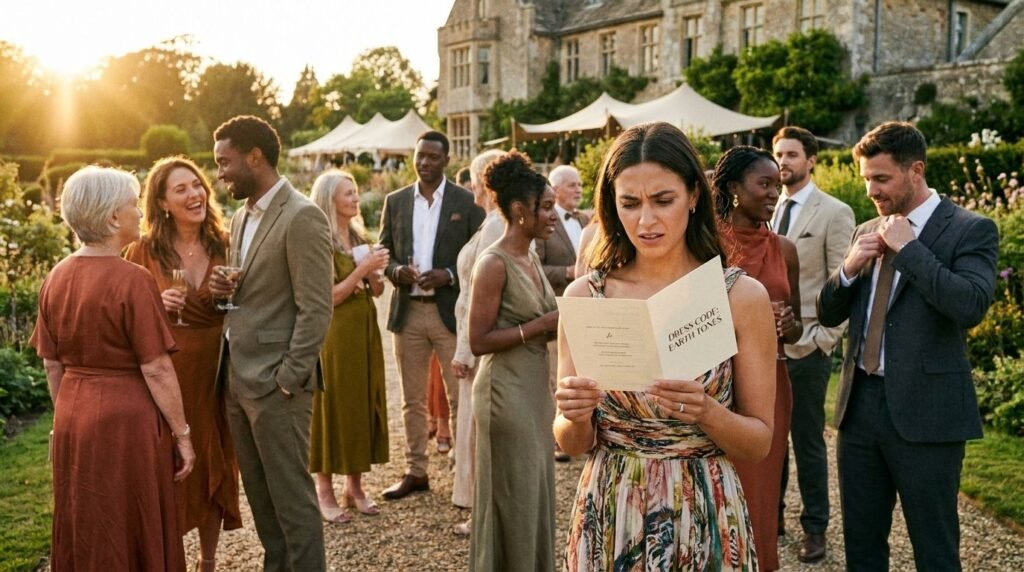

The Day I Opened a Wedding Invitation and Found a Dress Code
On sage green, unspoken rules, and the quiet math guests do before they’ve even RSVP’d.
“Guests are kindly asked to wear —”
Tap a color to see how it landed with the writer, standing in her kitchen with the invitation in one hand and coffee in the other.
A few months ago, I opened a wedding invitation that looked perfectly ordinary until I reached the second page. There, tucked beneath the ceremony details, was a list of clothing instructions. Guests were asked to wear shades of sage, champagne, or dusty blue. Black was discouraged. Bright colors were out. Patterns were “kindly requested” to stay home.
I remember standing in my kitchen with the invitation in one hand and my coffee in the other, reading it twice because I honestly couldn’t decide whether I was impressed or slightly overwhelmed.
That little moment stayed with me longer than I expected.
It wasn’t really about the colors. It was about how weddings have quietly become events where guests are sometimes expected to fit into the aesthetic as carefully as the flowers or table settings.
Sometimes a dress code feels thoughtful. Sometimes it feels like casting extras for a movie.
Dress codes used to be simple
Growing up, wedding dress codes were straightforward.
Formal meant wear a suit or a nice dress. Casual meant don’t show up looking like you just finished mowing the lawn. Black tie meant tuxedos if you had one, or the nicest thing you owned if you didn’t.
Nobody handed you a color palette.
Nobody measured your hemline.
Nobody wondered whether your tie would clash with the floral arrangements.
That simplicity had one major advantage. Everyone understood the assignment without feeling like they were taking part in a styling competition.
Clear expectations are different from detailed instructions.
Somewhere along the way, aesthetics became part of the guest list
I don’t think social media created this trend all by itself, but it certainly accelerated it.
Wedding photos now live online forever. Entire weekends are documented through drone footage, reels, cinematic highlight videos, and professional photography. Couples spend months choosing color palettes because every image tells part of the story.
When every photograph is expected to look magazine-worthy, it’s easy to understand why someone might ask guests to avoid neon green or giant logos.
Honestly, I get it.
If you’ve invested thousands into a venue overlooking a vineyard, seeing one bright orange Hawaiian shirt in every group photo probably isn’t your dream.
The request itself isn’t strange.
The scale sometimes is.
There’s a difference between helping guests fit the occasion and asking them to become part of the décor.
The unusual requests are the ones people remember
I’ve heard stories that sound almost fictional until you realize they actually happened.
Guests assigned different colors depending on which side of the family they belonged to.
Entire weddings where everyone was required to wear beige.
Requests banning black because it was considered unlucky.
Instructions that dresses must be floor-length, sleeves preferred, no floral prints, no visible logos, no sneakers, and no metallic accessories.
One couple reportedly wanted guests dressed according to the four seasons. Another asked everyone to dress in Renaissance-inspired clothing. Someone else wanted an all-white celebration except for the bride, who planned to wear gold.
Some of these ideas sound genuinely fun.
Some sound exhausting.
The interesting part isn’t how unusual they are. It’s how differently people react to the exact same request.
The same dress code can feel playful to one guest and stressful to another.
I understand why couples do it
Planning a wedding looks exhausting from the outside.
Every decision seems to multiply into ten more decisions.
Flowers become centerpieces.
Centerpieces become linens.
Linens become lighting.
Eventually, someone is worrying about whether navy blue jackets will clash with the bridesmaids’ dresses, and suddenly asking guests to wear earth tones doesn’t seem completely irrational.
When you’ve spent months building a vision, it’s natural to want everything to feel cohesive.
I don’t think that instinct is selfish.
I think it’s human.
People usually aren’t trying to control guests. They’re trying to protect a picture they’ve carried in their heads for months.
I also understand the guests
Here’s the other side.
Not everyone has five dresses hanging in the closet.
Not everyone owns a tan linen suit.
Not everyone has the budget to buy an entirely new outfit they’ll wear exactly once.
I think about the invitation I read in my kitchen. My first thought wasn’t whether sage green looked nice.
It was whether I owned anything remotely close to sage green.
I didn’t.
Then came the quiet math.
Try the quiet math yourself
Which of these do you already own? Tap what applies.
Could I borrow something? Should I shop? Would anyone notice if I wore navy instead? — that mental calculation happens before the celebration even begins.
A wedding invitation shouldn’t feel like an unexpected shopping list.
Etiquette has always balanced hosts and guests
Traditional etiquette was built around a simple exchange.
Hosts create a welcoming event.
Guests make an effort to respect it.
That balance works because both sides give a little.
Nobody complains about “cocktail attire” because it’s descriptive rather than controlling.
Nobody argues with “black tie optional.”
Those phrases explain the level of formality without dictating every visual detail.
Once requests become highly specific, the balance starts shifting.
Not because they’re automatically rude.
Because they’re asking guests to invest more than simple attendance.
Good etiquette isn’t about getting your way. It’s about making everyone comfortable.
I don’t think every request is unreasonable
I made the mistake, at first, of assuming these detailed dress codes were all excessive.
The more I thought about it, the less confident I became.
Some requests genuinely solve problems.
An outdoor wedding might encourage block heels instead of stilettos because guests would sink into the grass.
A beach ceremony might recommend linen and lighter fabrics because nobody enjoys sweating through heavy formalwear.
A cultural celebration may have clothing traditions that deserve respect.
Those requests aren’t about aesthetics alone.
They’re practical.
That’s an important distinction I nearly overlooked.
Context changes everything.
The line is thinner than people realize
There’s no universal rule saying where thoughtful guidance becomes too much.
For one person, asking everyone to wear earth tones feels easy.
For another, it’s an unnecessary expense.
That’s why the strongest opinions usually appear online.
Someone posts a wedding invitation asking guests to wear nine approved colors and avoid twenty forbidden ones.
Half the comments admire the vision.
The other half declare they’d decline immediately.
Interestingly, nobody reacts this strongly to restaurants asking for jackets or theaters requesting quiet.
The debate only appears when personal relationships enter the picture.
Expectations feel heavier when they’re attached to people we care about. Clothing is never just clothing once feelings get involved.
The invitation I keep thinking about
I eventually found something close enough to the requested colors.
Nobody inspected my outfit.
Nobody held up fabric swatches.
The wedding itself was beautiful.
The flowers were gorgeous.
The couple looked genuinely happy.
Months later, I barely remember what anyone wore.
I remember laughing during dinner.
I remember someone crying during the speeches.
I remember the bride hugging relatives she’d missed for years.
That’s the strange thing.
The photographs may preserve the colors forever.
Memory rarely does.
I still think back to standing in my kitchen reading that invitation because it captured the tension perfectly. Weddings ask us to celebrate people we love, yet sometimes we spend more energy worrying about whether our shoes match their mood board.
Maybe that’s just how modern weddings have evolved.
Or maybe it’s a reminder that the best celebrations aren’t perfectly color-coordinated.
They’re the ones where people feel like they belong.
A wedding isn’t a painting. It’s a room full of people.
↑ Back to top