
Sitting on the second shelf of my bathroom medicine cabinet right now is a crumpled, half-empty tube of sunscreen with French writing on the back. I bought three of them at a corner pharmacy in Paris two summers ago, shoved them into my carry-on bag between socks, and have been rationing the lotion drop by drop ever since.
Whenever friends came over and saw it, they asked the same question: why are you treating twenty-euro pharmacy lotion like liquid gold?
The answer was simple: it was the only sunscreen I owned that did not make my face feel like an oil slick, did not turn my skin chalky purple, and did not make my eyes sting like battery acid the second I started sweating on a humid afternoon.
For years, millions of Americans played this exact game. We bought Korean sun creams from grey-market import websites. We begged friends traveling in Europe or Japan to bring back tubes of drugstore lotion in their luggage. We felt like petty contraband smugglers, all for the radical crime of wanting decent sun protection that did not feel awful to wear.
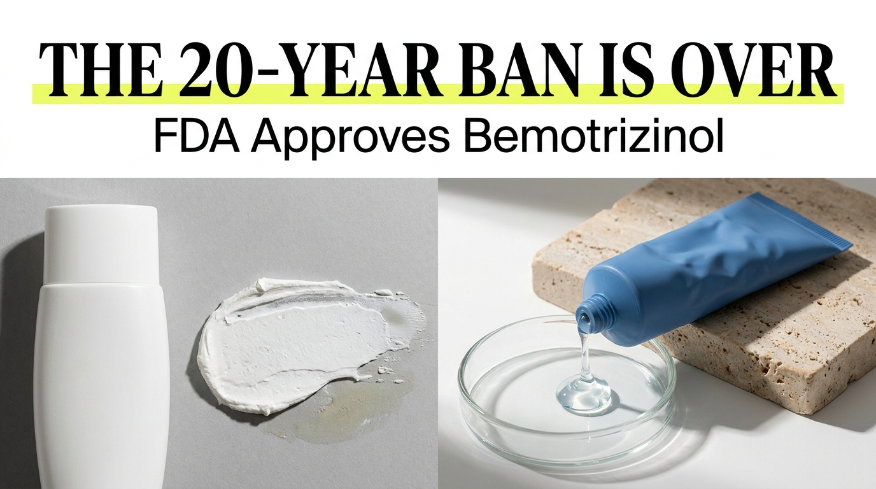
On June 9, 2026, that bizarre twenty-year chapter of American skincare finally showed its first real crack.
The Food and Drug Administration officially added a new UV filter called bemotrizinol to its permitted list of over-the-counter active ingredients. It was the first time the agency approved a new chemical sunscreen active in more than two decades. For dermatologists and skincare nerds who watched the rest of the planet use superior formulas while American drugstore aisles gathered dust, this was the equivalent of a dam bursting.
Yet the real story is not just that a new chemical got stamped with a government seal. The real story is why we were stuck in the 1990s for so long, and why getting better sunscreen into American hands was so absurdly difficult.
The French tube in my bathroom cabinet
To understand why anyone cared enough to bootleg lotion across international borders, look at what American sunscreen feels like compared to what the rest of the world uses.
If you walk into an American pharmacy today and pick up a bottle of chemical sunscreen, you will find the exact same core ingredient for deep UV protection: avobenzone.
Avobenzone has been the solitary chemical workhorse protecting Americans against long-wave ultraviolet A rays—the UVA wavelengths responsible for skin aging, deep tissue damage, and melanoma—since the late 1980s. But avobenzone comes with infamous flaws. It is fragile under sunlight. Left on its own, it begins breaking down within thirty minutes of sun exposure, meaning chemists have to load formulas with stabilizing chemicals like octocrylene just to keep it functioning.
Even worse, avobenzone stings. If you put it near your brow line and sweat on a hot morning, it migrates into your eyes, causing a burning sensation that can ruin your entire afternoon.
Compare that to the tube on my bathroom shelf. European, Korean, and Japanese sunscreens feel like lightweight water creams. They absorb in five seconds. They do not sting your eyes. They sit under a baseball cap without pilling, and they protect against UVA rays for hours without destabilizing.
For twenty years, American consumers were trapped in a false choice: endure the greasy, eye-stinging sting of outdated American chemical filters, or slather on thick white pastes of zinc oxide that make anyone with a darker skin tone look like a ghost.
People who hated both options simply stopped wearing sunscreen, turning bad chemistry into a genuine public health failure.
Why American sunscreen got trapped in 1999
The obvious question is: why did this happen? Why could someone in London, Seoul, or Sydney buy elegant, long-lasting sun protection at a convenience store, while Americans were stuck with formulas from the Clinton administration?
The answer lies in a quirk of federal law dating back to 1938.
In the United States, the Food, Drug, and Cosmetic Act treats sunscreens as over-the-counter drugs rather than cosmetics. Because sunscreens claim to prevent sunburn and reduce skin cancer risks, Congress classified them alongside aspirin and cough syrup. In Europe and Asia, by contrast, sunscreens are regulated as functional cosmetics. Regulators in those markets evaluate whether an ingredient is safe when rubbed on skin, monitor safety data, and approve modern filters quickly.
In America, treating sunscreen as a drug created a regulatory mountain.
To approve a new UV filter under modern FDA rules, a manufacturer must conduct multi-million-dollar safety studies. That includes testing how much of the chemical absorbs through skin into the bloodstream, whether it collects in organs, and whether it disrupts hormones.
The tragic irony is that the FDA was not wrong to care about safety. Studies in recent years revealed that older American filters like oxybenzone easily absorb through skin into the blood at levels exceeding federal thresholds. But while the FDA grew cautious about older filters, its approval process was so punishing and expensive that foreign chemical manufacturers simply gave up trying to enter the United States.
A regulatory framework built to keep us safe ended up freezing American sun protection in amber for a quarter of a century.
The heavy molecule that broke the twenty-year freeze
Which brings us to bemotrizinol. Known commercially by trade names like Tinosorb S and PARSOL Shield, bemotrizinol has been widely used across Europe, Australia, and Asia since 2000.
As announced in the FDA announcement on bemotrizinol and detailed by the American Association for Cancer Research, the agency finally granted bemotrizinol the coveted Generally Recognized as Safe and Effective (GRASE) status. It is the first new active sunscreen ingredient added to the American monograph in twenty-five years.
What makes bemotrizinol special comes down to basic physical chemistry: molecular weight.
Older chemical filters like oxybenzone and avobenzone are small molecules. Their small size is why they slip through skin layers and enter the bloodstream. Bemotrizinol, by contrast, is a molecular heavyweight. Its molecule is massive—roughly twice the size of older filters. Because it is so bulky, it physically cannot penetrate the stratum corneum, the skin’s outermost barrier. It sits harmlessly on the skin surface like an invisible shield, absorbing rays without soaking into your systemic circulation.
It is also broad-spectrum by design. A clinical overview in the American Journal of Managed Care explains that bemotrizinol absorbs both UVA and UVB rays across a wide band of light. It does not degrade when hit by sunlight. Where avobenzone falls apart after an hour of UV exposure, bemotrizinol remains stable, often acting as a partner to stabilize other ingredients in the bottle.
It does not sting eyes. It does not require harsh chemical stabilizers. It does not break down in the sun.
For once, modern chemistry actually delivered what everyday people wanted all along: protection that does its job without making you feel its presence.
What will actually change on our shelves, and what won’t
I want to celebrate this win, but we also need an honest reality check about what happens next.
The FDA gave its approval in June 2026, but that does not mean you can walk into a local supermarket tomorrow and find bottles of bemotrizinol sitting next to the aloe vera. Making sunscreen is not like mixing fruit punch. Skincare companies must formulate new emulsions, test stability across temperature swings, run SPF validation panels, and secure supply chains. Broad commercial rollouts will not hit mainstream American shelves in volume until early 2027.
There is also the question of price.
Because bemotrizinol requires specialized patent licenses and domestic supply lines, early American sunscreens featuring the filter will debut in premium skincare lines. You will see it first in thirty-dollar face lotions sold at specialty beauty stores, not in nine-dollar family pump bottles at the beach boardwalk. If modern sun protection remains locked behind luxury price tags, everyday families will still be rubbing chalky white pastes on their kids at the pool.
And finally, bemotrizinol is only one ingredient. Europe has more than twenty approved UV filters that remain completely blocked or backlogged in the United States, including popular filters like Uvinul A Plus and Tinosorb M. We cleared one hurdle after twenty-five years of begging, but we are still running far behind the rest of the world.
Still, looking at that dented French tube in my medicine cabinet, the relief is real. I will not have to nurse every drop like liquid gold anymore. I will not have to calculate how many bottles I can squeeze past airport customs on my way home from abroad.
Sun protection was never supposed to be an insider hobby for people who read chemistry blogs and pay international shipping fees. It was supposed to be a simple, pleasant habit that keeps ordinary people from getting skin cancer. After twenty-five years of waiting in the dark, American medicine finally took a step into the light.