
Why Dogs Do All the Weird Stuff They Do
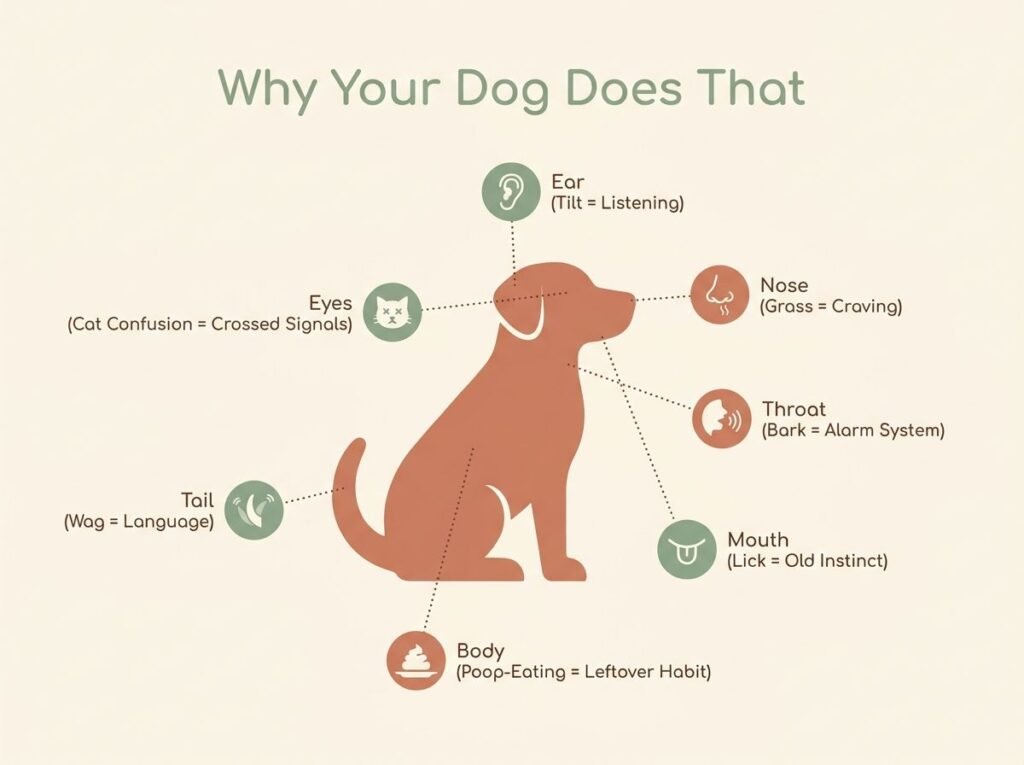
Why Dogs Do All the Weird Stuff They Do – I was making coffee last Saturday morning when tyson walked into the kitchen, looked at me, and tilted his head so far to one side I could hear his ear flop. I hadn’t said anything unusual. I’d just asked, out loud, to nobody, “Where’d I put the filters?” That was it. That was the whole trigger.
I stood there holding an empty coffee pot, staring at my dog, staring at me, head cocked like I’d just said something in a foreign language he almost understood.
That’s the thing about living with a dog for long enough. You stop asking about any one behavior in isolation and start noticing that your dog runs on a whole operating system you never fully learned, one you just picked up in pieces, the way you learn a person’s habits over years of marriage. The tail thing. The head tilt. The grass eating. The 3 a.m. howling. None of it is random once you actually look at it, and once I started digging into the actual reasons behind Otis’s greatest hits, a lot of it connected in ways I didn’t expect.
The Tail Wag Isn’t One Signal, It’s a Whole Language
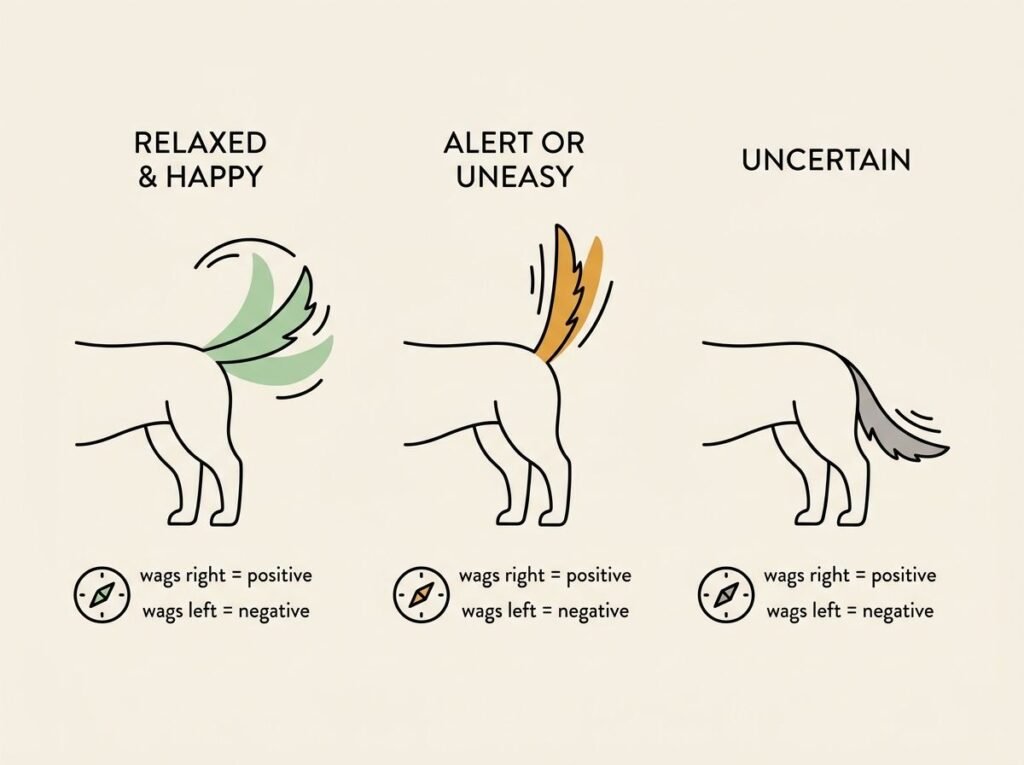
Everyone thinks a wagging tail means happy. It doesn’t, not by itself. A wagging tail means aroused, in the broad sense of the word — the dog is emotionally activated about something. Could be joy. Could be anxiety. Could be aggression winding up.
What actually matters is the shape and speed and direction of the wag. A loose, wide, whole-body wag is the happy one, the one where the hips get involved too. A stiff, fast, narrow wag held high is a different animal entirely, closer to a warning than a welcome. Researchers have even found that dogs wag more to the right when they feel good about something and more to the left when they don’t (something to do with which side of the brain is doing the processing), which is the kind of detail that sounds made up until you actually watch for it.
Otis’s happy wag involves his entire back half swinging like a pendulum. His “someone’s at the door and I’m not sure about them” wag is stiff, upright, almost robotic. Same tail. Completely different sentence.
Takeaway: don’t read the wag. Read the whole dog the wag is attached to.
The Head Tilt Is Your Dog Trying to Hear You Better
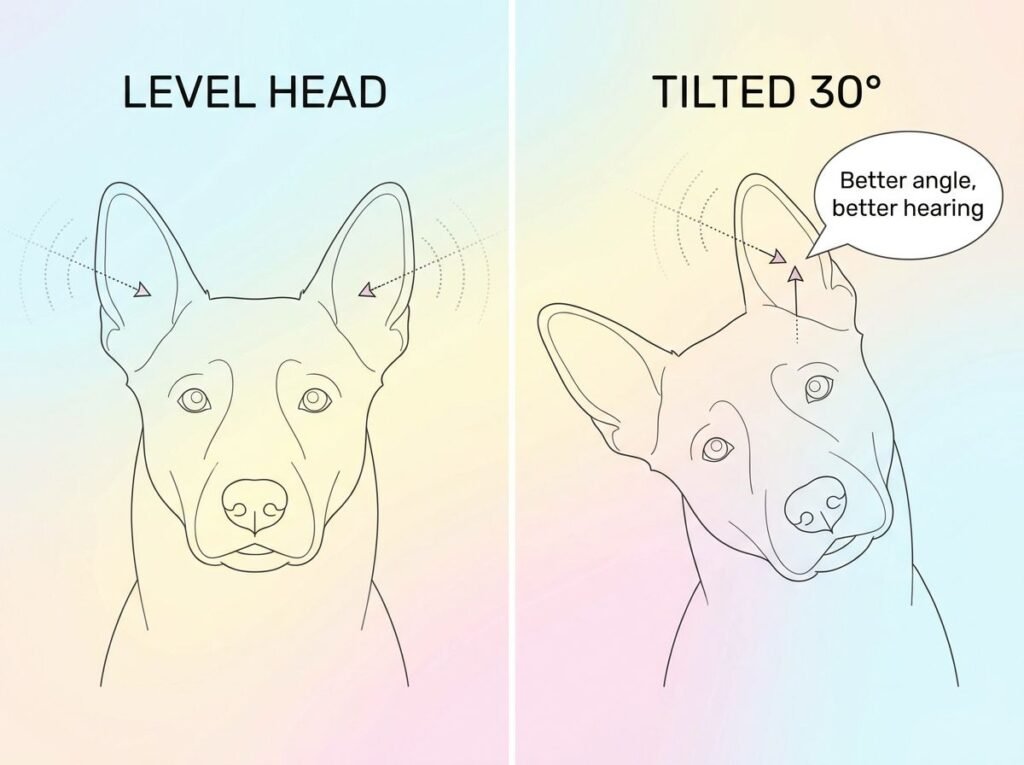
Back to that coffee filter moment. The head tilt looks adorable, and it is adorable, but it’s also functional. Dogs tilt their heads to reposition their ears and better locate the source and pitch of a sound, especially when you’re using a tone or a word they find interesting or unfamiliar.
There’s a theory that it also helps them see your mouth better, since a dog’s own snout can partly block their view of your face when their head is level. Some vets and trainers also think dogs learn that tilting gets a reaction out of us, more attention, more cooing, maybe a treat, and lean into the behavior because it works.
So it’s part hearing, part seeing, and part, frankly, dogs figuring out what makes humans go soft in the face. Nobody accuses a baby of manipulation when it does something cute to get picked up. Same deal here.
Takeaway: the head tilt is one part biology, one part a dog who’s noticed exactly what it does to you.
Licking You Is a Leftover From Puppyhood
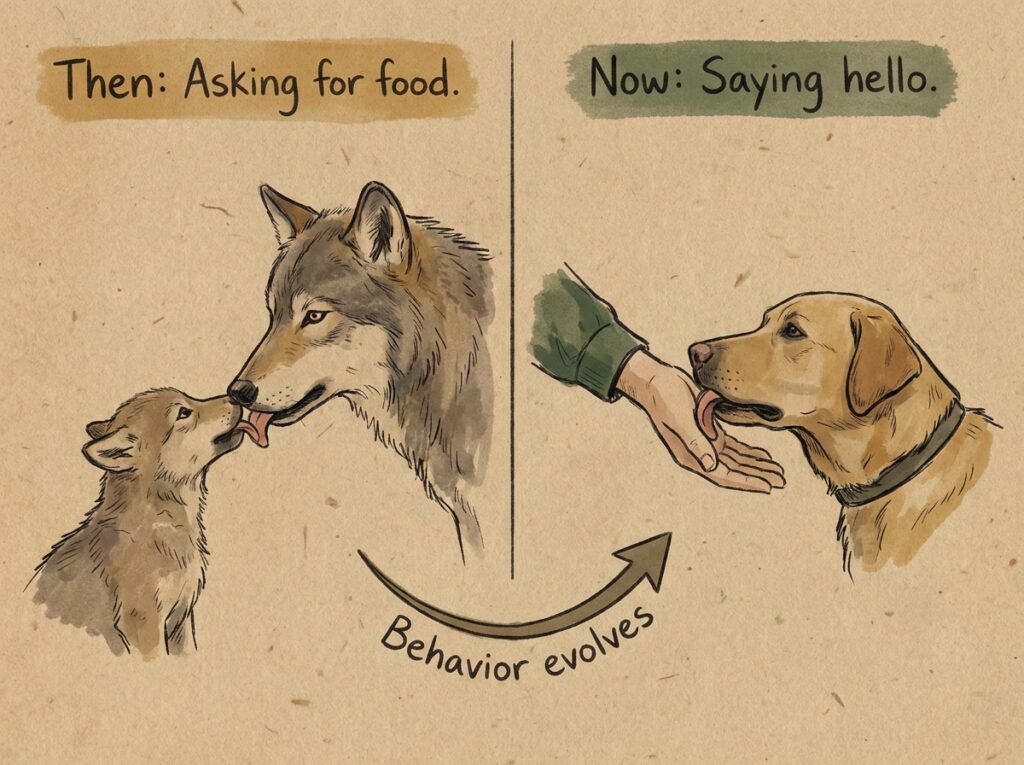
Otis licks my hand almost every time I sit down near him, unprompted, no treat involved. For a while I thought it was affection, full stop, and it partly is, but the actual root of it goes back further than that.
Puppies lick their mother’s mouth to encourage her to regurgitate food, an instinct baked in from before dogs were dogs, back when this was standard behavior in wolf pups. Domestic dogs mostly don’t need to do this anymore, obviously, nobody’s regurgitating dinner in my kitchen, but the behavior stuck around and got repurposed into something closer to a greeting, or a way of saying “you matter to me” the same way a person might touch someone’s arm mid-conversation.
Licking also releases endorphins for the dog doing it, which is part of why it can look almost trance-like, and it’s genuinely one of the ways dogs gather information, since a lot of scent and taste receptors are doing double duty when a dog licks your skin, especially if you’ve been sweating, cooking, or handling food.
Takeaway: the lick started as a request for food and turned into a hello. Dogs are good at repurposing old instincts for new relationships. So are people, honestly.
Eating Grass Isn’t Usually About an Upset Stomach
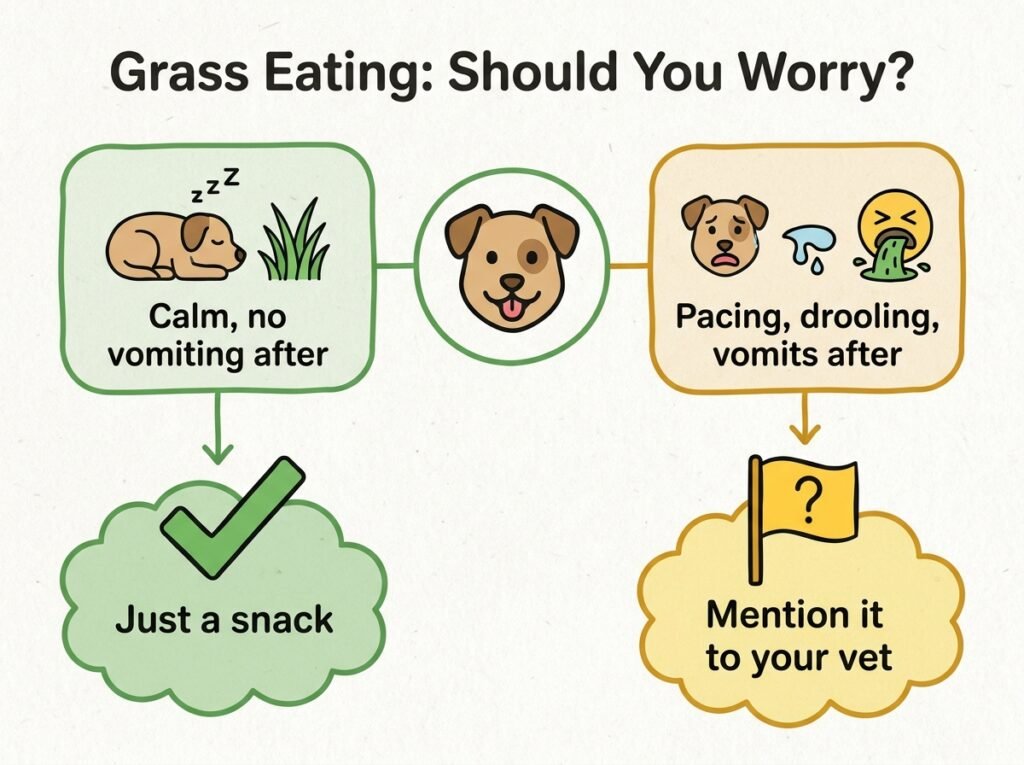
This one surprised me. The popular theory is that dogs eat grass to make themselves vomit when their stomach’s upset, and sometimes that’s true, but studies looking at actual dog behavior found that most dogs who eat grass don’t vomit afterward and don’t show signs of being sick beforehand either.
The more likely explanation, according to the research, is much less dramatic: dogs just like eating grass sometimes. It might satisfy a fiber craving, it might just be a texture and taste thing, the same way a person might chew on a piece of gum without any digestive motive behind it at all.
Otis grazes on grass in the backyard the exact same way he goes for a specific patch by the mailbox on walks, calm, unhurried, no distress in his body language at all. If he were actually nauseous, you’d see it — the pacing, the drooling, the tucked posture. Most grass eating just doesn’t look like that.
Takeaway: grass eating is usually a snack, not a symptom. Watch the rest of the body before you assume the stomach’s the problem.
Eating Their Own Poop Is Gross, and Also More Common Than People Admit
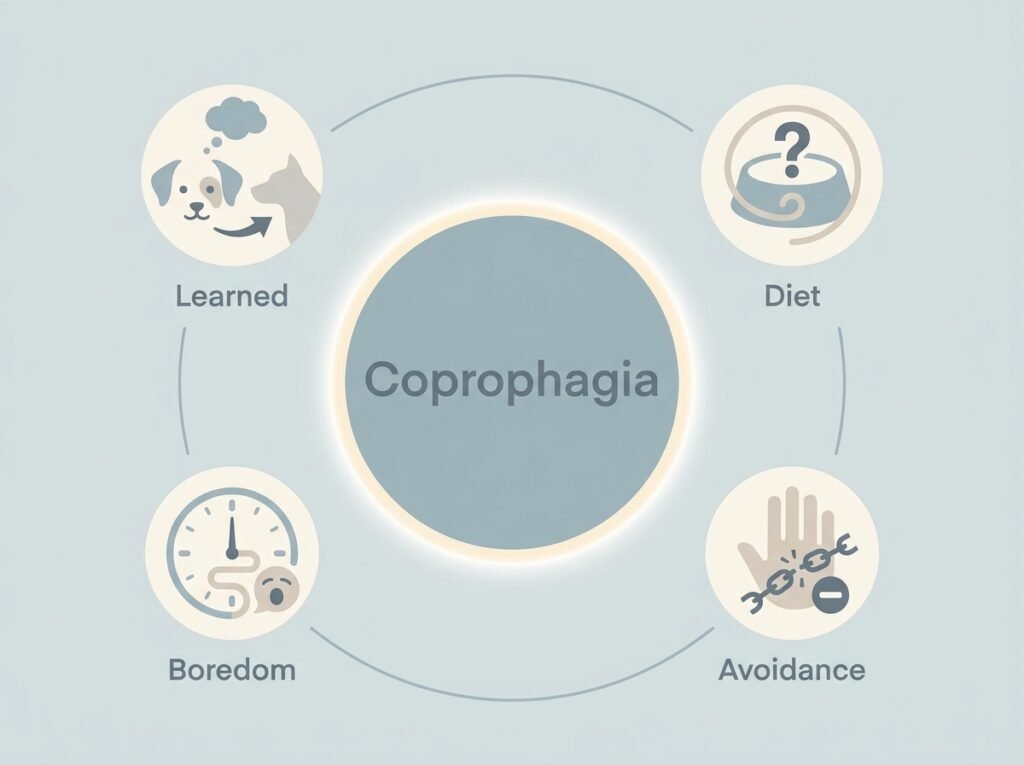
Nobody wants to write about this one, but it’s on every list of dog questions for a reason, because it happens more than owners like to say out loud. The scientific name is coprophagia, and it shows up in a genuinely wide range of dogs, not just ones with some obvious problem.
Puppies sometimes do it because their mothers used to clean up after them by doing exactly this, and the behavior lingers past the age it made sense. Some dogs do it because of a nutrient deficiency, though this is less common than people assume. Some do it purely out of boredom, or because they got scolded for having an accident once and learned that removing the evidence avoids the trouble. And some dogs just do it, with no clean explanation at all, the same way some people bite their nails and others don’t and nobody’s entirely sure why.
It’s rarely dangerous by itself. It is worth mentioning to a vet if it’s frequent, since it can sometimes point to a digestive issue or parasite worth ruling out. But it’s not usually the sign of some deep behavioral collapse. It’s just one of the less flattering things dogs do.
Takeaway: it’s unpleasant, it’s common, and it’s usually more boring than alarming.
Barking and Howling at Night Come From the Same Old Alarm System
Otis went through a phase last winter of barking at exactly 11 p.m., every night, at nothing I could ever identify. I’d get up, check the yard, find absolutely nothing, and go back to bed with a very smug-looking dog.
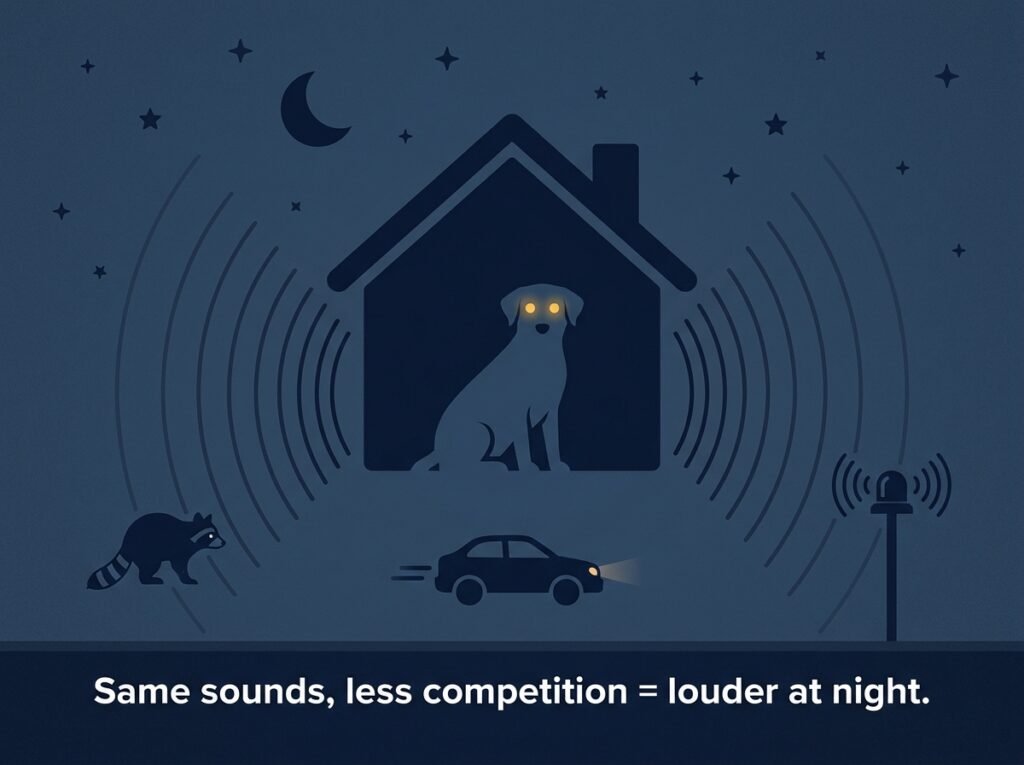
Nighttime barking and howling both trace back to the same root instinct: alerting the group to something outside the normal pattern. In the wild, this was actual survival behavior, warning the pack about an intruder or a predator. Your house doesn’t have predators, but your dog’s nervous system doesn’t know that. A raccoon crossing the yard, a car door two houses down, a neighbor’s dog starting up first, any of it can trip the wire.
Howling specifically is also just communication over distance, an old behavior for keeping a scattered pack in contact with each other. Some dogs howl back at sirens for exactly this reason, not because the siren hurts their ears (a common myth) but because it sits in a pitch range close enough to another dog’s howl that it triggers the same instinct to answer.
Nighttime makes all of this worse simply because it’s quiet. A sound that would get lost in daytime noise stands out sharply at 11 p.m., the same way you notice a creak in your house at night that you’d never hear at 2 in the afternoon.
Takeaway: it’s not that your dog hears more at night. It’s that there’s less competing with what they hear.
The Cat Thing Is Mostly a Translation Problem
Otis doesn’t hate cats, exactly, but he loses his mind a little whenever one strolls along our fence, and for years I assumed that was just some ancient predator-prey wiring turned all the way up.
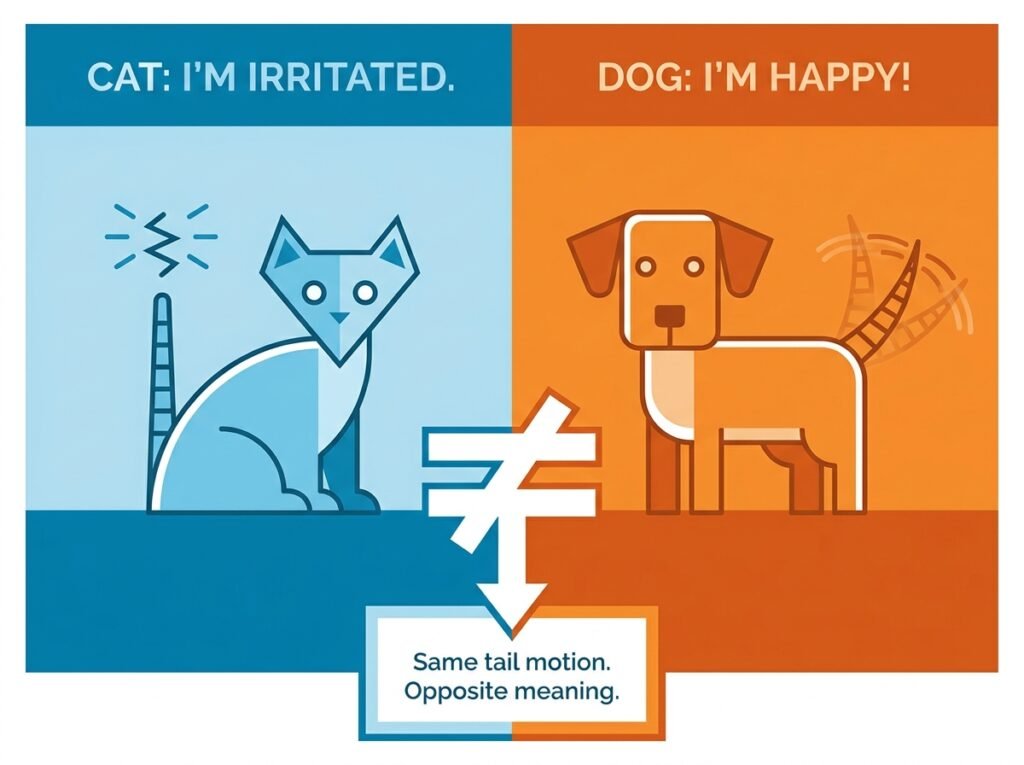
Some of it is that. But a lot of dog-cat conflict actually comes down to the two species using completely different body language for the same words. A wagging cat tail usually means irritation or agitation. A wagging dog tail usually means the opposite. A cat that stands still and stares is often warning you off. A dog that stands still and stares is often just curious, or unsure, or waiting to see what happens next.
Put those two animals in a yard together and you basically have two people speaking different languages, each one gesturing in ways the other reads as hostile. The cat freezes; the dog reads that as an invitation to approach. The dog approaches; the cat reads that as an attack. Neither one is actually starting anything. They’re just fluent in different dialects of the same general species of body language.
Dogs raised around cats from a young age usually skip most of this entirely, because they learn the dialect early, the same way a kid raised bilingual doesn’t struggle the way an adult learning a second language does.
Takeaway: it’s less “dogs hate cats” and more “dogs and cats keep misreading each other’s grammar.”
What Ties All of This Together
None of these behaviors, taken alone, is really about you specifically, and that took me a while to sit with. The tail, the tilt, the licking, the barking, even the cat stuff — it’s all old wiring, built for a version of dog life that mostly doesn’t exist anymore, running quietly underneath a golden retriever standing in my kitchen at 8 a.m. on a Saturday.
I still stood there holding that empty coffee pot a beat too long, though, watching Otis’s head tilted sideways at me like I owed him an explanation.
Maybe I did. Just not the one he was actually asking for.
TIRED OF READING THE FULL BLOG? Watch the short video here