

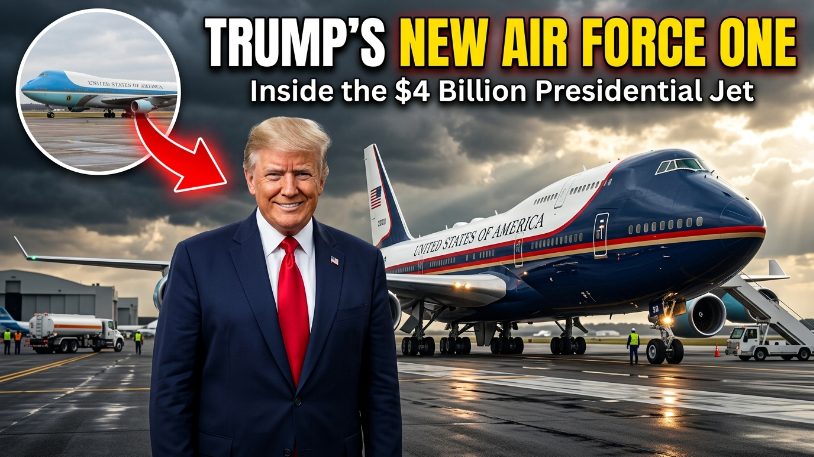
Trump’s Air Force One: Inside the New Plane, the Paint Fight, and the Delays Nobody Saw Coming
If you’ve been half-following the news about a new Air Force One and come away confused about what’s actually flying, what’s still on a Boeing assembly line, and why there’s suddenly a plane from Qatar in the mix, you’re not alone. This is genuinely one of the more tangled stories in modern presidential history, and most articles online either oversimplify it into “Trump wants a red plane” or bury the real timeline under years of recycled press releases.
Here’s the short version before we go deep: the aircraft currently serving as Air Force One is still the same Boeing 747-200 that’s been flying presidents since 1990. The brand-new, purpose-built replacement — known as the VC-25B — isn’t expected until mid-2028 at the earliest, nearly four years behind its original schedule. In the meantime, a donated Boeing 747-8 from the Qatari royal family has been converted into a stopgap presidential jet, and the entire executive fleet is getting repainted in a red, white, dark blue, and gold scheme that Trump first proposed back in 2018. None of that is a rumor. It’s the actual state of play as of mid-2026.
Let’s unpack how we got here, what each aircraft actually is, and why this has turned into one of the more expensive and drawn-out procurement stories in recent Air Force history.
What “Air Force One” Actually Means
A lot of people assume Air Force One is a specific, named aircraft — like the Titanic or Air Force Two. It isn’t. Air Force One is a call sign, not a plane. Any U.S. Air Force aircraft becomes “Air Force One” the moment the sitting president steps aboard, whether that’s a 747, a small transport jet, or even a helicopter (which technically carries the call sign Marine One instead, but the principle is the same). This distinction matters more than it sounds, because it explains why there can be talk of “Air Force One” referring to three or four different physical airframes at once — the current 747-200s, the incoming VC-25Bs, and now the converted Qatari jet — without any contradiction.
In practice, though, “Air Force One” has become shorthand for the two specific, heavily customized Boeing 747-200B aircraft that have carried presidents since the George H.W. Bush administration. These are the tail numbers 28000 and 29000, and they’re the planes most people picture when they hear the term.
Trump’s Actual Use of Air Force One During His Presidency
Throughout both of his terms, Trump has flown almost exclusively on the existing VC-25A fleet — the same aircraft used by Obama, Biden, and both Bushes. What’s changed is the visibility he’s given the next plane. Trump made the design of the replacement aircraft a recurring talking point starting in his first term, at one point telling reporters in 2018 that the incoming Air Force One would be “top of the line” and painted “red, white and blue, which I think is appropriate.” That comment turned out to be more than a passing remark — it set off a paint-scheme dispute that’s still playing out eight years later.
Trump has also continued flying on his own personal Boeing 757, nicknamed “Trump Force One” by the press, during periods when he’s traveled as a candidate or private citizen rather than as president. That aircraft carries a dark navy fuselage with a bold red stripe, and its resemblance to the livery Trump wants for the official presidential fleet isn’t a coincidence — it’s widely seen as the direct visual inspiration.
A Quick History of the Presidential Aircraft
Presidential air travel didn’t start with a 747. Franklin Roosevelt was the first president to fly in an aircraft specifically outfitted for the role, a C-54 Skymaster nicknamed the “Sacred Cow.” Eisenhower moved to propeller-driven Lockheed Constellations, and Kennedy ushered in the jet age with a Boeing 707 in 1962 — the same administration, notably, that introduced the pale blue-and-white livery designed by Raymond Loewy, the industrial designer also responsible for the Lucky Strike logo and Coca-Cola bottle contours. That color scheme has survived every administration since, through Republican and Democratic presidents alike, until now.
The current 747-200-based fleet entered service in 1990, meaning the aircraft flying presidents today are pushing 36 years old. For context, most commercial airlines retire wide-body jets long before that age. The Air Force has kept these planes airworthy through extensive, expensive maintenance programs, but age-related sustainment costs and parts obsolescence — the 747-200 hasn’t been in production for decades — are core reasons the replacement program exists at all.
The Boeing VC-25: Old and New, Explained
The “VC-25” designation covers two distinct generations of aircraft, and mixing them up is one of the most common sources of confusion online.
VC-25A refers to the two current aircraft, tail numbers 28000 and 29000, built on the Boeing 747-200B airframe. They’ve been in service since 1990 and remain the actual planes flying the president today.
VC-25B refers to the in-development replacement, based on the newer and larger Boeing 747-8 airframe — the last and largest version of the 747 ever built, and one of the final 747s to roll off Boeing’s production line before the program ended in 2023. Two 747-8s were purchased from a bankrupt Russian airline in 2015 and have spent years since being converted into militarized, secure, self-sufficient flying command posts.
That conversion is where nearly all the delay and expense has come from. Turning a commercial jetliner into a survivable presidential aircraft means installing secure communications systems resistant to electronic jamming, missile-defense countermeasures, an air-to-air refueling capability, a self-contained baggage and cargo system, an onboard medical suite, and electrical systems robust enough to run a mobile White House. None of that exists on a stock 747-8, and engineering it in has proven far harder than Boeing anticipated when it signed a fixed-price $3.9 billion contract in 2018.
Why the New Air Force One Keeps Getting Delayed
This is the part of the story that gets the least attention despite being the most consequential. The VC-25B was originally supposed to enter service by the end of 2024. It is now targeting mid-2028 for the first aircraft and mid-2029 for the second — nearly four years late on the first jet alone.
The delays stem from a cascade of separate problems rather than one single failure:
- Interior subcontractor bankruptcy. GDC Technics, the company originally contracted to design the aircraft’s custom interior, went bankrupt mid-project, forcing Boeing to find and onboard a replacement partner from scratch.
- Pandemic-era labor disruption. COVID-19 hit precisely when the program needed specialized, security-cleared aircraft technicians, and hiring never fully recovered on the original timetable.
- Wiring and structural rework. Government auditors have repeatedly flagged unfinished wire-bundle fabrication and the need to correct defects in earlier structural modifications.
- Fixed-price contract friction. Because Boeing agreed to a fixed-price deal rather than a cost-plus arrangement, every overrun comes directly out of Boeing’s margins, which has made the company reluctant to expand scope even as requirements evolved. Boeing has already booked well over $2 billion in losses on this contract, with executives publicly acknowledging the deal was a mistake for the company.
A Government Accountability Office report from mid-2026 noted the program has made real progress — the environmental control system design is finished, and staffing has improved — but cautioned that detailed interior design work and the wiring rework remain unresolved risks that could push the schedule again.
The Qatari 747: America’s Unlikely Stopgap Air Force One
Because the VC-25B slipped so far behind schedule, the administration pursued an interim solution: in 2025, the U.S. accepted a Boeing 747-8 as a gift from the government of Qatar, a luxury aircraft previously used by Qatari royalty. The Air Force tasked contractor L3Harris Technologies with rapidly converting it into a usable, secure presidential aircraft as a “bridge” jet.
That conversion moved fast by military aviation standards — roughly ten months — and L3Harris delivered the finished aircraft to Joint Base Andrews on June 19, 2026. It has since begun commissioning flights, described by the Air Force as validating mission capability and finalizing security protocols before the president can actually fly on it. Aviation analysts have raised pointed questions about whether a ten-month timeline is remotely sufficient to strip a foreign luxury jet down and rebuild it to the security standard required for presidential transport, and that skepticism remains a live debate in defense circles.
Separately, the Air Force also purchased two additional second-hand Boeing 747-8s, previously flown commercially by Lufthansa, for roughly $400 million. These aren’t intended to carry the president — they exist purely for training crews and providing spare parts, since the 747-8 is no longer in production and long-term parts availability was becoming a genuine concern.
Trump’s Redesign and the Paint Scheme Fight
The color scheme controversy deserves its own section because it’s been going on, in one form or another, since 2018 — longer than some entire presidential terms.
Trump’s original pitch was straightforward: replace the pale blue-and-white Kennedy-era livery with a bold red, white, and dark blue design, closer in spirit to his personal 757. During the Biden administration, the Air Force studied that proposal and rejected it, citing engineering concerns that darker paint on the aircraft’s underside could push certain components above their qualified temperature limits, along with added cost. Biden’s team instead approved a livery that kept the traditional pale blue tone with only minor tweaks.
That decision didn’t survive Trump’s return to office. In February 2026, the Air Force confirmed it was implementing a new paint requirement — red, white, dark blue, and gold — across the VC-25B, the converted Qatari jet, and the four C-32 aircraft used to transport the vice president and cabinet officials. The design closely echoes Trump’s original 2018 concept, complete with a billowing American flag graphic on the tail that wasn’t part of the earlier version. Notably, the Air Force has not publicly detailed how the new scheme addresses the same thermal concerns that sank the darker paint idea back in 2022, which some aviation analysts consider an unresolved question rather than a solved one.
The visual similarity to older commercial liveries hasn’t gone unnoticed either. Aviation writers and even members of Congress have pointed out that the new design bears a striking resemblance to retired liveries from TWA and US Airways, along with the charter aircraft used for presidential campaign travel in the 2000 and 2008 elections.
Comparing the Presidential Aircraft: Then, Now, and Next
| VC-25A (Current) | VC-25B (In Development) | Qatari 747-8 (Bridge Aircraft) | |
|---|---|---|---|
| Base airframe | Boeing 747-200B | Boeing 747-8i | Boeing 747-8i |
| Entered/expected service | 1990 | Mid-2028 (first jet) | 2026, pending final clearance |
| Origin | Purpose-built for USAF | Purpose-built for USAF | Donated by Qatar, converted by L3Harris |
| Livery | Pale blue and white (Kennedy-era) | Red, white, dark blue, gold | Red, white, dark blue, gold |
| Contract value | N/A (decades-old build) | ~$3.9–4 billion (fixed price) | Conversion cost undisclosed publicly |
| Role | Active presidential transport | Future long-term replacement | Temporary/interim presidential use |
Costs and Controversies Worth Understanding
The financial story here runs in two separate directions, and it’s worth keeping them distinct. On the government side, taxpayer cost for the VC-25B program has stayed close to its original contracted figure, since the fixed-price structure means Boeing — not the Air Force — absorbs most overrun costs. On Boeing’s side, that same structure has been financially painful: the company has repeatedly increased its projected losses on the contract, adding another $60 million to its loss estimate as recently as 2025, on top of billions already written off.
The political controversy runs along different lines entirely. Critics have raised questions about accepting a foreign government’s aircraft as a gift for presidential use, citing both security vetting concerns and the optics of a Gulf monarchy effectively subsidizing U.S. presidential travel. Defenders counter that the jet underwent extensive security screening — including what the Air Force describes as protocols developed by an interagency team specifically to detect and neutralize potential technical hazards on a previously foreign-owned aircraft — before ever being cleared for conversion work.
Security and Technology Inside the Aircraft
Whichever airframe ends up carrying the “Air Force One” call sign, the mission systems inside are what actually make it a presidential aircraft rather than a repainted jetliner. These typically include:
- Secure, jam-resistant communications equipment allowing the president to command U.S. forces from anywhere in the world
- Electromagnetic pulse (EMP) shielding to protect onboard electronics
- Aerial refueling capability, giving the aircraft theoretically unlimited range
- A self-contained baggage loader and boarding stairs, removing dependency on ground infrastructure at foreign airports
- An onboard medical suite equipped for emergency treatment and even minor surgery
- Advanced electronic countermeasures designed to defend against certain infrared and radar-guided threats
These systems are precisely why converting a commercial 747-8 takes years rather than months, and why oversight bodies remain skeptical the Qatari jet’s ten-month conversion timeline can meet the same standard without cutting corners somewhere.
Facts Most People Don’t Know
- The current Air Force One fleet can, in theory, remain airborne almost indefinitely thanks to in-flight refueling — the practical limit is crew endurance, not fuel.
- The presidential 747s carry their own onboard food preparation galleys capable of feeding roughly 100 people per meal.
- Air Force One’s registration numbers, 28000 and 29000, are rarely spoken aloud by air traffic control; pilots typically just say “Air Force One” regardless of which tail number is flying.
- The VC-25B program’s fixed-price contract was negotiated during Trump’s first term, meaning the same administration that’s now frustrated by the delays is the one that set up the contract structure blamed for some of Boeing’s reluctance to absorb scope changes.
- Boeing’s own 747 production line, which built every version of this aircraft since 1968, permanently closed in 2023 — meaning the two VC-25Bs are among the very last 747s Boeing will ever build.
Common Myths and Misconceptions
A surprising amount of misinformation circulates around this topic, so a few corrections are worth making plainly. Air Force One is not a single, specific aircraft — it’s a call sign that can apply to whatever plane the president is on. The current aircraft is not the same one used by Reagan or earlier presidents; that older 707-based plane was retired decades ago. The Qatari jet is not, contrary to some social media claims, an untouched luxury jet being flown as-is — it has undergone extensive security and structural modification before any presidential use. And the paint scheme change, while politically charged, is not unprecedented; presidential aircraft liveries have shifted before, just never quite this dramatically since the Kennedy era.
Public Reaction and the Political Debate
Reaction has split fairly predictably along partisan lines, though not entirely. Some aviation historians and design critics have voiced aesthetic objections independent of politics, arguing the new scheme sacrifices the visual elegance of the Loewy design for a look that reads as more commercial than presidential. Others, including some members of Congress, have focused less on aesthetics and more on the broader pattern of delays and cost overruns, treating the paint scheme as a minor sideshow compared to the more pressing question of when a genuinely new, purpose-built presidential aircraft will actually exist.
The Future of Air Force One
Based on the most current information available, the realistic timeline looks like this: the Qatari-derived bridge aircraft should become operational sometime in 2026, giving the administration its preferred livery years before the “real” VC-25Bs arrive. The first VC-25B is targeted for mid-2028, with the second following roughly a year later in mid-2029 — assuming no further slippage, which given the program’s track record is far from guaranteed. Congress has already increased VC-25B program funding to support what officials call “acceleration initiatives,” suggesting continued political pressure to close the gap faster rather than let it drift further.
Frequently Asked Questions
Is Trump flying on a new Air Force One right now?
Not yet. As of mid-2026, the president still flies primarily on the existing VC-25A fleet in service since 1990. A converted Qatari 747-8 was delivered to the Air Force in June 2026 and is undergoing commissioning flights, but it had not yet entered confirmed presidential service at the time of the most recent official updates.
When will the new VC-25B Air Force One be ready?
The Air Force currently targets mid-2028 for the first VC-25B and mid-2029 for the second, according to the most recent Government Accountability Office reporting. Both dates have slipped multiple times already, so further delay remains possible.
Why did Boeing’s Air Force One contract go so far over schedule?
A combination of factors: the bankruptcy of the original interior subcontractor, pandemic-related labor shortages, unresolved wiring and structural rework, and the financial strain of a fixed-price contract that leaves Boeing absorbing most cost overruns rather than the government.
What color is the new Air Force One going to be?
Red, white, dark blue, and gold, replacing the pale blue-and-white livery used since the Kennedy administration. The Air Force confirmed this paint requirement in February 2026 for the VC-25B, the converted Qatari jet, and the C-32 fleet.
Is the Qatari plane really becoming Air Force One?
It’s being converted into an interim presidential aircraft, not a permanent replacement. The jet, donated by Qatar’s government in 2025, is undergoing extensive security modification by L3Harris and was delivered to the Air Force in June 2026 for further testing before any presidential use.
How much does the new Air Force One cost?
The original 2018 contract was valued at roughly $3.9 billion for two aircraft, though Boeing has since booked well over $2 billion in additional losses absorbing overruns under the fixed-price structure. Separately, the Air Force spent about $400 million acquiring two used 747-8s purely for training and spare parts.
What is the difference between VC-25A and VC-25B?
VC-25A refers to the current 747-200-based aircraft flying since 1990. VC-25B refers to the newer, in-development replacement built on the larger 747-8 platform, expected to enter service starting in mid-2028.
Why is the current Air Force One livery pale blue?
That design dates to the Kennedy administration, created by industrial designer Raymond Loewy, and has remained largely unchanged through every subsequent presidency until the current repainting effort.
Did Trump design the new paint scheme himself?
Trump proposed the red, white, and dark blue concept during his first term in 2018, reportedly inspired by his personal Boeing 757. The Biden administration rejected it over cost and engineering concerns before Trump revived it after returning to office.
Can Air Force One refuel in mid-air?
Yes. Both the current and future presidential aircraft are equipped for aerial refueling, which effectively removes range as a limiting factor on presidential travel.
Why did the Air Force buy two extra used 747-8s if new ones are already being built?
Those two aircraft, purchased from Lufthansa for about $400 million, are intended solely for crew training and spare parts. Since Boeing ended 747-8 production in 2023, the Air Force wanted to secure a long-term supply of components before the type became difficult to source.
The Bottom Line
The Trump Air Force One story isn’t really one story — it’s three overlapping ones: an aging fleet still doing the job it was built for in 1990, a next-generation replacement stuck in one of the most troubled procurement programs in recent Air Force history, and a diplomatically awkward but genuinely fast-moving stopgap built from a foreign government’s donated jet. The paint scheme, for all the attention it gets, is arguably the least consequential part of this whole saga compared to the deeper questions about program management, contractor accountability, and how long a president can reasonably be expected to fly on 36-year-old aircraft while waiting for their replacement. What’s certain is that by the time the VC-25B finally enters service, the plane sitting on the tarmac will have spent almost as long in development as some of the presidents it’s meant to serve have spent in office.