

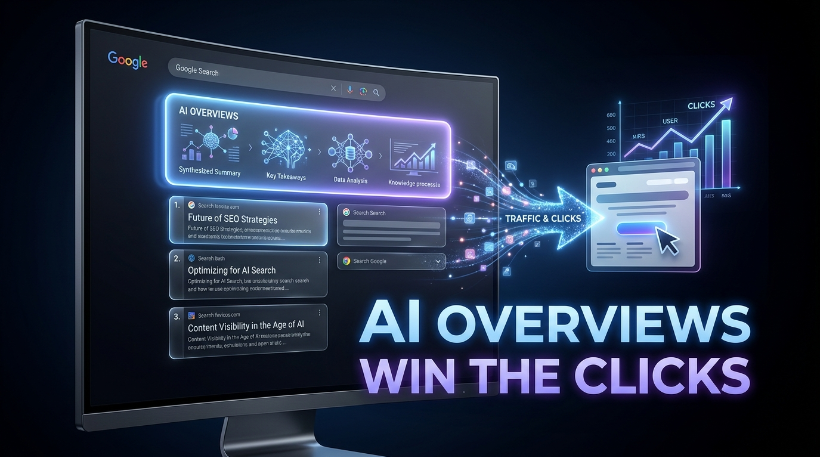
Google Search is changing fast. AI Overviews can now answer parts of a search query directly on the results page, giving users summaries, explanations, comparisons, and links to supporting websites before they ever reach the traditional organic listings.
For publishers and SEO professionals, that creates an obvious concern: if Google answers the question, why would someone click your website?
The answer is that AI Overviews do not eliminate the opportunity for organic traffic. They change what makes a result worth clicking. Google says its AI search features still rely on core Search ranking systems and that the same foundational SEO practices remain important. Pages must be crawlable, indexable, useful, and eligible to appear in traditional Search before they can be considered as supporting links in AI features.
The winning strategy, therefore, isn’t to create content specifically for machines. It’s to create content that gives users something an AI-generated summary cannot fully replace.
What Are Google AI Overviews?
AI Overviews are AI-generated responses that appear within Google Search for queries where Google determines that an additional synthesized explanation can help the user. Rather than forcing users to open several pages to understand a topic, Google can provide an overview and include links to websites that support or expand on the information.
This changes the traditional search journey.
Previously, a user might search:
“How long does SEO take to work?”
Then choose one of the top-ranking pages.
With an AI Overview, the user may first see a concise explanation, followed by several relevant sources. The initial answer may satisfy a basic question, but users who want evidence, examples, original research, detailed instructions, tools, or expert perspectives still have reasons to visit individual websites.
That distinction is important for content creators.
Your goal isn’t simply to be the page that provides the shortest possible answer. Your goal is to become the best next destination after the answer.
Why AI Overviews Change the SEO Game
Traditional SEO often focuses heavily on rankings, impressions, and clicks. AI search introduces another layer: visibility inside an AI-generated search experience.
Google’s own guidance makes an important point: there are no special technical requirements or secret AI-specific markup needed to appear in AI Overviews. Existing SEO fundamentals continue to matter.
That means you shouldn’t rebuild your entire SEO strategy around buzzwords such as “AEO” or “GEO.”
Instead, concentrate on four things:
- Being discoverable and indexable
- Clearly answering the user’s intent
- Providing original information and useful context
- Giving visitors a compelling reason to continue to your website
The last point is becoming particularly important.
If your page only repeats information that can easily be summarized in three sentences, an AI Overview may satisfy the user’s needs without generating a click.
If your page contains original data, detailed examples, practical tools, expert commentary, comparisons, case studies, or useful implementation steps, there is much more value behind the click.
1. Answer the Main Question Early
One of the simplest ways to optimize content for AI Overviews is also one of the most important traditional SEO practices: answer the searcher’s question clearly.
Don’t make readers scroll through 800 words of background information before they find the answer.
For example, if your target query is “how to improve website speed,” start with a concise explanation of the most important actions:
- Compress oversized images.
- Reduce unnecessary JavaScript.
- Improve server response time.
- Use browser caching.
- Remove unnecessary third-party scripts.
Then explain each recommendation in greater depth.
This structure helps users immediately understand the answer while creating opportunities for deeper engagement.
It also makes your content easier to understand because each section has a clear purpose.
2. Build Content Around Search Intent, Not Just Keywords
Keyword targeting still matters, but a single keyword rarely tells you everything a searcher wants.
Consider the query:
“Best CRM for small businesses.”
The searcher may actually want to know:
- Which CRM is easiest to use?
- Which one is affordable?
- Which has automation?
- Which works for a five-person team?
- Which offers a free plan?
- Which is best for sales teams?
- What are the disadvantages of each option?
A weak article targets the keyword and produces a generic list.
A stronger article addresses the complete decision-making process.
Think beyond:
“What keyword should I rank for?”
Ask:
“What decision is the reader trying to make?”
That shift can make your content substantially more useful.
3. Add Information That Isn’t Easily Replaceable
This is arguably the biggest opportunity in the AI Overview era.
Google’s latest guidance emphasizes the importance of valuable, unique, non-commodity content. In other words, publishing another version of information that already exists everywhere isn’t a strong long-term strategy.
Look for ways to add original value.
Use Original Examples
Instead of saying:
“Internal links can improve website navigation.”
Show readers what that looks like.
For example:
A page about “technical SEO” could link naturally to detailed guides about crawlability, canonical tags, XML sitemaps, and JavaScript SEO.
Include First-Hand Observations
If you have tested a strategy, explain what happened.
Instead of:
“Shorter titles may improve CTR.”
You could discuss how changing a title from a generic phrase to a benefit-focused version affected impressions, clicks, or engagement in your own experiment.
Create Original Data
Research, surveys, experiments, screenshots, calculations, benchmarks, and case studies can make content significantly more valuable.
An AI Overview can summarize a general concept. It cannot replace the unique dataset or methodology behind your research.
4. Structure Your Content for Humans and Search Engines
Good formatting matters even more when users are scanning for information.
Use descriptive H2 and H3 headings that tell readers exactly what comes next.
For example:
Weak heading
“More Things to Consider”
Strong heading
“How Internal Links Help Google Discover Important Pages”
The second heading provides immediate context.
Use:
- Short paragraphs
- Descriptive subheadings
- Bullet points where appropriate
- Numbered steps for processes
- Tables for genuine comparisons
- Examples that clarify complicated concepts
- Bold text sparingly for important ideas
Google specifically recommends making important content available in textual form and maintaining a strong page experience.
5. Make Your Content Easy to Cite and Verify
If you want your content to become a useful source in AI-powered search experiences, clarity matters.
Don’t bury important claims inside vague paragraphs.
For example, instead of writing:
“Websites generally need to focus on a variety of technical things to improve their search performance.”
Write:
“Google needs to be able to crawl and index your page before it can consider that page for Search visibility.”
The second statement is clearer and easier to verify.
When making factual claims, use credible sources and link to them where appropriate. Keep statistics current, explain where numbers come from, and avoid unsupported claims.
This is particularly important for topics involving finance, health, law, technology, or rapidly changing information.
6. Optimize for the Click After the Answer
This is where many AI-search strategies go wrong.
Some publishers focus so heavily on appearing in AI-generated answers that they forget the business objective: getting valuable visitors to the website.
Your page needs a strong “why click?” factor.
Imagine Google displays:
“The average email open rate varies by industry.”
That’s useful, but generic.
Your page could go further with:
- Industry-specific benchmarks
- A downloadable calculator
- Subject-line examples
- Testing methodology
- Recent campaign data
- Segmentation recommendations
- A comparison of email platforms
- A step-by-step optimization framework
Now the search result provides the starting point, while your website provides the depth.
That’s a much stronger reason to click.
Google has also reported that visitors arriving from AI search experiences can be higher quality, with users more likely to spend additional time on the site.
7. Strengthen Internal Linking
Internal links help both users and search engines discover related content.
Suppose you publish an article about AI Overviews.
You could naturally connect it to related pages covering:
- Keyword research
- Technical SEO
- Search intent
- Content clusters
- On-page SEO
- Google Search Console
- Link building
Don’t add links simply to increase the number of internal links.
Use descriptive anchor text and link when the additional page genuinely helps the reader. Google recommends crawlable links and meaningful anchor text because links help both discovery and understanding.
A strong internal-linking system can also turn individual articles into a connected knowledge base rather than isolated pages.
8. Don’t Ignore Technical SEO
Amazing content can’t perform if Google can’t properly access it.
Before worrying about AI Overviews, make sure your fundamentals are working.
Check that:
- Googlebot isn’t unintentionally blocked.
- Important pages are indexable.
- Your pages return successful HTTP responses.
- Important content isn’t hidden behind inaccessible functionality.
- Your site works properly on mobile devices.
- Pages load efficiently.
- Internal links are crawlable.
- Structured data accurately reflects visible content.
Google states that pages generally need to be indexed and eligible to appear with a snippet in Search to be eligible for supporting links in AI Overviews and AI Mode.
There is also no special “AI Overview schema” you need to add.
If someone promises a secret markup that guarantees AI Overview visibility, be skeptical.
9. Use AI to Assist Content Creation, Not Replace Expertise
AI tools can make research, outlining, editing, and content organization faster. But publishing large volumes of automatically generated pages without meaningful value is risky.
Google’s guidance specifically warns that generating many pages with AI without adding value can fall under its scaled content abuse policies.
A better workflow is:
Research → Analyze → Create → Add Expertise → Fact-check → Edit → Publish → Improve
Use automation to accelerate repetitive work, but add human judgment where it matters.
Your experience, examples, opinions, research, testing, and editorial standards are what can transform generic information into genuinely useful content.
10. Measure More Than Organic Clicks
AI search requires a broader definition of SEO success.
Don’t only track:
Impressions → Clicks → CTR
Also monitor:
- Engagement
- Conversions
- Leads
- Sales
- Sign-ups
- Returning visitors
- Time spent on important pages
- Assisted conversions
Google introduced dedicated Search Generative AI performance reporting in Search Console in 2026, initially rolling the reporting out to a subset of sites. The new reporting provides additional visibility into impressions from generative AI features such as AI Overviews and AI Mode.
As these reporting capabilities expand, SEO teams should evaluate whether AI search visibility produces meaningful business outcomes rather than treating every impression as equally valuable.
A Practical AI Overview Optimization Checklist
Before publishing an important article, ask:
- Does the introduction answer the main search intent?
- Are the most important answers easy to find?
- Does every major section provide useful information?
- Have I added original examples, research, experience, or data?
- Are headings descriptive and logically organized?
- Are factual claims accurate and supported?
- Are relevant internal links included?
- Can Google crawl and index the page?
- Does structured data match what users can actually see?
- Is the page fast, readable, and mobile-friendly?
- Does the article give users a reason to click beyond the basic answer?
- Have I defined a meaningful business goal for the traffic?
If several answers are “no,” improving those areas is likely more valuable than adding another 500 words.
The Future of SEO Is About Being Worth the Click
AI Overviews don’t mean SEO is dead. They mean the value equation is changing.
Google is increasingly capable of answering straightforward questions directly in Search. That makes generic, easily summarized content less valuable.
The opportunity is to move up the value chain.
Don’t just answer the question.
Explain the reasoning.
Show the process.
Provide evidence.
Share original insights.
Compare real options.
Demonstrate what works.
Give readers tools and examples.
And most importantly, create something worth visiting after Google has already provided the basic answer.
Google’s current guidance is clear that traditional SEO fundamentals remain foundational for AI search. There are no secret AI-specific ranking tricks that replace technical accessibility, helpful content, strong page experience, and people-first publishing.
The websites most likely to win in this environment won’t necessarily be the ones trying hardest to “game” AI Overviews. They’ll be the ones producing information that users still want to explore after the summary ends.
That is the real way to optimize your content for AI Overviews—and win the clicks that are left.