

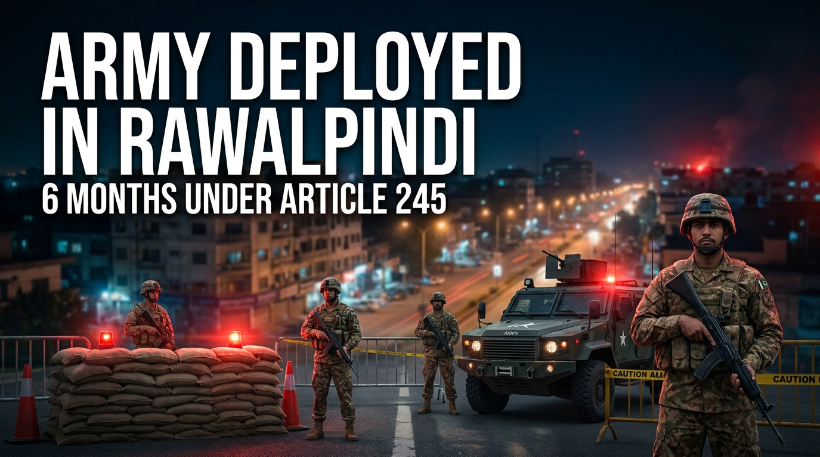
The federal government has authorised the deployment of three companies of the Pakistan Army in Rawalpindi for a period of six months under Article 245 of the Constitution of Pakistan, marking a significant development in the city’s security arrangements. The decision was formally notified by the Ministry of Interior on August 21, 2026, following a request from the Punjab Home Department.
The deployment has been approved for what the government describes as “sensitive security duties.” According to the notification, the troops are intended to help the Rawalpindi district administration avoid undesirable situations and respond effectively to unforeseen security circumstances.
For residents and people following Pakistan’s political and security situation, an important question is what this deployment actually means. Does it indicate an emergency? Does Article 245 mean martial law? What role will the Army have alongside civilian authorities? Understanding these points provides a clearer picture of why the decision has been made and what its likely implications are.
What Happened in Rawalpindi?
The federal government has approved the deployment of three companies of the Pakistan Army in Rawalpindi for six months, with the arrangement taking effect immediately. The decision followed a formal request from the Punjab Home Department.
The Interior Ministry’s notification states that the Army will perform sensitive security duties and assist the district administration when required. The stated objective is to prevent an undesirable situation and ensure an effective response if an unforeseen security challenge develops.
The notification does not publicly identify every location where soldiers will be stationed or provide detailed operational information. That is unsurprising because specific security deployments and operational arrangements are often not disclosed publicly.
Reports have indicated that the deployment is intended to strengthen security around sensitive locations and important routes while allowing civilian authorities to request military assistance when circumstances require additional support.
How Large Is the Deployment?
The government has authorised three Army companies for Rawalpindi. Some reports have estimated the combined deployment at more than 400 personnel, although the official notification itself focuses on the number of companies rather than providing a detailed personnel breakdown.
The distinction matters because a company is a military organisational unit rather than a fixed number of soldiers in every circumstance. Its exact strength can vary depending on its composition and operational role.
Why Has the Army Been Deployed in Rawalpindi?
The official explanation centres on security preparedness. The Punjab Home Department requested assistance, and the federal government approved the deployment under Article 245.
The decision also comes against a backdrop of heightened security and political tensions in the Rawalpindi-Islamabad area. Recent reporting has linked the move to security concerns following an armed incident in Rawalpindi involving a man reportedly associated with Pakistan Tehreek-e-Insaf, although the government notification itself does not state that this incident was the sole reason for the deployment.
This distinction is important when evaluating the news. The government’s formal explanation is broader: the Army has been called in to perform sensitive security duties and provide support during potential unforeseen situations.
Another factor attracting attention is the political calendar. PTI has announced plans for a long march towards Islamabad on September 27, creating additional focus on security arrangements in the wider Rawalpindi-Islamabad region.
However, it would be inaccurate to conclude solely from the deployment that the government has announced a particular future operation or that the Army will automatically be used against political demonstrations. The official notification does not make such a claim.
What Is Article 245 of the Constitution?
Article 245 of the Constitution of Pakistan establishes important functions of the Armed Forces. It provides that, under the direction of the federal government, the Armed Forces defend Pakistan against external aggression or the threat of war and, subject to law, can act “in aid of civil power” when called upon to do so.
This constitutional provision is the legal framework being used for the current Rawalpindi deployment.
In simple terms, Article 245 allows the federal government to call upon the Armed Forces to support civilian authorities when additional security assistance is required.
Does Article 245 Mean Martial Law?
No. The invocation of Article 245 does not automatically mean martial law.
This is one of the most important points for readers to understand. The current notification specifically describes the Army’s role as assistance to the district administration for sensitive security duties. It does not announce the suspension of civilian government or the imposition of martial law.
Pakistan’s Constitution separately provides frameworks for extraordinary constitutional situations. Article 245 itself concerns the functions of the Armed Forces and their deployment in aid of civil power.
Therefore, seeing soldiers deployed under Article 245 should not automatically be interpreted as meaning that the civilian administrative structure has been replaced.
What Role Will the Army Play?
The precise operational responsibilities have not been publicly detailed in the Interior Ministry notification. Nevertheless, the stated purpose gives a general indication of the Army’s supporting role.
The troops are expected to assist the Rawalpindi administration in dealing with security concerns, particularly where additional manpower and rapid response capabilities may be needed. Reports have described the focus as including sensitive locations, important routes and potential unforeseen security situations.
Army Support vs Routine Policing
There is an important difference between military assistance and ordinary policing.
Routine policing remains primarily the responsibility of civilian law-enforcement institutions. Police investigate crimes, register cases, conduct normal patrols and handle everyday public-order responsibilities.
An Army deployment under Article 245 provides an additional layer of support when the government believes existing arrangements require reinforcement.
Think of it as adding another security capability to an existing system rather than automatically replacing the system.
How Long Will the Deployment Last?
The authorised period is six months, beginning immediately from the date specified in the government order. The notification was issued by the Ministry of Interior on August 21, 2026.
This means the current authorisation is not described as an indefinite deployment.
The six-month period also provides authorities with time to maintain enhanced security preparedness while monitoring developments in Rawalpindi. Any future extension, modification or withdrawal would depend on subsequent government decisions and the security situation.
Readers should therefore distinguish between the currently authorised six-month period and speculation about what might happen afterward.
What Could the Deployment Mean for Rawalpindi Residents?
For ordinary residents, the most noticeable change may simply be an increased security presence in selected areas.
People may encounter additional security personnel around sensitive locations or important routes. Depending on operational requirements, security checks or traffic-management measures could also become more visible in certain areas.
However, the government has not publicly released a complete list of deployment points or announced that everyday civilian life across Rawalpindi will be placed under military control.
For residents, the practical approach is to rely on official announcements rather than social-media rumours. Security arrangements can change quickly, and unverified claims about checkpoints, closures or planned operations can create unnecessary confusion.
What Should Residents Do?
Residents can take several sensible steps during periods of heightened security:
- Follow instructions issued by local authorities and law-enforcement agencies.
- Allow additional travel time if security checks affect major routes.
- Avoid spreading unverified claims about security operations.
- Keep identification and essential documents accessible when travelling.
- Follow official traffic and public-safety instructions.
- Stay informed through reliable news organisations rather than anonymous social-media posts.
These measures are useful regardless of whether the Army, police or other security agencies are responsible for a particular security arrangement.
Why Rawalpindi Is Strategically Important
Rawalpindi has an unusual strategic importance within Pakistan. It is a major urban centre located directly next to Islamabad and is closely associated with the country’s military and national security infrastructure.
Its geographical proximity to the capital means that developments in Rawalpindi can have implications for security arrangements across the wider Islamabad-Rawalpindi metropolitan area.
That does not mean every security development in Rawalpindi should be interpreted as a national emergency. Rather, the city’s strategic importance helps explain why authorities may take additional precautions when they anticipate potential security challenges.
What the Six-Month Deployment Does Not Automatically Mean
Several assumptions can easily arise when people hear that the Pakistan Army has been deployed under Article 245. It is useful to separate confirmed facts from speculation.
First, the deployment does not automatically mean martial law. Article 245 provides a constitutional mechanism for the Armed Forces to assist civil authorities.
Second, the notification does not say that the Army is taking over the entire civilian administration of Rawalpindi.
Third, the official order does not provide evidence that every political activity in the city will be handled by the military.
Finally, the phrase “sensitive security duties” should not be expanded into specific operational claims that have not been confirmed by authorities.
Keeping these distinctions clear is particularly important when a security-related story is developing rapidly.
What to Watch in the Coming Months
The situation in Rawalpindi will likely remain closely watched throughout the six-month deployment.
The most important developments will include any changes to the government’s security assessment, announcements from the Punjab Home Department, updates from the Interior Ministry and developments involving major political gatherings or public-order situations.
The September 27 political mobilisation announced by PTI is also likely to receive significant attention because of its planned movement towards Islamabad.
At the same time, readers should avoid assuming that every subsequent security measure is directly connected to the current Army deployment unless authorities confirm such a connection.
Army Deployed in Rawalpindi for Six Months: Key Takeaways
The Army deployed in Rawalpindi for six months under Article 245 is a major security development, but its official scope is narrower than some social-media discussions may suggest.
The federal government has authorised three companies of the Pakistan Army following a request from the Punjab Home Department. The troops are intended to perform sensitive security duties and assist the district administration in preventing undesirable situations and responding to unforeseen circumstances.
The legal basis is Article 245 of Pakistan’s Constitution, which permits the Armed Forces to act in aid of civil power when called upon, subject to law.
Most importantly, the current deployment should not automatically be confused with martial law or a replacement of civilian administration. Its stated purpose is security assistance, and the authorisation is currently limited to six months.
As developments unfold, the most reliable way to understand the situation will be to distinguish official notifications from political commentary and social-media speculation. For residents of Rawalpindi and people following Pakistan’s security situation, that distinction will be especially important as authorities manage the city’s security arrangements over the coming months.